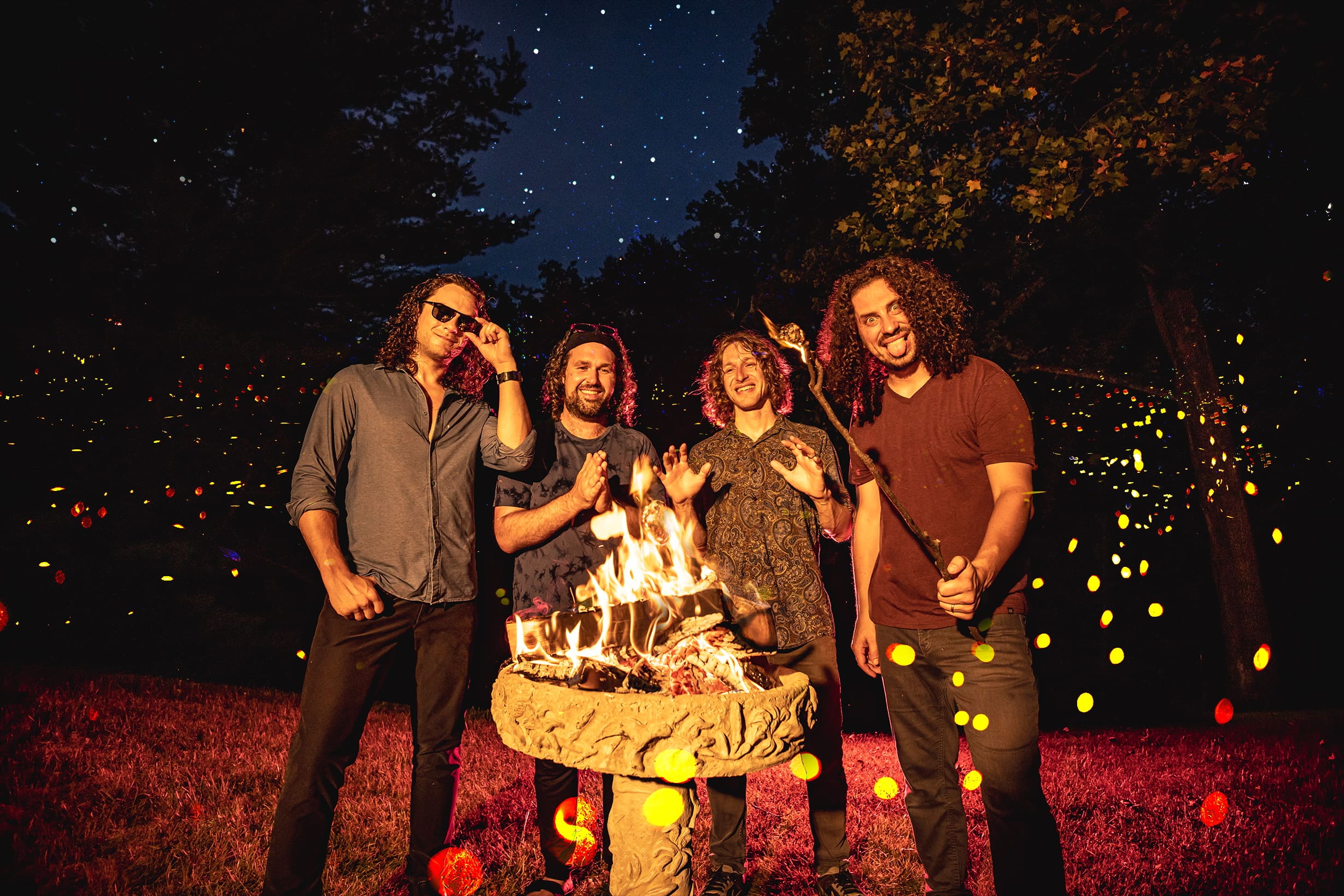
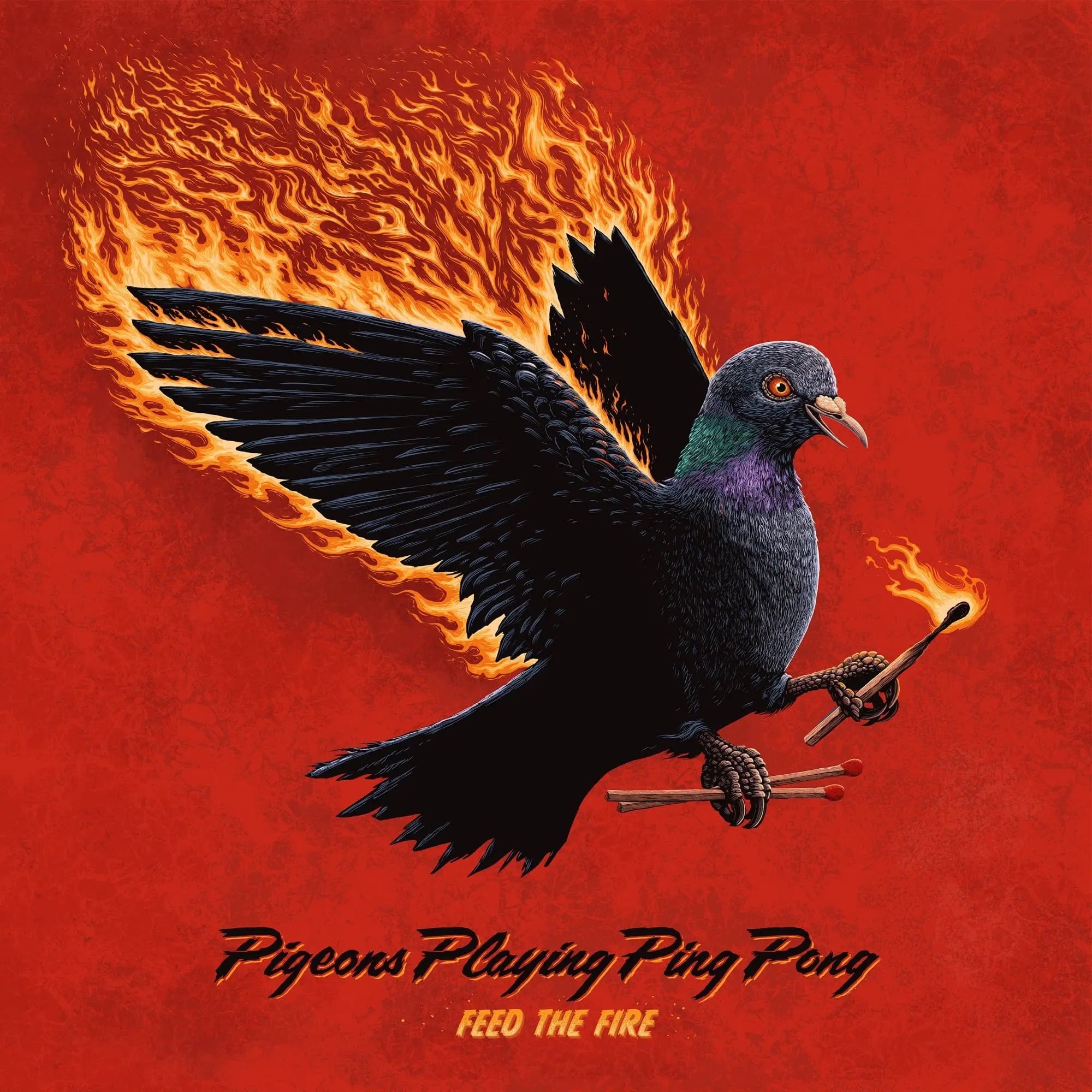
Pigeons Playing Ping Pong are not just the most perfectly named band in the history of modern music. With their 2025 album, Feed the Fire, the band has cemented itself as one of the premier bands in the world of jam.
Quadruple P has always been a go-to band for fun funky music that you can shed your inhibitions and shoes and head to the dance floor or festival ground and loose yourself in the moment. Feed the Fire, while still funky and fun as hell, marks the band’s tightest, most sophisticated and most accessible album to date. Don’t let the word “accessible” fool you though, Pigeons Playing Ping Pong has not gone mainstream — in fact you could say they’ve become more attuned with themselves as musicians and songwriters.
Recently, we caught up with Greg Ormont, the lead vocalist and guitarist for Pigeons Playing Ping Pong. Greg spoke at length about their new album Feed the Fire, evolving while remaining true to the core, the importance of their fanbase, and how grateful they are for where their career has taken them.
Feed the Fire is your eighth studio album. Let’s just start with a layup question. How do you feel this stands out from the other albums you’ve done on both a lyrical and sonic perspective?
We always hope to grow in anything in life, right? I hope that any effort we make, whether it’s music, lyrics, or even just your personal journey, is a step in the right direction. And I really feel like, you know, while each album feels like a step, this one felt a little more like a leap. I think that our songwriting is getting a little more sophisticated and cohesive. It’s interesting. It shows our evolution, but you can still feel very much where we came from, which was the intention.
Speaking of sophisticated lyrics, let’s talk about “Donkey Hotel.” I’m driving to cover the opening of Netflix House in Philadelphia, grooving to the record. Then Donkey Hotel comes on. Take me on the journey of this song came to be.
I’m taking it you’ve never been to the Donkey Hotel?
This is a real place?
It can be, it can’t be. It is for me. It’s funny. I just mentioned that I think our songs are getting more sophisticated, but I can’t seem to shake that silly goofiness that personified our excitement at the outset of starting this band, with a band name, like, Pigeons Playing Ping Pong…
It’ll always be a great name.
Well, we thank you. We certainly take the project seriously, but the undercurrent of that is just pure joy, silliness, and not taking yourself too seriously. We want our songs to be better, and we want our lyrics to be more meaningful, but we also don’t want to lose that relaxed funness that comes with the territory of being in a band for a living.So it’s an interesting dichotomy, and wanting to stretch your artistic expression while also maintaining this youthful, spur-of-the-moment kind of energy. And “Donkey Hotel” was kind of just a joke at band practice.
I was riffing off of the book, the story of Don Quixote, just Don Quixote and [I] made the joke as a bad pun. Now that I’m a dad, I can do that. And, we jokingly said in practice, “Oh, that’s an amazing name, let’s play Donkey Hotel right now.” Our drummer played the intro drum fill, and we hit two chords, sang the words, and we were just off to the races. And it’s funny, because it was one that I didn’t really think about the symbolism, or the metaphor, or the bigger picture, or the sophistication of it. I really just went with the fun. And that’s been a theme in our band from the start. When we met in college, we were having fun in our friends’ basements, and now we’re having fun across the country at beautiful venues.
It reminded me of a Beastie Boys song where you’d have an album filled with serious, thoughtful, politically charged songs and then a song about farts.
It’s funny, there’s certain songs that we’ll spend a lot of time working on, flipping every stone and making sure it’s just airtight ready. It takes a lot of focused effort. And then there’s the songs that just come out pretty quickly, and Donkey Hotel was one of those that just kind of flowed. I knew when I was writing the lyrics that I wasn’t writing, a masterpiece along the lines of “Imagine” by John Lennon.
Or maybe you did?
“You asked for an ass and you got it,” is one of the lyrics, so I don’t know. (laughs).
Okay, let’s check out of the Donkey Hotel, and get into the rest of “Feed the Fire.” You’ve talked about taking steps to evolve with every record, but this one felt like a leap. Why is this such a big change for the band?
There’s multiple things on this record that feel new for us. If you look at it just from a Cliff Notes, quick view of it our bassist sings lead on one of the tunes, and that’s never happened before. We’re not shaking the world up here, but we have a song that’s in 6-8, which is not common for us. We’re usually a 4-4-4 kind of band and we had some songs songs could have just been instrumental, but then there’s just, like, some sparse lyrics here that, like, set the tone of it and give it some context, which… and then the music does the rest of the talking, which is something that I think is really cool and bold.
Then there’s other songs, like “Right Track,” and I think it is a lot more accessible to a broader audience than some of the previous album songs. We’ve been a band for nearly 20 years, and hopefully that cohesion and the four of us working in lockstep is heard on this record and at our live shows.
You mention the accessibility to a broader audience. Do you ever get concerned when someone says your song sounds mainstream or very accessible that you’re straying away from your roots, or could alienate your fanbase? Because there are songs on this album if this was 20-25 years ago would’ve been hits on alt-rock radio.
Well, thank you, that’s very nice. No, it doesn’t scare me to be a jam band that has songs that are accessible to more than the jam fans. we’re very measured in extending, you know, evolving our sound into different directions, but not losing the core of what got us here. We actually have that conversation pretty often, because as songwriters, we’ve been writing high-energy, dancey funk songs for a long time, and it’s exciting to write something different. Just like in anything in life you’re doing the same job for a while, but then you volunteer that one weekend, and it’s fresh, and it’s exciting. Doesn’t mean you’re gonna quit your job and do that, but there’s a jolt of novelty that comes with it.
And… again, with songwriting we found ourselves, not necessarily for this album, but just in general, writing stuff that doesn’t really sound like us, or the past us. I think that’s because we’re stretching our legs as songwriters and stretching our boundaries. We also recently had a conversation where it was like, ‘Let’s also go back to what got us here. Let’s go back to our basics.’ I think it’s pretty common for any creative endeavor to make it to a certain point, and it’s natural for humans to want to evolve and stray into different uncharted territories. But, you don’t want to leave the people that got you there behind.
So, I think even since this record came out most of the songs we’ve been releasing on tour, the newest new harkens back to that original high-energy psychedelic funk, that dance party energy, as, like, a callback to just catch ourselves from straying too far from where we came from. We’re pretty conscious of that. That said, I like playing all different styles.From the start, we haven’t just been a funk band — we play rock, we play island-style music. As long as you can smile and dance to it, we’re here for it.
You brought out two points that naturally lead into two different questions I have. First, you’re talking about keeping to the core of yourself, and I feel like that speaks directly to your fans, “the flock”. Obviously, you were a big WCW fan, you loved Raven and his group, hence the name. [Greg smiles and agrees]. Yes, thank you for getting that reference.
Back to the question, how important today is community, especially within the world of jam-type bands, to just to survive? So how is it important from both a business perspective and for the soul?
At the risk of hyperbole, the community is everything. The connection we feel with the fans it’s such an interesting kind of cyclical flow. Not only just the energy from the fans while we’re playing, that’s been spoken about ad nauseum, and it couldn’t be more true. But even just seeing the same people in the front row as we travel. It only further inspires us to make each show incredible for them, and to make it different, and unique, and to push ourselves, and to write new songs for them. I hope that the inspiration goes both ways, because the fans being passionate ignites our fire to push and push and push ourselves.
And then, you mentioned from a business perspective, I mean, without [community] the world is not what it was. Our business model is tickets and t-shirts. It’s all about touring. So, we make these albums not to make money at all. We make them for the fans, and hopefully they like it enough to come see us at the show. That’s where the visceral energy, the religious experience that we feel happens anyway. The dragon we’re chasing is that live moment where fans and band are peeking together in a really natural, beautiful way. And the album is a way to take a snapshot of that moment in time. But it’s not by any means, like, a sound business venture to put out albums these days.
It also gives us great perspective. We do these meet and greets here and there, and we’ll meet people who it’s their first time seeing us and we’ll meet people who it’s been over a hundred times seeing us — and that is so humbling and inspiring. We’ll meet people who played our music as they walked down the aisle, and we’ll meet people who played music at their friend’s funeral. And it really helps keep us from getting lost in what city are we in? It really keeps it on a personal level.
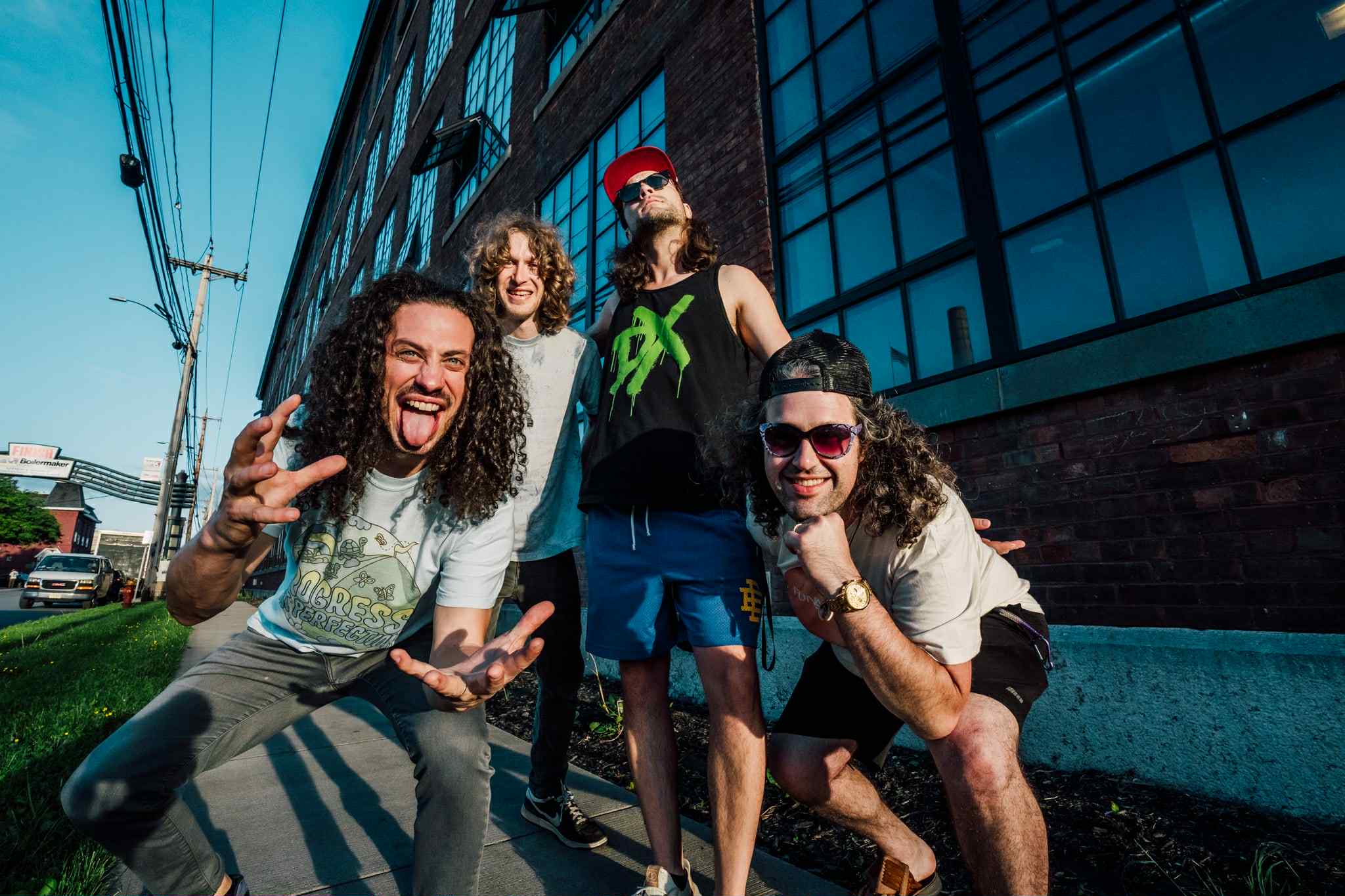
To get to build those relationships with those people and to be thinking about them while we’re playing adds so much context and heart to what we do every day. We’re fortunate. When we’re on tour, every day is a long, long wait to get up to the show, but the shows are electric and exciting. Knowing the community and having that close connection with them keeps it from being just another show every night. Every night, we’re in this city where we have these relationships, where we have this history. We’re able to frame our minds because we’re connected with our community, if that makes sense.
It makes all the sense. And so it was kind of playing to my next question. I’ve interviewed different bands throughout this year, and talked about creating new music. I talked to the Wood Brothers, and they write songs in the studio, then redo them live. And then I talked to Daniel Donato, and he’s just like, it’s all live, and I think it fits into what you were saying. How do you take that live experience and put it onto wax? Like, literally imprint it onto something?
It’s hard to replicate the energy, and that’s something that, again, after eight albums, I think we’ve gotten better and better at. I almost joke that I wish I wore those Oculus glasses and had a superimposed crowd while we’re recording. It can be sterile in the studio, and because of that, you could get a little in your head, and that’s not where the magic is. The magic is when you’re not thinking. When you’re able to just flow and let your mind and body kind of just connect and roll.
What I’ve noticed about the studio, it is 95% mental and 5% physical. You know how to play the songs, but you really need to speak directly from your soul and your experience and your point of view. I personally like to transport myself to who’s going to be listening to this? And that’s something that you don’t know, but whatever gets me there, I’m trying to channel that energy because otherwise, we’re in this airtight vacuum recording. It’s been a challenge, but I also think that’s why I feel like this album was a leap. It really does feel more like a set list of ours, which has natural ebbs and flows and peaks and valleys, as opposed to a collection of songs. It’s telling more of a bigger story, and that’s why I’m happy that a song like “Donkey Hotel,” which you referenced, is kind of zany and off-the-wall and silly, because that’s part of our story, too.
We’re showing you the evolution, we’re showing you peaks, we’re bringing home valleys, we’re hopefully having some more singable songs, because that’s just great to do. I love singing to everything I’m listening to as a fan. Then we hit you with the “Donkey Hotel” and be like, ‘Oh, by the way, it’s been us this whole time!’ Don’t forget that we’re the goofballs that you’ve gotten to this point.
It is really challenging. It’s not surprising it’s hard to wrap your head around, because the difficult thing about live music is that you can’t replicate it. That’s what we’re chasing. That’s why we’re on the road right now. That’s why we’re spending time away from home to chase this. It’s like our religion. It’s a connection that is hard to find in society, and it’s hard to put it in a box, in a package, and put it on wax, and have it resonate the same way. So we have to pick and choose where we extend songs, where we tighten them up, where the polish comes in, where the natural kind of edge comes in, and hopefully it reminds people of our live energy, but it’s delivered in a crisp, you know, high-fidelity package.
So, speaking of that. In a press release I was reading about you guys it says this is one of your most ambitious goals you’ve ever done. And you’re chasing that live dragon. Are you finding it? Because I’ve seen you’re going to bigger spots, and you’re doing two nights down in Baltimore, you’re doing The Cap, you’re doing all these places on festivals. Are you with the goal for this year? Did you hit it, do you think, with the live experience for yourselves?
Hell yeah. Absolutely, dude, I love playing. We just had an incredible Sunday night at Tipitina’s in New Orleans, and the energy was just bonkers. It’s interesting how, from show to show, you just don’t know what’s coming. It was Sunday. I put out a lot of energy on stage, but throughout the day, I kind of conserve it. And I was dragging a little, and I wasn’t sure, I was like, ‘It’s Sunday night, I know it’s New Orleans, are people coming out?’ And then as we got up to showtime, it just clicked into another gear.
And just like how we get to meet the fans and talk to them, and that helps add context, being in a place like Tipitina’s, there’s history oozing out of the walls, and to be part of that is such an honor. I could feel the energy of New Orleans, and all the people that have played there, and the pinch-me moment of being part of it, too.
Just like the Capitol Theater. Everyone has played there, and the fact that we get to go bring our fans, pack the place out, and pour it out it’s an honor. It’s not a moment to be squandered, and we’re the type of band that will never look back at a show and be like, ‘We could have given it a little more.’ We leave it all out. And, when you do that, you’re gonna find what you’re looking for. It’s just about your intention and how much you put in is what you get out. I look at all the stuff that we do with music as like with any profession, or relationship, or anything in life, if you put everything in, you’re gonna find something. That’s what we do with the records and the live shows, so I’m always finding the dragon, and because the dragon’s so good to us. I’m chasing it, too.
You’ve been doing this for 20 years, essentially. There’s a lot at work, there’s a lot of yourself, like I said, you leave it all on the floor. What is it about this band, this group of people, that keeps you out, gets you out of bed every morning. Why do you love it?
When we’re connected in an unconscious way, and we’re bringing our music together, all four of our DNA on it, bringing it to a peak. It’s hard to think of a better feeling on Earth. The only thing that comes to mind is, my family and seeing them grow and things like that, my kids, but you know…what keeps you in a marriage all these years? That feeling of love, right? You experience all these different relationships, and then there’s one that clicks, and it’s unlike anything you’ve ever experienced.
Now, does that mean that it’s always rainbows and sunshine all the time? Absolutely not. But that feeling is universally recognized as special, and that’s how I feel when we’re playing. We’re also, at this point, like you said, it’s been nearly 20 years, we have so much foundation that we’re working off of that it’s so much fun at this point. It’s like a couple that’s already been through bumps in the road, and they know how to navigate them, so when they arise, they’re prepared for it, and then they can just enjoy the sweetness of their labor.
The other thing that’s really cool about this project is that, like, we didn’t intend for this to happen, per se. I mean, I went to college, I met a guitarist, we started playing music, because that’s what you do. It was just the rite of passage for someone who likes to sing and plays a little guitar, and on the other hand, my guitarist had played his whole life, and it was just a match made in heaven, and instead of joining a fraternity, we started a band and played in people’s basements and had the time of our life. And it really snowballed into something much bigger than ourselves, but I think if we were intending to create a band that had a following, we’d probably fail. It’s just one of those things like, you meet your spouse when you stop looking for them. That type of energy is what feels like how this band came to be.
We also have some perspective, having been around for so long, that a lot of our contemporaries have come and gone. They’ve been incredibly talented, amazing bands who have played for over 10 years, and they were unable to keep it going, and that only shines a light on how special this opportunity is, and how fleeting these things can come and go, and how there’s a bigger picture at play. It’s not something to be taken for granted. We don’t take it for granted in the slightest. I’m thrilled to be sitting in Mississippi, having an interview with you, talking about Tips and the Cap, like, I mean, what a life.
Final question, what are, five things you’re stoked about for the band for the rest of this year, early next year?
We’re playing The Cap, two nights. I’m from New York – Fort Washington on Long Island. The history of the Capitol Theater, to be part of that story is an absolute honor, and as a result, it is an opportunity we will never take lightly. We released a live album from The Cap, our first live album in many years, and again, that was not the plan. It’s just after the show, we were like, holy shit, this place brings the best out of us, and probably everyone. It’s the same thing with Tipitina’s just two days ago, there’s something about these places that you hear about, and you finally go there. So, I’m super stoked to come back to the Cap.
We’re doing our first New Year’s in Colorado, and that’s been one of the best states for us in the history of the band. It was the first time we went out west, in quotes, because it wasn’t all the way, but Colorado opened welcomed us with open arms, and we were utterly blown away at the reception of a bunch of people who had never heard of a weird pigeon band come out and party with us and dance as if they’ve known us for years. So it’s our first time doing New Year’s in Denver for two nights with our longtime friends, the Magic Fiends.
It’s hard to pinpoint what I’m excited about, because truly, I’m excited for all of it. I’m sitting here on a Tuesday in Mississippi, and I’m like, ‘Alright, Jackson, what’s it gonna be?’ I have a feeling it’s gonna be awesome. There’s something about going to these smaller towns that as an East Coaster, you may have opinions about what it may be like, and then just being utterly floored as to what the vibe is like. I remember the first time in Omaha, I was like, what are we doing in Omaha? It was like a Wednesday or Tuesday. Sold out, packed house, party till late, it was wild, and it really made me…check myself on casting any judgments across the board in life. You just don’t know until you’re there.
So, I’m stoked to continue to travel the country with my best friends and play music, man, whether it’s at The Cap or the hole in the wall, you know? It’s just, it’s a blessing.