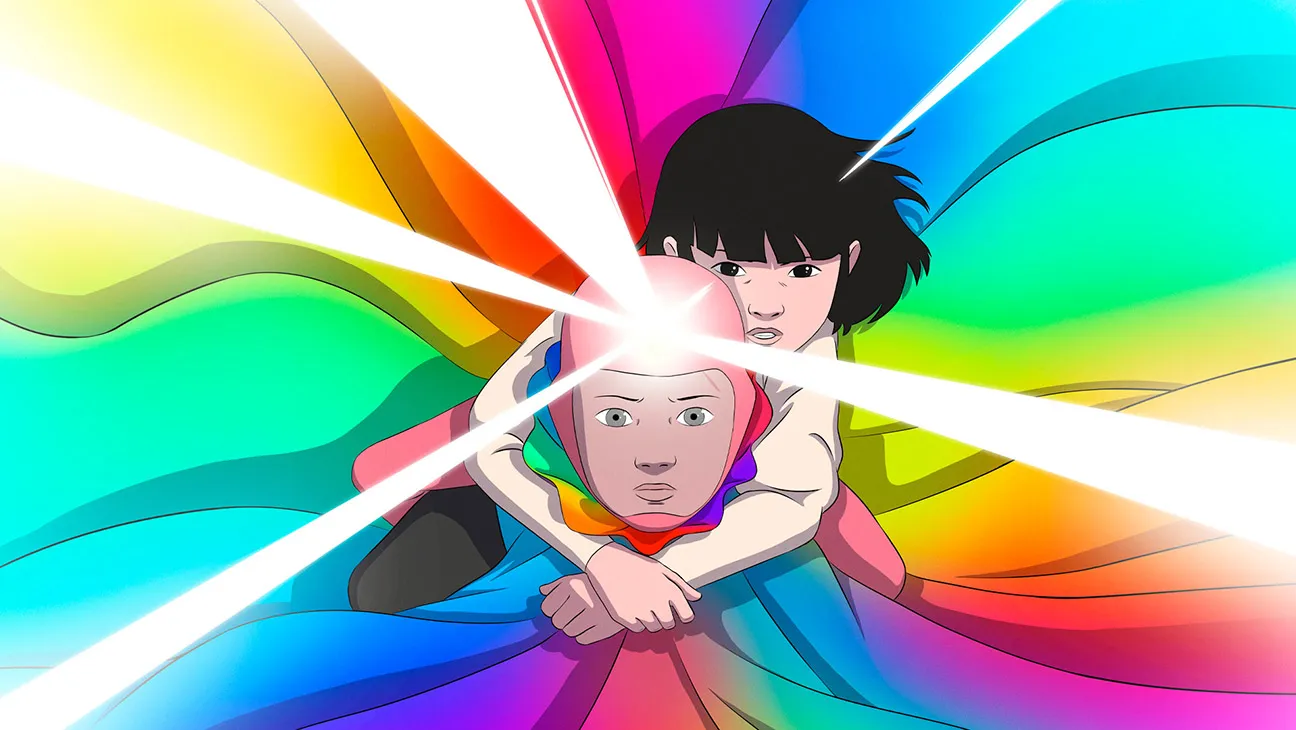
After Flow triumphantly won the Academy Award for Best Animated Feature Film last year, there are more eyes than ever on the emerging European animation scene. That’s what’s drawn us to Arco, the latest animated film from French director Ugo Bienvenu. And, frankly, despite a couple of hiccups, Arco is another example of the incredible artistry and vision for the genre within Europe right now.
The film takes viewers into 2075, where robots, digital projections, and protective domes shape our daily living. It’s why Iris (Romy Fay) is so lonely, as she only sees her parents through holograms and is cared for by her robotic caretaker Mikki (Natalie Portman/Mark Ruffalo). However, her wish for change is suddenly answered by the arrival of a rainbow-clad ten-year-old named Arco (Juliano Krue Valdi), who travels from the year 2932. Arco’s aesthetic is astonishing, as it carries this nostalgic soul that’s uplifted by a crisp color palette. In spirit, it blends French hand-drawn art styles with some modern anime influences that burst with a sense of adventure. Honestly, from the opening stretch of Arco flying away from his family’s futuristic home in the clouds, this film evokes major Studio Ghibli vibes. It’s what gives the film a booming sense of scale that Bienvenu and his team work within flawlessly.
The visual of Arco and his family basically riding rainbows to travel through time is truly awe-inducing. Arco’s rainbow-colored time travel suit is instantly iconic-feeling because of its modern anime look, and it’s almost like this eye-catching centerpiece to the film’s art style. Even the way Bienvenu characterizes this not-too-distant, tech-driven future is both ambitious and visually rich. The robots seen throughout different parts of society, ranging from teachers to police, offer a Black Mirror-like eeriness. And yet, oddly enough, Mikki showcases a warmth and determination to protect Iris that’ll quickly make them a fan-favorite.
There are some incredibly memorable character designs, including three colorful conspirators searching for Arco who embody that Adult Swim brand of anime weirdness. And scenes that utilize digital projections elevate the story excellently. The last act features an escape sequence that transports everyone through different eras of humanity that’s a pure feast for the eyes and ups the experience to epic levels. Not to mention, the choice to have Iris’s parents mostly shown through holograms reflects the cold nature of a tech-consumed humanity that influences some key themes tied to current leanings towards AI and digital living.
The only real knock on the animation is the way that dubbing is handled. If you’re watching an English-dub of Arco, the lip-synch being off is definitely distracting and throws off some of the great voice-acting. Arco has a very stacked voice cast—especially when it comes to the supporting characters. Will Ferrell, Andy Samberg, and Flea are a perfect combination for the film’s color-coordinated trio of brother antagonists, as they deliver funny dialogue with ease. The dual voices of Ruffalo and Portman for Mikki are surprisingly perfect and reflect the two roles Mikki plays in Iris’s life. They evoke a genuine love and care viewers will instantly connect with and are a big reason Mikki offers so much heart in the story—especially in the last act. Then there’s Fay and Vladi, who have such a heartfelt connection that beams through Iris and Arco the entire time. The maturity and wonder they bring to their voices makes them vastly more compelling and embodies an innocence that wraps around you. All of these things come together within a narrative that (mostly) holds together for an adventure between two unlikely companions.
Arco is that type of classic adventure film that anyone can enjoy, where two people seeking escape find each other and themselves along the way. It’s a story about discovery and personal exploration that grabs you by the hand and excitedly takes you on a joy ride. There’s constant fun to be had and some heart-wrenching beats that tug at the heartstrings. Unfortunately, it feels like Arco leaves too much potential untapped and often shortchanges its story trappings and themes. Now, that’s not to say that the story doesn’t leave a big impact because it definitely has its moments. Iris’s frustrations with her parents’ lack of connection with her hits some tender lows and Arco’s desire to just fly away embodies that universal yearning for independence as a kid. Plus, there’s plenty of tear-inducing conclusions that cut deep because of how much you grow to love these characters. But, it’s hard not to leave Arco feeling underwhelmed by how the narrative is pieced together and certain story choices. The way the film builds up its antagonists only to have them turncoat without much cause is pretty odd and disappointing. Sometimes the story moves too quickly and doesn’t allow for the emotion it builds to burn long enough. And, despite there being some emotional highs with the final moments, it’s capped off by a flash forward that’s too condensed to be satisfying and glosses through important moments that would’ve been nice to see actually play out.
Even with some missed opportunities with its storytelling, Arco is a remarkable animated film that ranks among the most visually captivating of the year. It’s a marvel for the eyes that can’t be passed up and features some ambitious ideas that culminate in a surprisingly touching adventure. Plus, if it can garner similar awards attention as Flow, Arco could signify a huge shift in eyes towards Europe’s thriving animation scene, giving it a larger impact and legacy than the surefire cult classic it already is.