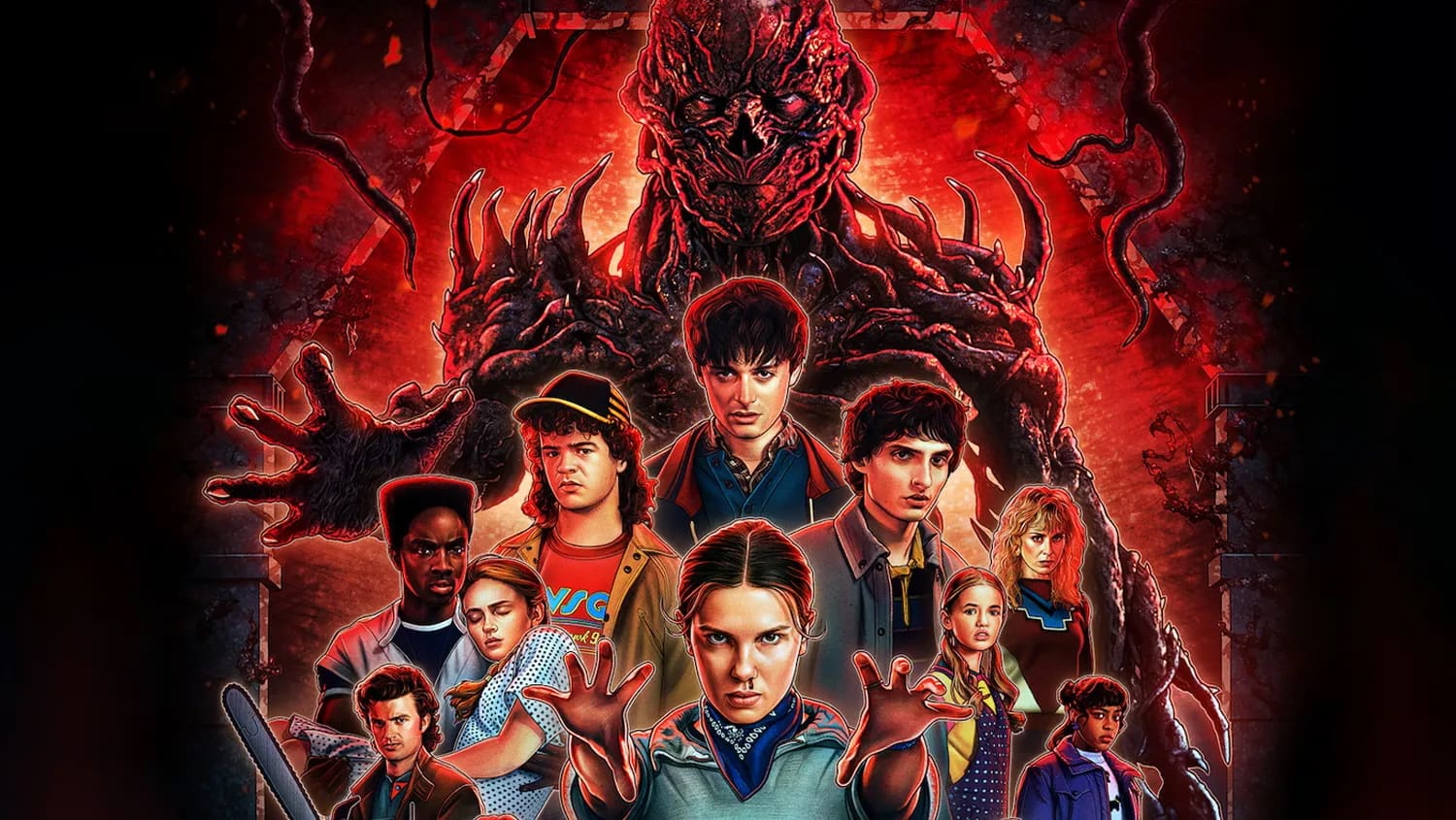
Nearly a decade ago, Netflix dropped the first season of Stranger Things and launched the opening salvo of the streaming wars. In the intervening years, many have chased the magic of Matt and Ross Duffer’s platform-defining series, but none have held on for as long or as tightly as this retro-horror-fantasy darling. Perhaps the only comparable platform-defining series, The Mandalorian over on Disney+, also took hold of the public imagination, but has since burned out the vast majority of fuel in its jetpack as Disney scrambles to define and redefine their Star Wars vision.
Stranger Things, on the other hand, has consistently proven itself tough enough to absorb easy jabs about its bloated runtimes and aging “teen” cast. At the end of the day, no matter how many holes viewers punch in this series, its signature style and cast of lovable, scrappy underdogs never really let it drop far from the top of the genre television game.
Strength of vision, hard work, and years of success earned Stranger Things oodles of well-deserved fan loyalty and benefit of the doubt, but it also burdened the Duffer Brothers with one of the biggest challenges in all of television: bringing a beloved television series to a satisfying conclusion. No matter what you do in a situation like this, you will likely leave some of the fan base unsatisfied. If you lean too heavily into fan service, you’ll be pegged for taking the easy way out; if you get too obtuse, folks will bemoan the lack of solid answers and resolution. Stranger Things tries to do it all in the finale (to varying degrees of success), but ultimately, the Duffer Brothers find the correct conclusion to their nostalgia-fueled, crowd-pleasing adventure.
If you haven’t watched the Stranger Things finale, now is the time to head back to Hawkins and catch up before we delve into an Upside Down hellscape littered with spoilers.
Stranger Things, Season Five, Episode 8: ‘The Rightside Up’ clocks in with two-hour runtime that allows it to attempt a little bit of everything, from clever story beats and tearjerking farewells to underwhelming fan-service and more than a few unforced errors. In fact, the whole thing feels a lot like the moment when our intrepid heroes face off against a Godzilla-sized manifestation of The Mind Flayer and take to the high ground to unload everything in their arsenal – including a credit-card-commercial-teased flame thrower, a flare gun, pointy sticks, and Nancy’s signature shotgun. Of course, in this analogy, the Duffers and company are trying very hard to fend off the monoculture and its lofty expectations.
The Duffers’ epic finale battle with the monoculture picks up right where the penultimate episode left off. Operation Beanstalk is in full swing as the gang books it into the belly of the beast to put an end to this nightmare once and for all. Everybody gets to help take down Vecna (Jamie Campbell Bower, The Twilight Saga: New Moon)
- Max (Sadie Sink, The Whale) guides El (Millie Bobby Brown, The Electric State) and Kali (Linnea Berthelsen, Devs)through Vecna’s mind so they can disrupt his inter-dimensional collision.
- Holly the Heroic (Nell Fisher, Evil Dead Rise) leads her classmates to safety.
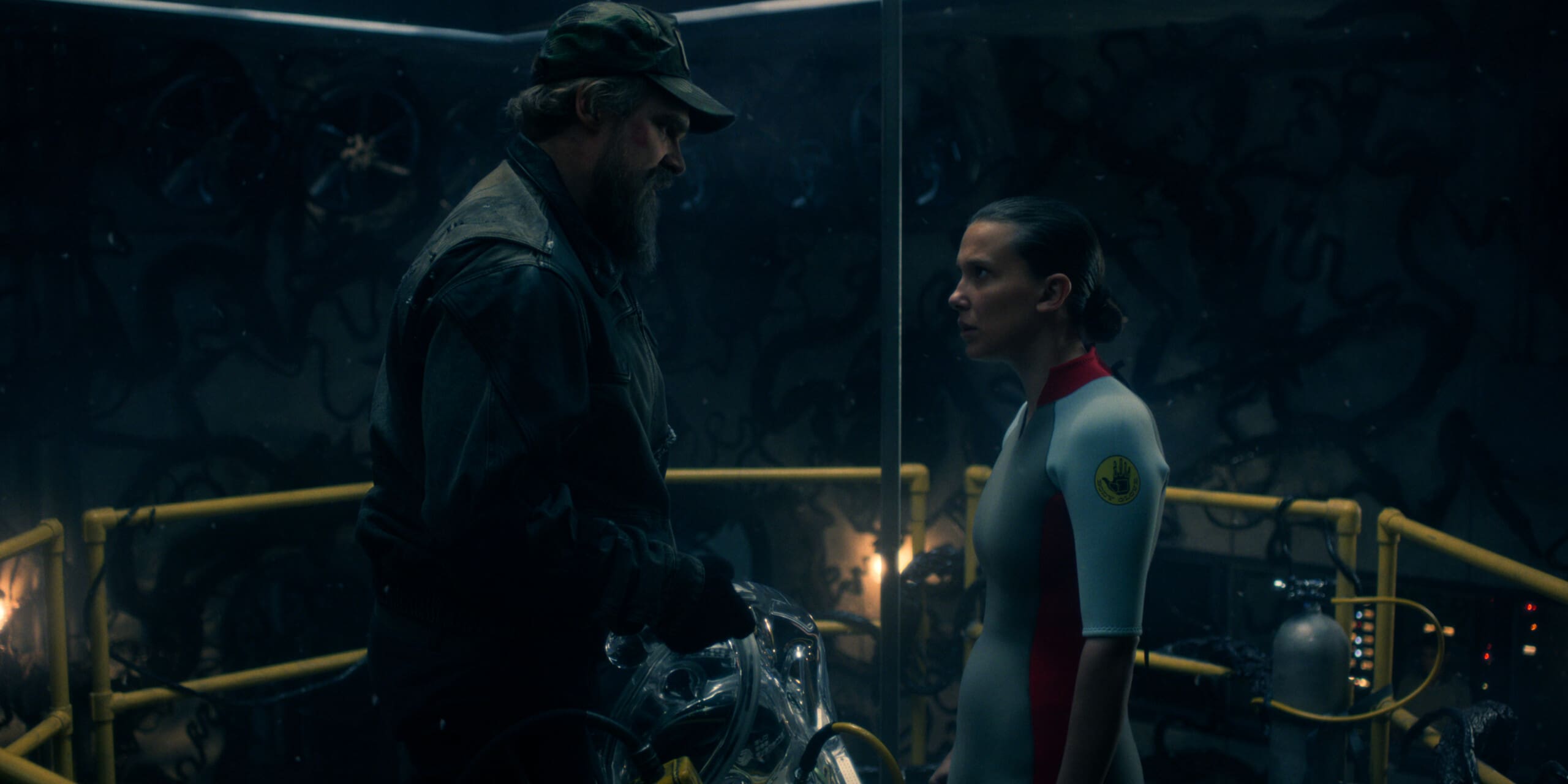
- Hopper (Thunderbolts*) kills some sadistic paramilitary goons. He can’t save Kali, but the strength of his devotion causes Kali’s tortured heart to grow three sizes that day.
- Murray (Brett Gelman, The Other Guys) high-fives himself for blowing up a government “kryptonite” helicopter.
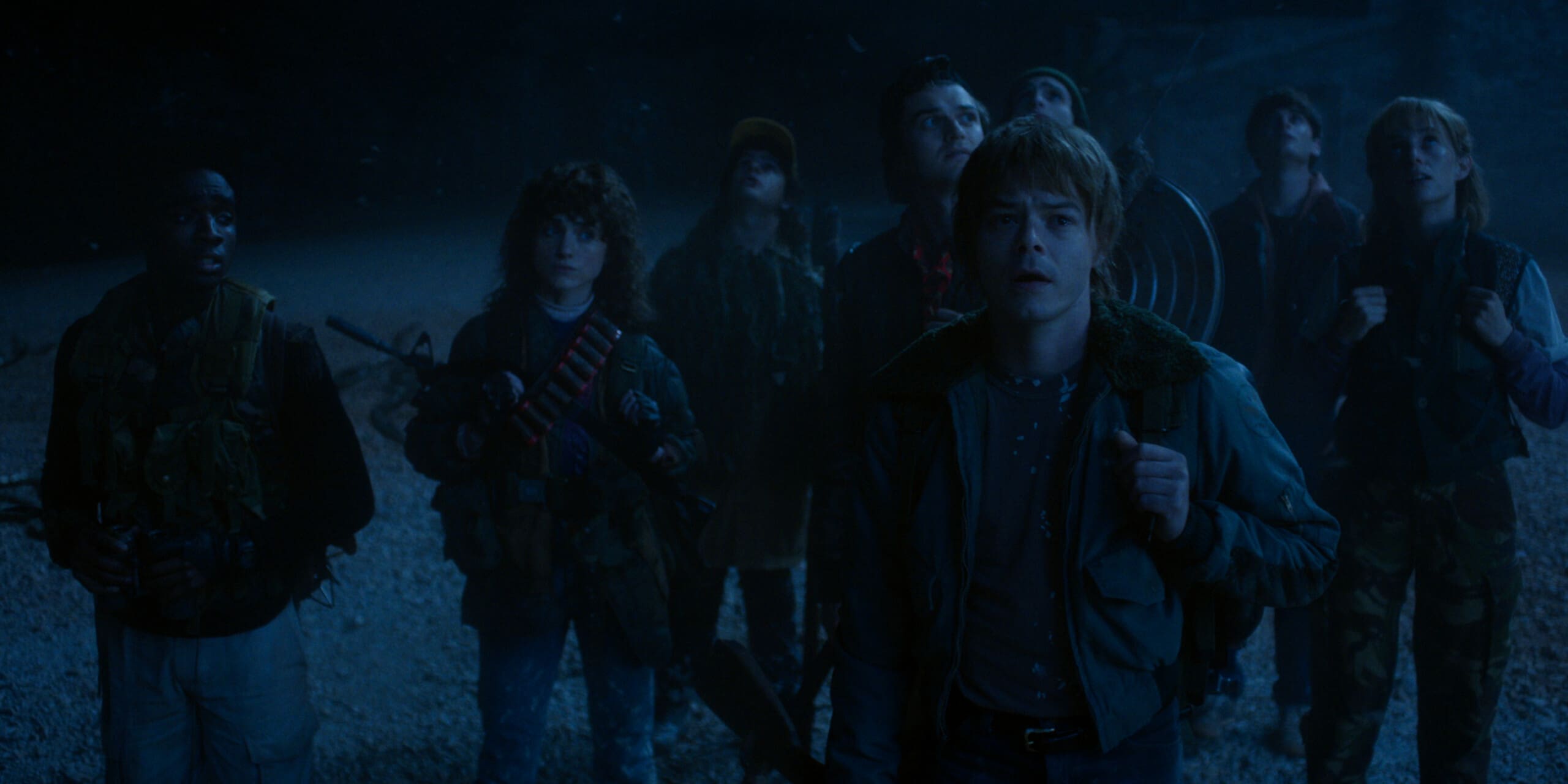
- Nancy (Natalia Dyer, Velvet Buzzsaw) and company take a trip to the Dimension X firing range.
- After kicking Vecna’s ass inside of his mind palace, El returns to kick his ass back in reality.
- Will (Noah Schnapp, Hubie Halloween) attempts to appeal to the last vestiges of humanity in Vecna, but is ultimately forced to unleash his sorcerer powers and rip off Vecna’s Season Five Groot-arm instead.
- Joyce (Winona Ryder, Beetlejuice Beetlejuice) beheads a choking, dying Vecna with her trusty axe and makes it clear that he “fucked with the wrong family.”
After Operation Beanstalk succeeds, the crew is hijacked by Dr. Kay (Linda Hamilton, Terminator) and Company, but not in time to stop our heroes from destroying the Upside Down and freeing Hawkins from its ties to Dimension X; in the chaos, El escapes and offers Mike (Finn Wolfhard, Ghostbusters: Afterlife) a tearful psychic farewell before she is swept away into the collapsing wormhole.
18 months later, an extended epilogue catches us up on the state of our survivors.
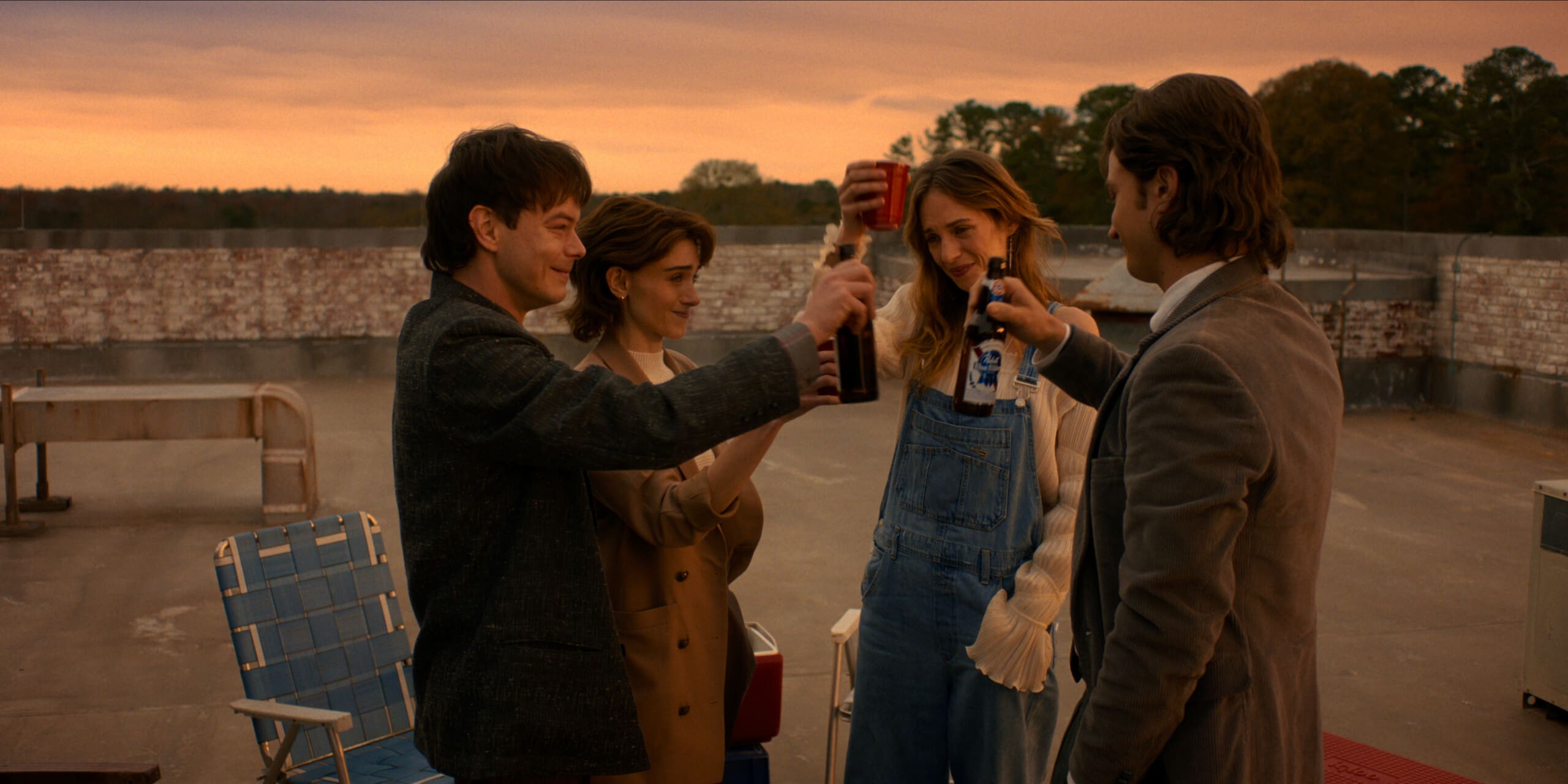
- Steve (Joe Keery, Fargo) Nancy, Jonathan (Charlie Heaton, New Mutants), and Robin (Maya Hawke, Inside Out 2) are full-fledged independent adults forging their respective paths in the real world while acknowledging that their bond is irreplaceable.
- Hopper and Joyce are getting hitched and getting the hell out of Hawkins.
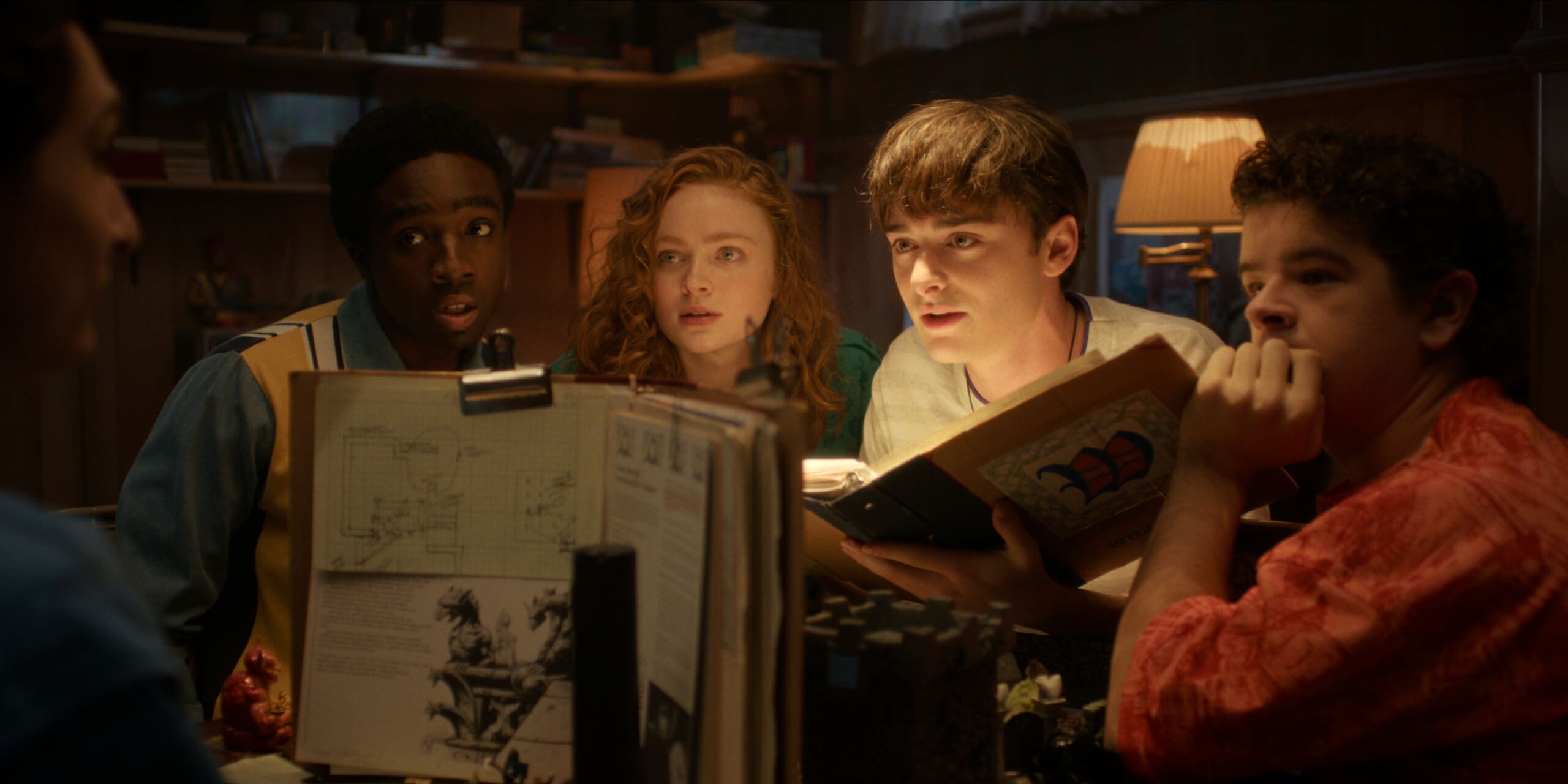
- Mike remains hung up on El while Will, Dustin (Gaten Matarazzo), Lucas (Caleb McLaughlin, The Goat), and Max embrace the future wholeheartedly; nevertheless, we learn that the party’s bonds are stronger than ever in a post-graduation D&D session.
- Mike passes the torch to his little sister as she forms a new party with her friends.
We also get a second interpretation of what happened to El in the Upside Down, but we’ll get to that later…
Finally, the finale hits viewers with an inventive D&D-campaign-book-inspired end credits sequence to help us soak in the last bits of nostalgia … and nod to another promotional tie-in. It’s a bit on the nose, but however you feel about the finale, Stranger Things more than earned this flex after a decade of fantasy adventure. Furthermore, it offers a compelling model to weigh the pros and cons of the finale. Like any D&D session, there were clear ups and downs.
ROLLING A NATURAL 1
It’s impossible to ignore the collision of some questionable season-long choices and sloppy execution down the stretch.
One of the biggest missed opportunities of Season 5 comes in the form of Linda Hamilton’s Dr. Kay. While the prospect of Sarah Connor herself entering the Upside Down was teeming with possibility and Hamilton’s signature badass persona is convincing as always, she never constitutes an emotional threat within the story. At the end of Volume 1, Kay seemed to imply she had a larger history with El, but that tease never plays out. Furthermore, Kay is such an afterthought for our main characters that after the success of Operation Beanstalk they seem to have completely forgotten about storming a military base and killing a bunch of soldiers to access the Upside Down. Rather than seek an alternate exit or develop an escape plan on the fly with the help of assorted found objects for visual aids, the whole crew just sort of joyrides back onto the base with zero sense of danger or apprehension. After the wormhole collapses, the flash forward leaves us to assume that Kay and her crew just kind of packed up and left town with no repercussions for our central characters.
Similarly, it feels like the finale missed a chance to fully capitalize on a phenomenal season-long performance from Jamie Campbell Bower as Vecna/Henry Creel. After consistently teasing Vecna’s humanity and even revealing the traumatic event that granted him his powers, it seemed likely that our heroes would access some of that humanity as part of the final solution. Instead, Henry reveals that helping the Mind Flayer was his choice all along and that he really truly believes that crashing Dimension X into the Earth is a perfect reflection of his world view.
This choice is all the more dizzying alongside the knowledge that an entire play dedicated to humanizing Vecna, Stranger Things: The First Shadow, is currently running on Broadway. This story beat becomes downright confounding when we consider all of the time spent retconning Henry Creel from a troubled child cursed with an innate darkness to an “aw, shucks” Boy Scout who found himself in the wrong cave at the wrong time. Sure, Will’s attempt to use empathy instead of violence reminds us of the purity and heroism of our core cast, and perhaps even illustrates how important the influence of El’s found family was to helping her control her relationship with her powers, but it feels like layering in some catharsis for the remnants of Henry Creel’s humanity might have resonated with audiences more than falling back on the latest CGI spider-monster.
Before moving on from Henry Creel, it’s also worth noting the weird Season 5 unforced error of crafting a memory that put Henry Creel in high school with every single adult we’ve ever met in Hawkins, including Joyce and Hopper. It’s strange that their shared history with this character never came up after many months of dangerous “crawls” and lots of time to process the Season 4 Vecna info dump. If this memory had played out as a full retcon with emotional stakes, we might have had an open mind, but here at the end of all things, it’s clear that this was nothing more than an Easter Egg to set up a joke about young Ted Wheeler feeling up his future wife.
Honestly, the sloppy execution doesn’t end there. We’ve spent a lot of emotional time with Steve Harrington over the years after he quickly blossomed into a fan favorite during Season 2. He has continued to find himself at the emotional heart of the series and Joe Keery deserves a ton of credit for keeping fans invested in the show. This season, he has continued growing up and coming to terms with the relationships in his life. Unfortunately, this included a very forced rivalry with Jonathan Byers.
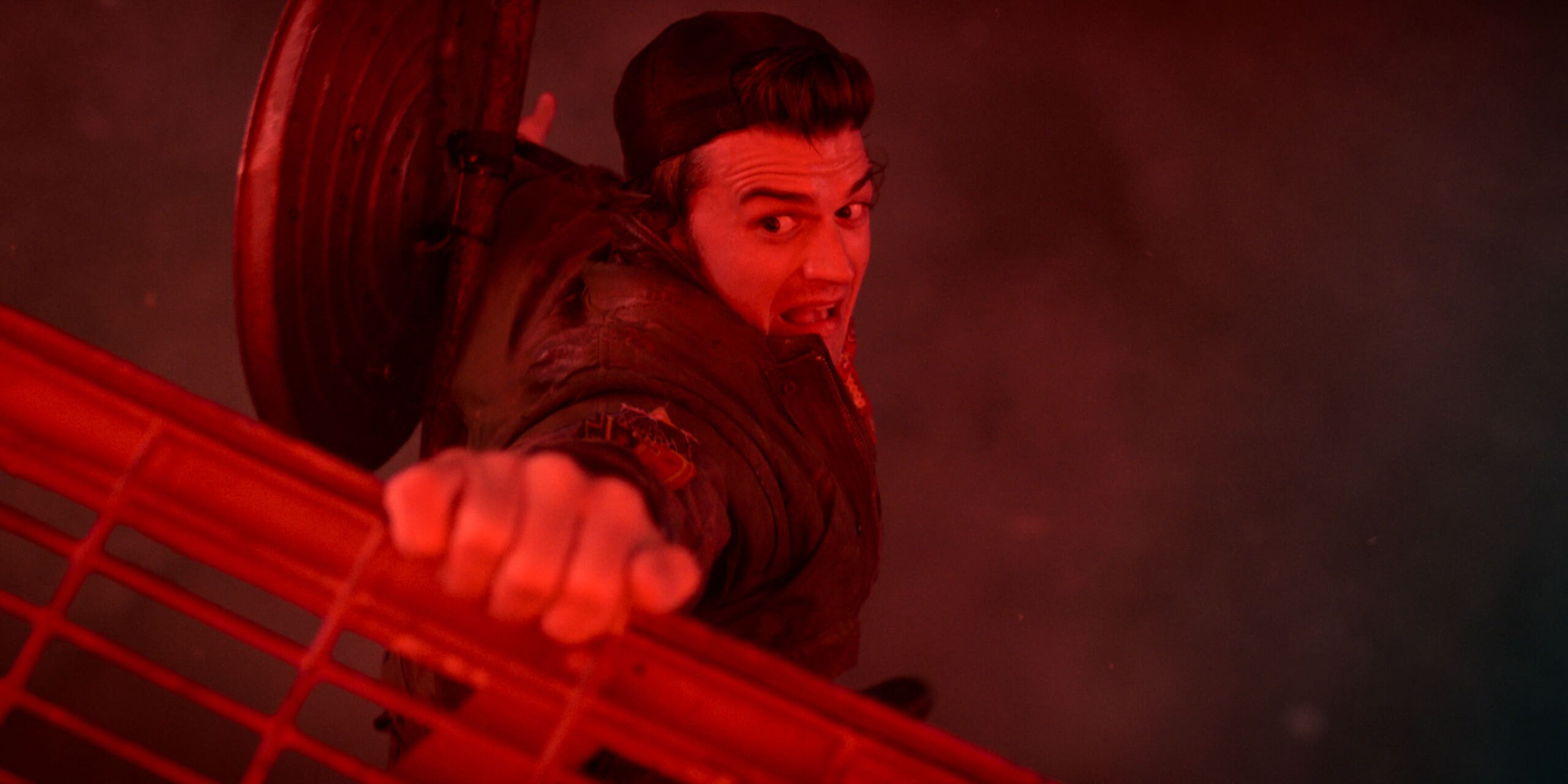
Despite some verbal sparring and showboating over their respective relationships with Nancy Wheeler, Steve and Jonathan have been effectively putting their differences aside to work together all season. So, when the finale propped up one of the season’s weakest storylines as the emotional payoff for a silly fake-out death, it was hard to keep the eye-rolls in check. It’s annoying enough to see Steve’s fingers slip from the tower before the screen cuts to black — as if for a commercial break — only to be snatched out of thin air by Jonathan Byers, but the real sin comes in the aftermath when Steve seems shocked that Jonathan didn’t just let him die. Not only does this artificial reconciliation underestimate the audience, but it’s redundant.
Volume 2 offered one of the best scenes in the show’s history with the moving un-proposal/breakup between Nancy and Jonathan. It was so effective that all of the time we spent watching Steve and Jonathan fight earlier in the season was almost worth it. Jonathan comes to terms with all of the excuses he built up in his head to hide from the fact that he and Nancy’s romance had run its course. In that moment, audience members understood what was fueling Jonathan’s attitude, and the rivalry storyline was resolved. It’s a shame to watch the show waste valuable time in the finale to over-explain and oversimplify a story beat they landed two episodes earlier.
We also can’t get out of this finale without acknowledging the cheesiness that populates the epilogue. We love Joyce and Hopper, and we want them to have nice things, but something about Hop’s very basic proposal and plan to settle into a slightly more lucrative local law enforcement gig feels a bit forced and uninspired — particularly in the context of the finale’s desire to call out performative order and control in society.
Perhaps all we needed was a more holistic glimpse of Joyce and Hop nestled into a comfortable future with a sense that they’ve maintained the respective sharp edges that make them such a great match. Similarly, watching Steve on the path toward domestic life and his “six little nuggets” as a phys ed teacher and baseball coach also feels a bit too tidy. Sure, any group of high school friends will generate a mix of homebodies and folks who venture out from the nest, but again, it might have been better to see Steve deploy his emotional intelligence with a student rather than treat his life as a tongue-in-cheek punchline alongside playful jabs at liberal arts colleges and anti-capitalist/cannibal art films (naturally, this reviewer will be seated for “The Consumer” on opening night).
Despite the fact that these critiques and shortcomings find space to take hold (everyone’s mileage may vary on which epilogue revelations landed or fell short), it’s hard to feel too disappointed by the finale. At the end of the day, Stranger Things is a show that almost singlehandedly redefined how we make and consume television, and it found a decade of success across multiple demographics. On top of all of that, the show built a family of young actors who’ve grown up against a backdrop of on-screen fantasy horror. At the end of the day, shared television experiences bring people together, and Stranger Things is one of the biggest shared experiences in television history. In other words, The Duffers and their cast of characters have more than earned the right to get a little sappy. Perhaps it’s worth accepting the cheese factor in order to see the characters we love so dearly earn some rewards instead of making more sacrifices.
ROLLING A NATURAL 20
When assessing Stranger Things, we can’t lose sight of the fact that its success stems from its aesthetic nods to campy horror and kids on bikes in the fantasy/sci-fi/adventure epics of the 1980s. While this show has held its own shoulder-to-shoulder with prestige television for the last decade, it came into this world as a crowd-pleaser that told heightened morality tales against a supernatural background. It falls from a different tree than the more cerebral genre-bending of shows like Severance and Pluribus.
While this reviewer isn’t the biggest fan of CGI-laden action, Stranger Things wouldn’t be Stranger Things if we didn’t get to see Eleven psychically tear open the chest of a kaiju spider to murder the child-predator demon that lives inside. Stranger Things wouldn’t be Stranger Things if Nancy Wheeler didn’t strap on twice her weight in guns and ammo over an ’80s fashion statement, grit her teeth, and unload a hail of bullets on a big, scary monster. Stranger Things wouldn’t be Stranger Things if a tortured mom didn’t get to hack away at the choking, writhing remains of the monster that kidnapped her baby boy and took his innocence away.
Stranger Things gets to be Stranger Things in this finale.
On top of that, the finale sticks the landing on its most important emotional task and delivers an effective goodbye for our core D&D crew. After Dustin turns his valedictorian speech into a reflection on the potential creative power of chaos and all of the strength he drew from his trauma-bond family, we get to see our crew blow off a cool graduation party to finish off their D&D campaign. Watching these actors back where they started 10 years ago is a total joy. Not only is it moving to see them hold on to a little piece of the innocence that was taken from them, but it was the best display of their team chemistry that we got all season. Maybe it’s a bit indulgent for Mike to predict a happy future for each of his friends, complete with cutaway montages, but this show earned that opportunity. After everything these kids have been through, it feels great to catch a glimpse of their confident, independent futures. It’s also moving to watch them tearfully prop up their D&D binders on a basement shelf as the next generation takes their place.
Sure, it’s not much of an A24 ending, but it’s a damn good Toy Story 3 ending. From that perspective, the Stranger Things finale finds itself in great company.
As an added bonus, the finale has one more ace up its sleeve in its most important storytelling decision.
In the closing moments, Mike pieces together what actually happened to El at the end of Operation Beanstalk. He realizes that she must have been a psychic projection, because the military “kryptonite” devices would have prevented her from using her powers. Mike infers that a dying Kali had a change of heart and helped El fake her own death, strike out on her own, and end the cycle of trauma perpetuated by seedy government agents looking to harness the powers of Dimension X. Technically, Mike is theorizing, but the footage of El in the real world seems to confirm his theory.
For years, El has struggled for independence in the face of constant abuse and gaslighting at the hands of “Papa” and her other government handlers; she’s even been forced to navigate the well-intentioned controlling instincts of the overprotective Hopper and her novice boyfriend Mike. On top of those struggles, El lives with crippling guilt and fear that she might be the actual monster at the center of the story. While her apparent death in the middle of the finale is a painful development, it’s still somewhat of a relief to see her make a choice entirely on her own for possibly the first time in the entire series. Fortunately, the decision to reveal a plausible escape for Eleven is the critical decision the finale needs in order to stick the landing.
How do you end a story for a character who has been deprived of autonomy for her entire life by government handlers, flawed father figures, and even her first love? She couldn’t settle down into domestic life like Lucas and Max — she has been living in a trap her entire life without any real chance to make an informed and independent decision; she’d still be trapped, no matter how much her found family loves her. Another option is to commit to the noble sacrifice. Sure, this gives El some autonomy, but it’s a cold and bitter ending for an innocent character who has already been forced to sacrifice so much. We would pity her tragic end.
This leaves us with the only correct ending: The Huck Finn ending. Yup. You heard that right. Believe it or not, El’s ending is not entirely unlike Mark Twain’s Adventures of Huckleberry Finn. Like Eleven, Huck Finn is an abused and abandoned child with a monstrous father and the ever-present fear that he is destined to follow in his dad’s footsteps. Huck does his best to learn from all of the well-intentioned folks who want to help him, but he doesn’t learn anything very valuable. Eventually, Huck saves his friend Jim from slavery by following his own heart, despite the hateful and selfish behaviors he learned from observing “civilized” society. In the closing moments, Huck pushes aside the antics of his buddy Tom Sawyer and buckles at the offer of a brand new invitation for a comfy domestic life with Tom’s aunt. He wants no part of it:
“I reckon I got to light out for the Territory ahead of the rest, because Aunt Sally she’s going to adopt me and civilize me, and I can’t stand it. I been there before.” (Adventures of Huckleberry Finn)
In fact, author and critic T.S. Eliot once argued that this was a near-perfect ending:
“For Huckleberry Finn, neither a tragic nor a happy ending would be suitable. No worldly success or social satisfaction, no domestic consummation would be worthy of him; a tragic end also would reduce him to the level of those whom we pity. Huck Finn must come from nowhere and be bound for nowhere…He belongs neither to the Sunday School nor to the Reformatory. He has no beginning and no end. Hence, he can only disappear; and his disappearance can only be accomplished by bringing forward another performer to obscure the disappearance in a cloud of whimsicalities.” (T.S. Eliot, “Introduction to Huckleberry Finn”)
Eleven exists in a similar space. She can’t be resigned to dress up and perform for others in a world she doesn’t understand, but she also deserves much more than our pity. Allowing her to disappear behind the artifice of Mike’s D&D campaign as an open question is perhaps the most perfect ending for our beloved mage. She has been carrying the weight of the world for far too long.
If Twain and Eliot feel too heavy for you, look no further than Dustin’s valedictorian speech. It’s just another version of the Huck Finn ending:
“I’m not pissed off anymore, but I am worried – worried because now that the chaos is over, Principal Higgins and every square like him is gonna do their damndest to put everything back in order, and I don’t want order…”
Here at the end of Stranger Things, it’s easy to understand why the creative team was trying so hard to put everything in order to please the monoculture, but the proper formula was actually quite simple: set Eleven free. This reviewer can’t imagine a more perfect ending than that.