Written by Molly Minnium
Bridgerton Season 4 marks an awaited shift in focus, placing Benedict Bridgerton (Luke Thompson, Dunkirk), the second Bridgerton son, at the center of the story. Known for his resistance to marriage and the ton’s expectations, Benedict’s season builds on a Bridgerton legacy of passionate, high-stakes romance, but now faces a desire that exists outside the boundaries of what society is willing to forgive.
As a leading man, Benedict proves surprisingly well-suited to this shift; his long-standing detachment from society’s rituals makes him the rare Bridgerton whose love story can realistically push against the ton’s rigid class structure rather than comfortably operating within it.
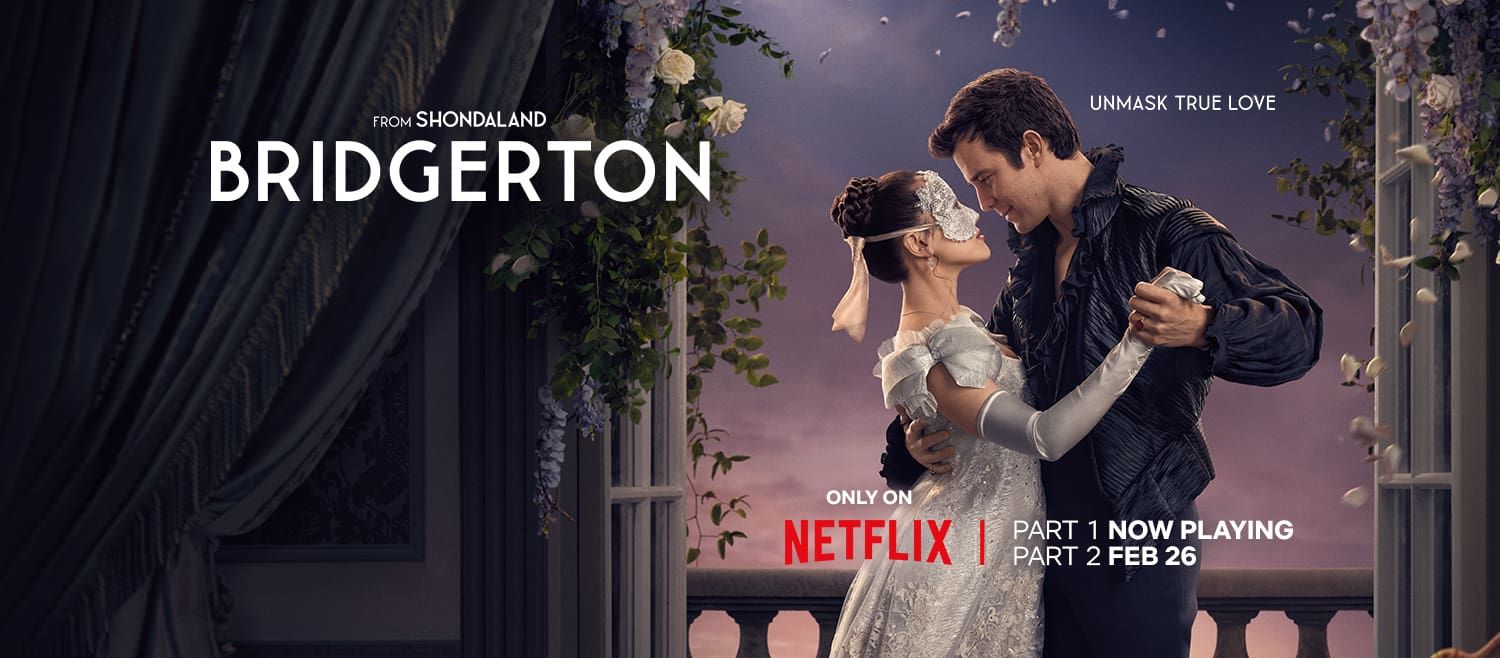
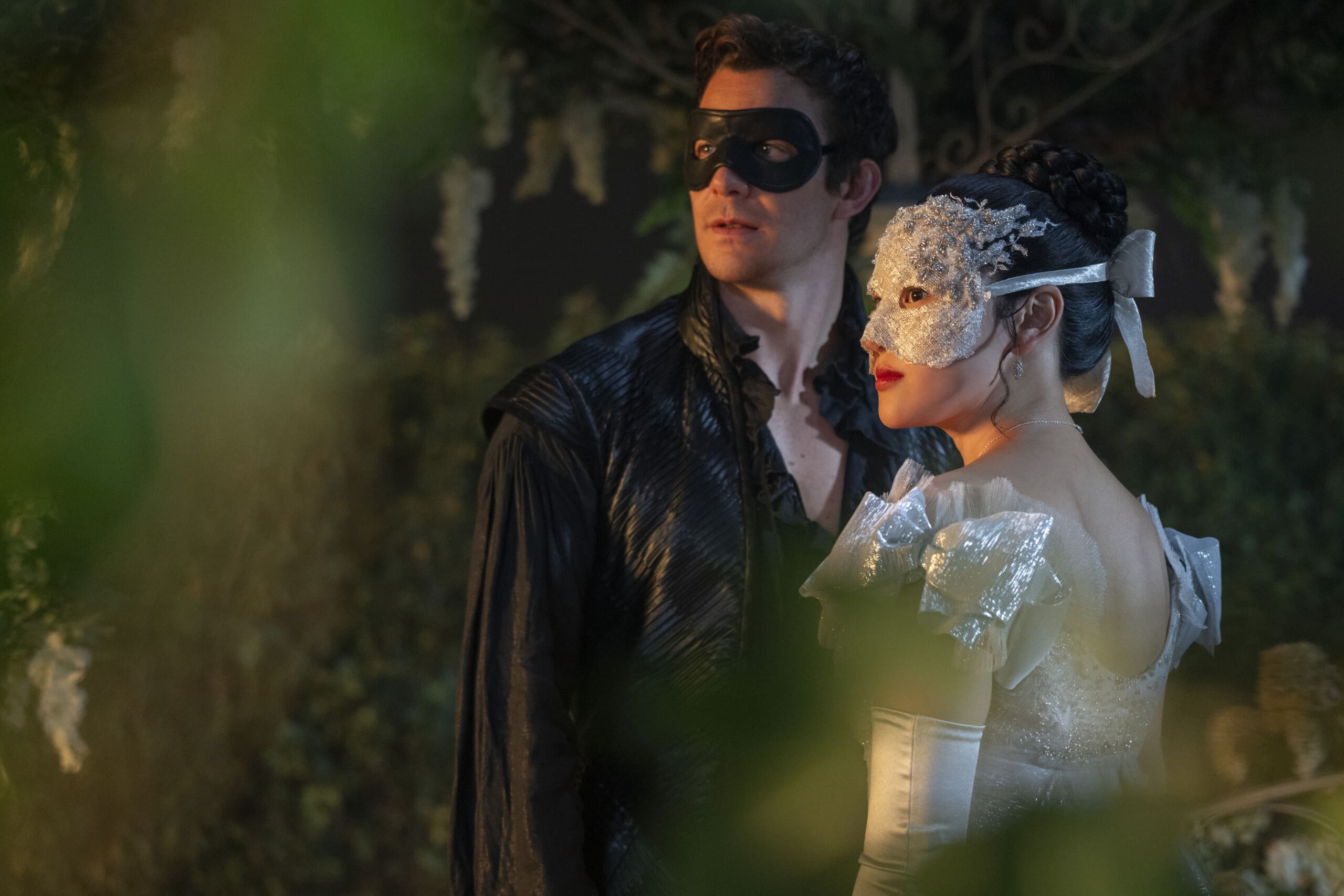
Bridgerton Season 4 Part 1 leans into secrecy in a more practical way, kicking off the season with a Bridgerton hosted masquerade that briefly allows characters to step outside their assigned roles. For Benedict, that anonymity sparks a connection he’s never felt before, one rooted in ease rather than expectation. But Bridgerton is careful not to romanticize that freedom for long. Once the masks come off, the season makes clear that not everyone is afforded the luxury of returning to society unchanged.
Benedict’s connection at the masquerade only works because he does not know who Sophie Baek (Yerin Ha, Dune: Prophecy) really is. As the Lady in Silver, she exists outside the unforgiving hierarchy of the ton, anonymous, untethered, and briefly protected from vicious ridicule. That anonymity allows Benedict to project desire without consequence. When they meet, Sophie hides her dance card, admits she is not seeking a husband, and seems more captivated by the chandelier than by any potential suitor. That distance from the marriage market is precisely what draws Benedict in. To him, she appears to belong to his world, even though the audience knows she does not.
Episodes 2 and 3 complicate that fantasy by revealing Sophie’s reality. Far from a mysterious debutante, she is a servant in the Penwood household, an illegitimate daughter kept in the home not out of kindness, but control. The season leans unapologetically into its Cinderella parallels: the cruel stepmother figure in Araminta Gun (Katie Leung, Arcane), the spoiled sisters who take their privilege for granted, the midnight curfew at the ball, and even the ill-fitting glass slipper equivalent in the shoes that ultimately betray Sophie’s identity. Sophie’s labor is constant and invisible, and her brief night of freedom is treated as theft rather than joy.
What makes the Cinderella framework effective here is how deliberately it’s grounded in labor. Rather than using class difference as a backdrop, Bridgerton forces it into every interaction, making the imbalance impossible to ignore.
In Episode 3, Sophie is dismissed from the Penwood household once her stepmother pieces together the truth of her night at the masquerade. The punishment is swift and personal, not just for attending the ball, but for daring to enjoy it. Her firing reinforces the season’s Cinderella framework: Sophie is not cast out because she did something cruel or reckless, but because she momentarily forgot her place. As the fairytale goes, Sophie’s Cinderella fantasy ends exactly where it always does: at midnight.
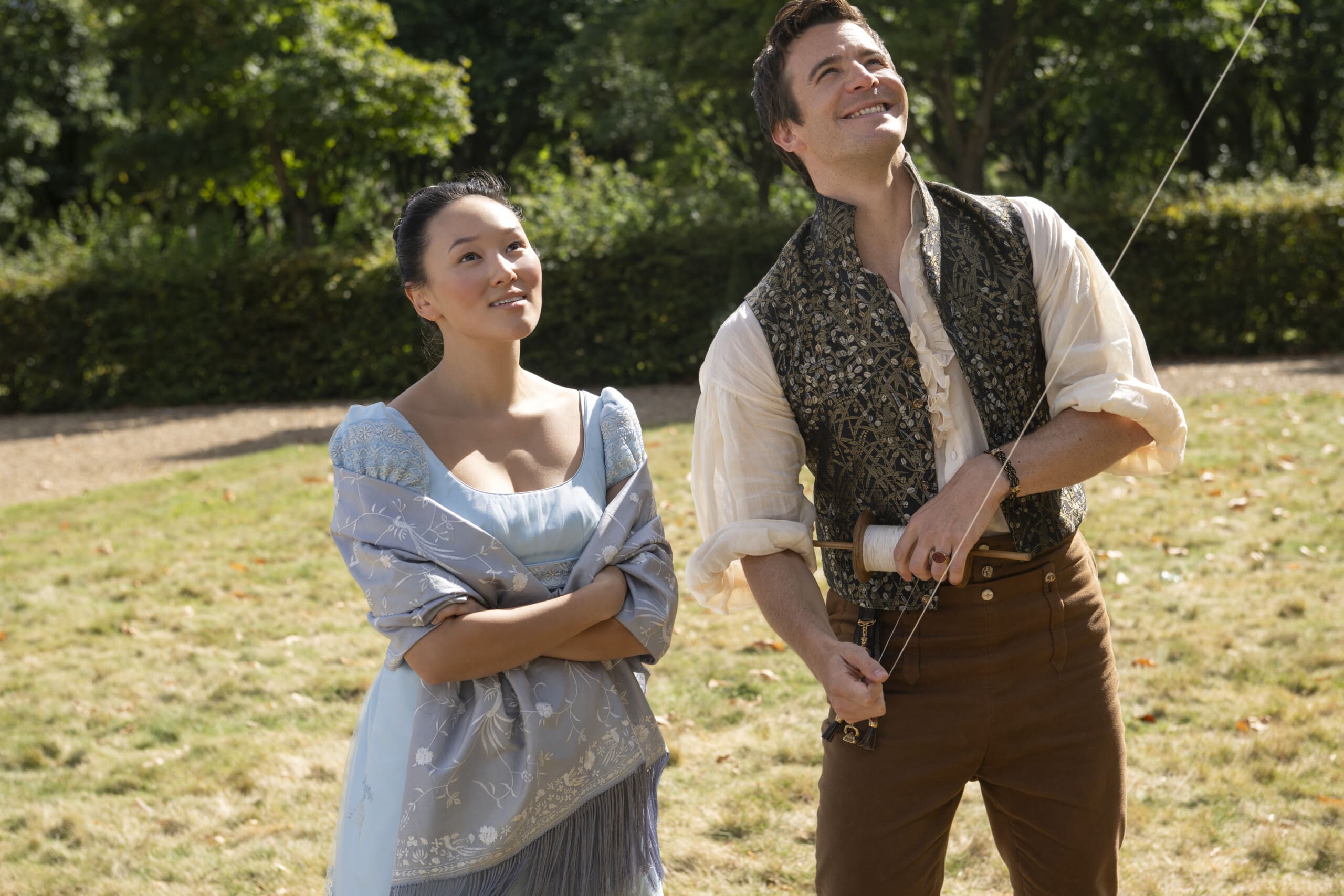
In the aftermath of Sophie’s dismissal, circumstances strand Benedict and Sophie at a countryside cottage, a rare and temporary space where hierarchy appears to soften. Removed from London and the gaze of society, Sophie tends to Benedict’s injuries, shares books and conversation with him, and allows herself moments of leisure she has never been afforded. Their soft intimacy deepens here through care, aided by Luke Thompson’s restrained performance and Yerin Ha’s quiet authority, both of whom allow silence and hesitation to carry the emotional weight between them. Crucially, the show never actually confirms whether Benedict recognizes Sophie as the Lady in Silver or merely feels echoes of that connection, keeping his desire suspended between memory and reality.
Sophie is a deliberately frustrating presence. Her hesitation and emotional distance, specifically her refusal to tell Benedict that she was behind the mask, even once they grow close, often slows the narrative, making her feel less accessible than previous Bridgerton leads. Yet that resistance aligns with the season’s thematic focus. Sophie isn’t written to be liked or understood; she’s written to survive, and the show asks viewers to tolerate that restraint rather than romanticize it.
When Benedict offers Sophie the role of mistress in Episode 4, the moment lands less as a romantic gamble and more as a miscalculation. It’s clear he believes he’s offering something meaningful, safety, comfort, and devotion, without realizing how narrow those terms are. The proposal reveals that while Benedict’s feelings may be sincere, his imagination is still limited by societal hierarchies. He can picture wanting Sophie, but not choosing her publicly.
Sophie’s refusal is the season’s clearest moral statement. She does not reject Benedict out of pride or romantic idealism, but out of self-respect. Accepting would mean agreeing to exist only in private, desired but never defended, known but never claimed. In a genre that often treats secrecy as romance, Bridgerton Season 4 instead asks a sharper question: not whether love can survive secrecy, but who secrecy is designed to protect, and who it asks to disappear.
Sophie’s story does not exist in isolation. Throughout Part 1, Lady Whistledown’s (Nicola Coughlan, Derry Girls) attention quietly shifts away from debutantes and toward servants, exposing how much of the ton’s stability relies on invisible labor. The so-called “maid wars,” sparked by Sophie’s dismissal, underline the same imbalance Benedict fails to confront: society only notices servants when they disrupt comfort.
By reframing a Cinderella story around class, labor, and visibility, Bridgerton Season 4 Part 1 signals a more complicated future for its romantic fantasies. Desire still drives the narrative, but it is no longer enough on its own. The shift feels less like a reinvention and more like an uprooting, one that asks its most privileged characters to confront what their desires cost others.
Moving into Part 2, the uncertainty isn’t Benedict’s feelings, but whether their class divide will be what stops them from their happily ever after. With the Penwood family moving next door, Lady Bridgerton navigating her own late-in-life romance, and Lady Whistledown widening her gaze beyond the ballroom, Bridgerton signals that fantasy alone is no longer enough, and that desire comes with risks. What remains to be seen is whether the show will allow love to be transformative, or safely conform.