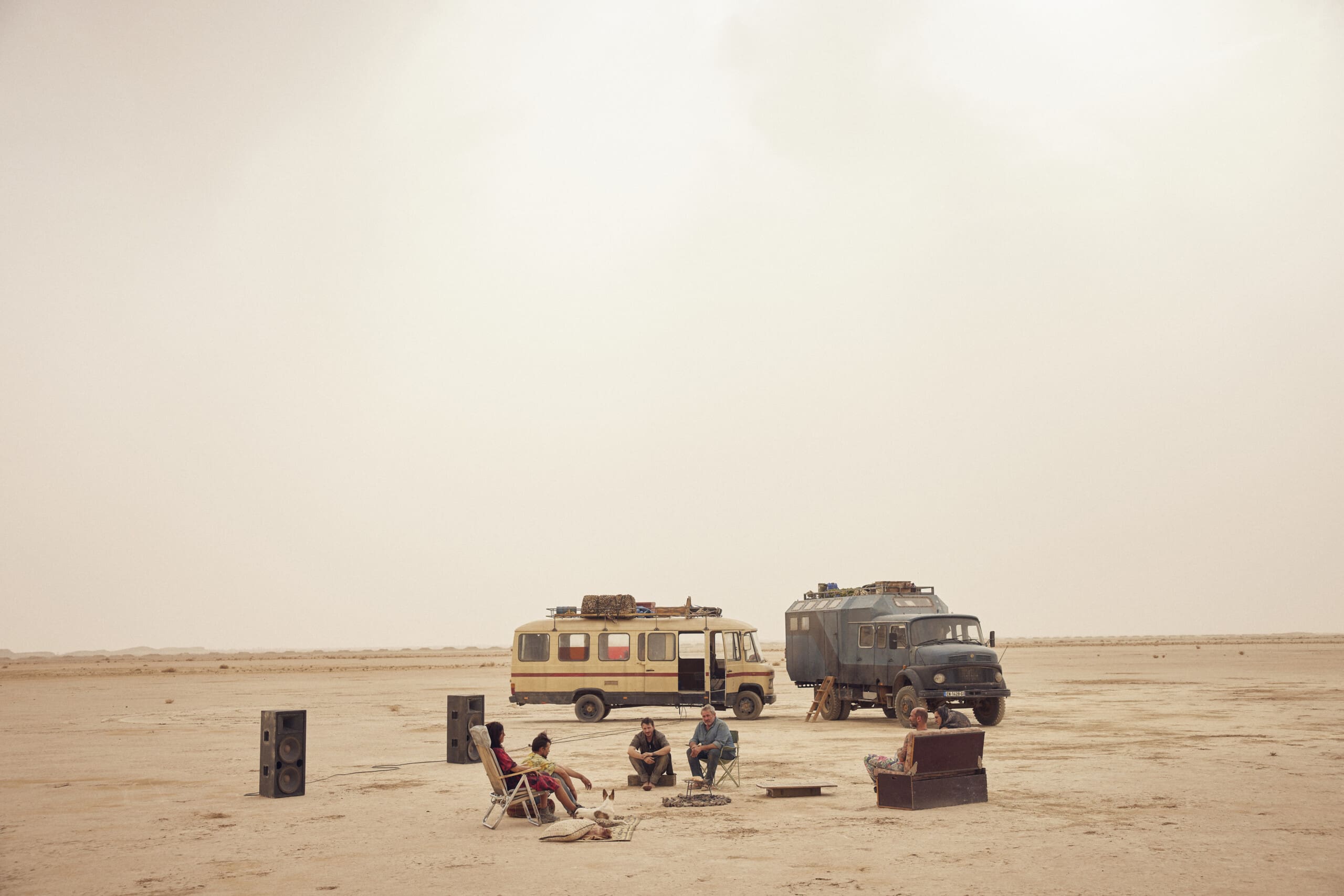
The new film Sirât, directed by Oliver Laxe and nominated for Best International Feature at this year’s Oscars, begins with a title card defining it. An Arabic word, in Islam, it signifies the narrow, treacherous bridge everyone crosses in order to go from life in this world to paradise. While the righteous make it safely, the unworthy fall into an eternity of hellfire. And while Laxe’s film is not quite so abstract in exploring this journey, it is often unbearably tense and filled with moments of devastating loss.
For the most part, the plot centers around Luis (Sergi López) and his son Esteban (Bruno Núñez Arjona). We first meet them wandering through a rave in the Moroccan desert in hopes of finding their missing daughter/sister, who disappeared five months prior. However, before that, our first impression is of Kangding Ray’s pulsing, growling score. Before we even see the mass of people dancing to its driving, undeniable rhythm, we experience it reverberating off of high desert cliffs. In that way, it becomes elemental—perhaps even mystical—and it makes it even more jarring to see a clean-cut middle-aged man and his young son weaving through this blissed-out crowd of EDM disciples.
Still, even as out-of-place as the pair initially seem, when the military prematurely shuts down the rave and reports suggest a new world war may have begun, Luis and Esteban quickly latch onto a set of attendees who plan to travel across the desert to another rave where Luis may find his daughter. So begins Sirât‘s growing sense of danger. Can they trust these people? How do we know these ravers, with their retrofitted bus and military vehicle, won’t leave Luis and Esteban stranded in the desert in their tiny minivan? Indeed, Luis’s own behavior to the group reflects that mistrust. When Esteban suggests they share their chocolate with the group after the ravers shared their dinner, he resists, arguing that they have to take care of themselves first on this long journey.
However, the longer the group travels together, the more fraternal their connection becomes. When the minivan gets stuck at a river crossing, the ravers seem to abandon them only to return to tow them across. When Esteban’s dog, Pipa, accidentally ingests some of the ravers’ LSD, they help nurse her back to health. When they stop for the night to rest, Tonin (Tonin Janvier), dresses up his leg stump in sunglasses and uses his prosthetic as a guitar to entertain the group. Thus, in the film’s first half, Laxe and co-writer Santiago Fillol lull the audience into thinking that even if Luis can’t restore his biological family, at least he’s found a new one with these ravers. That is, until the trio of vehicles begin navigating a narrow, uneven road that winds through the mountains.
That section of the film becomes something akin to 1953’s The Wages of Fear or 1977’s Sorcerer. Suddenly, Luis and Esteban’s little minivan seems like an asset, as the larger vehicles’ tires ride dangerously close to the edge. When Jade (Jade Oukid) looks out of her window to see the ground hundreds of feet down over the sheer, crumbling cliff edge, the viewer can’t help but feel a little sick. That nauseated feeling only intensifies when they’re caught on that road in the rain at night and one of the vehicles becomes stuck. The tension builds as the group tries to free the vehicle and the sense of foreboding we feel as Esteban and Pipa play too close to the edge or the group gather behind the trapped vehicle to push it is nearly unbearable.
And because every danger up to that point never manifests in tragedy, we hope that the same will be true here, but Sirât takes a turn at its halfway point and the rest is so tense and upsetting that it’s possible that even the film’s stellar production and cast will not keep some viewers from turning on it. However, its in the way Laxe’s film sits with this terror and trauma that it becomes meaningful and powerful.
Certainly you can look at Sirât as a statement that life is constant tragedy and loss. You can also look at it as a testament to the way empathy, community and kindness make life bearable. You could even look at the film simply as a bleak drama not necessarily trying to say something larger about life. Really, you can take whatever meaning you want from it. And isn’t that the point of faith? Isn’t that the point of art?