
Written by Molly Minnium
If you’re looking for a happy ending Valentine’s Day movie, Wuthering Heights is not it. Full of drama and devastation, this adaptation trades romantic fantasy for passion that feels as destructive as it is intoxicating.
Margot Robbie’s haunting and intense performance of Catherine “Cathy” far outshines Jacob Elordi’s portrayal of the brooding Heathcliff. Elordi leans heavily into silence, allowing tension to simmer beneath minimal dialogue. While that approach occasionally risks emotional distance, it strengthens the portrayal of Heathcliff’s transformation into something colder and more dangerous. Still, the emotional groundwork laid by Owen Cooper as young Heathcliff is what truly gives the character depth. Alongside Charlotte Mellington as young Cathy, Cooper’s raw performance beautifully captures the intensity and innocence of their bond before it turns into obsession.
The film refuses to romanticize their early years. Wuthering Heights is not a whimsical childhood playground; it is unstable, violent, and emotionally neglectful. Heathcliff grows up as both dependent and unwanted. A beggar taken in by Cathy’s father, he endures a cruelty from him that marks him physically and psychologically. Cathy’s closeness with him emerges in response to that brutality, they hide from the world together and they cling to one another for survival. Cathy’s attachment to Heathcliff grows in response to her father’s abuse. They share rooms, secrets, and stolen moments of quiet in a house that never feels entirely safe.
As years go by, atmosphere becomes the film’s most powerful storytelling device. Wuthering Heights is filmed in dim interiors and constant rain and wind, the moors stretching endlessly under gray skies. The house itself feels damp, dark and suffocating. That oppressive tone makes the shift to The Linton’s home even more striking. Edgar Linton (Shazad Latif), portrayed as polished and composed, embodies everything Heathcliff does not: stability, wealth, legitimacy. Edgar arrives and Cathy is immediately obsessed with the idea of being called on. When she impatiently ventures to the estate, the change in scenery is jarring. The Grange bursts with light, color, and warmth, flooding the screen. Floral gowns replace torn, stained clothing, birds chirp where the wind once howled and the contrast is more than obvious.
Her attraction to Edgar is not framed as passionate love, more as a way out. He represents upward mobility, protection from poverty—all things Cathy never thought she’d have. When she accepts Edgar’s proposal, the film avoids melodrama, there is no excitement or overwhelming happiness. Instead, the emotional rupture is quiet and devastating. Heathcliff overhears only fragments of Cathy’s emotional conversation with her maid Nelly (Hong Chau), enough to wound him, not enough to understand her full confession. She tells Nelly of her heart being torn between the two men, but that marrying Healthcliff would degrade her. After hearing this, Heathcliff takes to horseback and literally rides off into the sunset. His departure feels abrupt, like something torn violently rather than concluded.
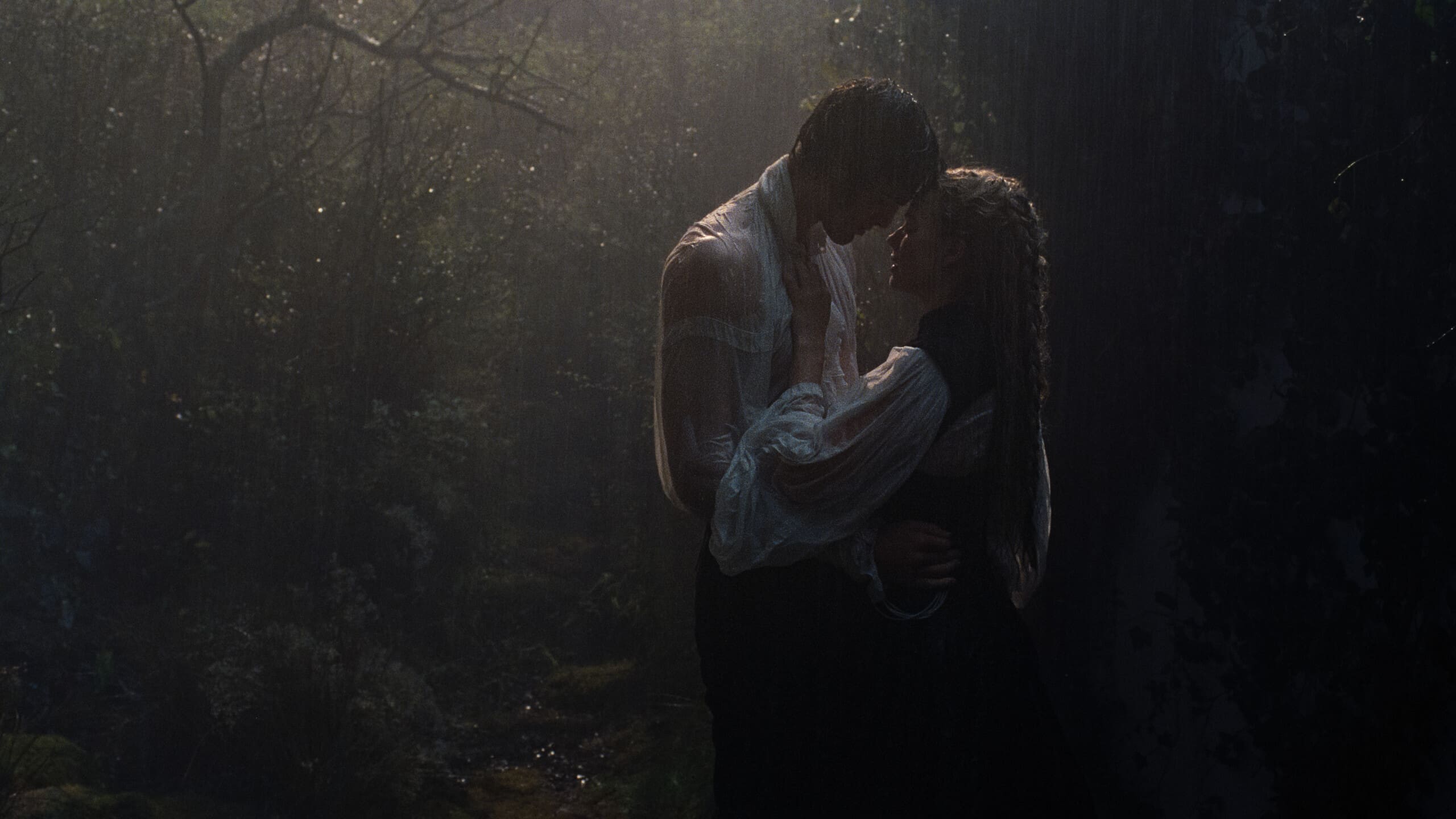
Cathy goes on about her new luxurious life, seemingly happy, but secretly devastated by the loss of her true love. When Heathcliff returns years later, the transformation is unmistakable. He is groomed, controlled, handsome and carries himself with a quiet authority that replaces boyish vulnerability. Yet beneath that composure simmers resentment. His reunion with Cathy is electric, not softly nostalgic, but unresolved fury wrapped by desire. The chemistry between Robbie and Elordi intensifies here, their proximity charged with accusation as much as longing.
Their renewed attachment unfolds in secret—not as romantic triumph—and it isn’t satisfying. Instead, it shows how easily passion becomes territorial, as Heathcliff’s jealousy sharpens into something animalistic. Their intimacy carries weight, but it also carries threat, what might be celebrated as epic romance in another adaptation feels here like two people unable to stop hurting one another.
This corrosive dynamic extends outward. Heathcliff begins an involvement with Isabella (Alison Oliver) after Cathy tries ending their affair, introducing a whole new layer of emotional violence to their relationship. His motivation is made clear to Isabella that the only desire he has is to wound Cathy as deeply as he believes he has been wounded. The film strips away any lingering mystique around Heathcliff’s romantic appeal.
Cathy begins to unravel at the news of Healthcliff’s new union with Isabella. In a life surrounded by light and luxury, she appears increasingly hollow. Her agony makes her sick physically and even sicker mentally, seeing and hearing things, talking nonsense to Nelly. Her illness gets past Nelly, who thinks she is dramatizing her loss of Heathcliff.
Ultimately, the film challenges the soulmate narrative at the heart of Wuthering Heights. Cathy and Heathcliff repeatedly insist their souls are the same, but this adaptation interrogates that idea. When love demands possession, when identity depends entirely on another person, what remains of oneself?
Visually, the conclusion reinforces that bleak question. The moors remain vast and indifferent, the wind never softens, and there is no golden-hour redemption. Instead, the film leaves viewers with a haunting stillness—the sense that some passions burn too hot to survive.
Wuthering Heights is not interested in comforting its audience or providing a happy ending love story. It is interested in unsettling them. By emphasizing atmosphere, class tension, erotic intensity, and emotional brutality, the film reframes a literary classic as something far more disturbing than romantic.