Written by Molly Minnium
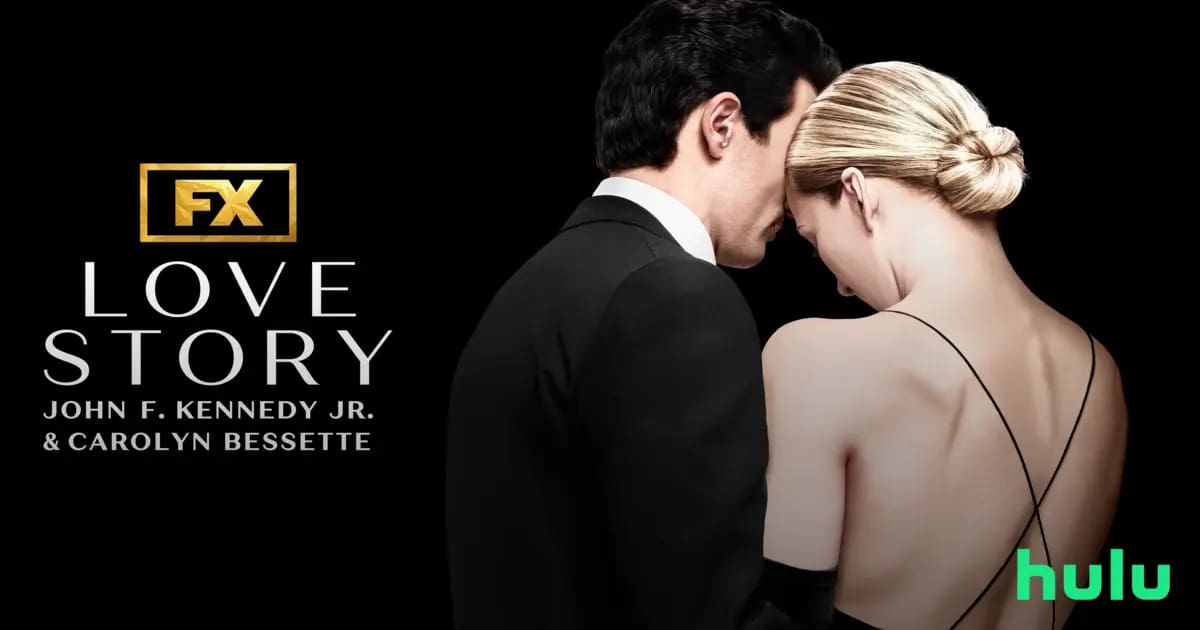
Every episode of Love Story will leave you wanting more, in the same way Carolyn Bessette herself is so accurately described throughout the series. She’s magnetic but guarded, affectionate but unreadable and always just slightly out of reach. The series mirrors that energy, crafting a romance that is less about grand gestures and more about what happens behind closed doors, subtle glances, and screened phone calls; it emphasizes the space between public image and private truth.
The Ryan Murphy produced series, currently streaming on Hulu, opens with a disclaimer stating it is merely “inspired by actual events” and reminds us that certain depictions have been “dramatized or fictionalized for storytelling purposes.” It’s an honest admission that turns out to be quite an ironic one. The story that follows is based on people’s lives who were endlessly dramatized and fictionalized by tabloids and the public imagination. The show exists in that same gray space that it critiques. It recreates figures who already live in America’s collective memory, while simultaneously exposing how that memory was constructed in the first place.
The series doesn’t begin with romance but on July 16, 1999; immediately grounding the story in its tragic endpoint. Paparazzi crowd outside a nail salon as Carolyn (Sarah Pidgeon, I Know What You Did Last Summer) appears visibly overwhelmed before her and JFK Jr. ‘s (Paul Anthony Kelly, Body Language) fatal flight to Martha’s Vineyard for a family wedding. It then abruptly jumps back in time to 1992 before the pair met. The series, just four episodes in, has already planted subtle clues pointing to John’s growing interest in aviation, a quiet thread that foreshadows the tragedy we know is coming.
While the writing and structure establish the emotional foundation, the performances bring it fully to life. Sarah Pidgeon plays Carolyn so well with a quiet emotional restraint that emphasizes her avoidant tendencies. She steers clear of caricature, instead leaning into gestures like a raised eyebrow, a paused response, the smallest shift in body language, to communicate Carolyn’s guarded nature. There’s a confidence in her performance that mirrors the character’s independence, but she also allows vulnerability to surface in moments of anger and doubt. The fourth episode left off with Pidgeon trying to control her emotions when discovering the publication of her and John’s relationship. It is expected and anticipated to see where she continues to take her strong emotions in this role.

Paul Anthony Kelly, in only his second major role, takes on the daunting task of portraying one of America’s most recognizable figures. Rather than attempting to mimic JFK Jr., Kelly focuses on his internal conflict, the tension between legacy and identity, public expectation and private longing. At times, his performance feels slightly restrained, but that hesitation ultimately serves the character, reinforcing a man constantly aware of being watched.
The show strategically reinforces this emotional contrast through its visuals: warm, golden lighting floods intimate scenes, but step into an office or a Kennedy family dinner and the tone shifts colder and sharper. Public life is fluorescent, while private life glows. The series does an excellent job at pulling in the young adult demographic they’re clearly targeting using songs like “Fade Into You,” “No Ordinary Love,” “Linger,” and “Lover, You Should’ve Come Over” to heighten the emotional weight of each moment and allow viewers to truly feel what the characters are experiencing.
Across its first four episodes, the series carefully builds the backstory behind their relationship. Their first meeting at a Calvin Klein event is layered with tension, John publicly photographed on the red carpet while Carolyn slips in through the back with a designer friend, already signaling how differently they move through the world. Their flirtation continues at her office when he shows up asking for a new suit, forcing proximity during his fitting. At the same time, John’s unresolved relationship with Daryl Hannah complicates everything, her desire for marriage and permanence contrasts sharply with Carolyn’s reluctance to define anything too quickly.
As John works to launch George magazine and step out of his father’s shadow, pulled between legacy and independence, while Carolyn navigates her own rise at Calvin Klein. Jackie Kennedy Onassis’ (Naomi Watts, The Impossible) declining health adds emotional gravity, culminating in her death, a moment that strips John of his public armor and pushes him toward Carolyn. Even as their connection deepens, the outside world closes in, from anonymous letters questioning Carolyn’s motives to paparazzi catching them on a boat and splashing headlines across newsstands.
Kelly Klein (Leila George, Animal Kingdom) captures the weight of that reality when she tells Carolyn, “Shiny people like that, they belong to everyone.” John isn’t just a man, he’s an inheritance and a beloved public figure that his family and America will do anything to protect. Even his grief becomes communal; when Jackie dies and he steps out to address reporters and paparazzi the very next morning. The show makes it clear that he never fully belongs to himself.
Carolyn on the other hand is so sure of herself it makes John envious. She is unimpressed in a way that feels powerful, not dismissive. She makes him come to Calvin Klein to see her, doesn’t give him her number, she leaves dinners early and bed before he wakes up. John is used to being chased, but now he’s the one running after Carolyn.
If Love Story falters at all, it’s in its pacing. At times, the deliberate slow burn borders on repetition, particularly in scenes that reiterate the same tension between public life and private longing. It drags the tension out too long that it almost simmers out, and before you’ve even realized, two years have gone by. Some viewers may find the narrative restrained to a fault, craving more dramatic escalation. But the show remains thematically consistent, never abandoning its central question: how do two people build something real when the world insists on mythologizing them?
Ultimately, Love Story is less interested in recreating headlines than in exploring what those headlines cost. The series frames their romance, not as a fairytale, but as fragile, something easily torn apart by tabloids. In that way, Carolyn becomes the emotional center of the story, never being fully defined or fully consumed. Carolyn always leaves not just John wanting more, but the audience as well. And that is exactly what this show does at the end of each episode.