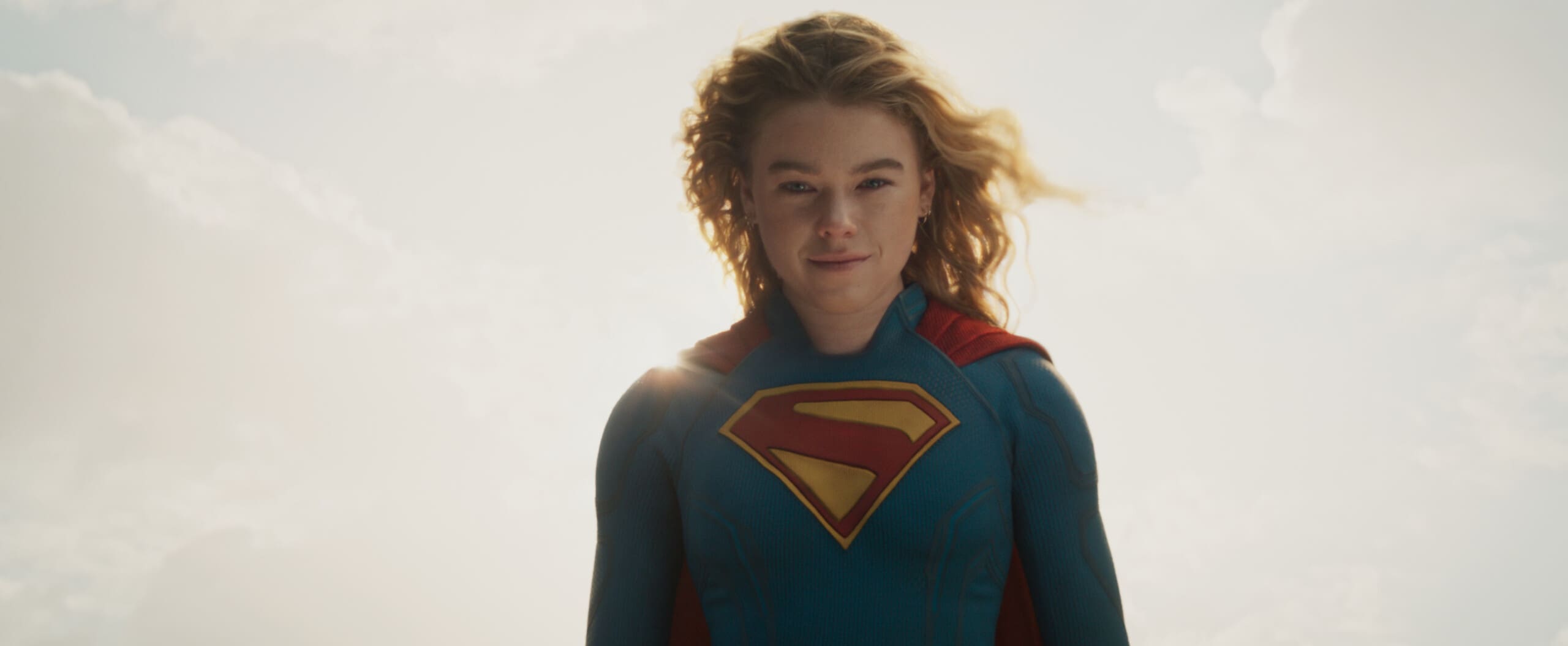
Craig Gillespie’s Supergirl reintroduces fans to Kara Zor-El (Milly Alcock) while aiming to reveal more of her backstory and tell a story about belonging, but essentially, the film just plops Supergirl into Guardians of the Galaxy and threatens to kill her dog. While taking place just after the events of Superman, Supergirl attempts to set itself apart from last year’s film, just as Kara tries her best to separate from her goody-two-shoes cousin.
Kara has left Earth, choosing to hang out in red sun galaxies where alcohol can affect her—and that it does. In scenes very reminiscent of Star Wars, Kara is seen celebrating her 23rd birthday for days on end alone, except for her trusty dog, Krypto. It’s at one of these bars that a drunken Kara first meets Ruthye (Eve Ridley), a young girl determined to avenge her entire family, unjustly slaughtered by the Brigands, a group of all-male space pirates who look like they lost their way looking for the Mad Max set. When their leader, Krem (Matthias Schoenaerts), hits Krypto with a poisonous dart that leaves him with 72 hours to live (side note: how come days and hours are the same on every planet in this universe?), Kara and Ruthye find themselves with the same goal of tracking down the Brigands, much to Kara’s dismay.
In true superhero fashion, Kara clearly prefers to work alone (her favorite line is “wait here”), but she’s, of course, lucky to have a team behind her. And lucky for the audience, the most unexpected character (also hunting down the Brigands) is Jason Momoa as Lobo, an intergalactic, motorcycle-spaceship-riding bounty hunter meant to be “destroyer of worlds,” but, instead, feels like Ares in a young adult film. Still, Momoa is so engrossing as Lobo that he easily becomes more than a cameo.
The plot of Supergirl is thin at best; Gillespie clearly hopes to distract his audience with revelations of shared trauma among the characters. He tries hard to make Supergirl a film about grief and found family, but never lets those heavier moments have the time they need to truly deliver. For their part, Alcock and Ridley have great chemistry, making for a fun, unlikely duo, but Gillespie doesn’t give them the scenes they need to truly shine. Kara and Ruthye both think they are going through grief alone, that no one could ever relate to, so they push each other away. While this is a natural response to grief, Gillespie focuses much of the film on this response, rarely allowing the two to truly connect. Instead, what should have been moments of heartache, connection, and triumph—like Kara insisting (over and over again) that revenge will never make Ruthye feel better—simply play out as cheesy.
Despite the lack of direction, Supergirl is still an entertaining film to watch, thanks in large part to the choreography, effects, and cinematography of the fight scenes (something Gillespie was probably banking on to move this film forward). Rob Hardy creates some beautiful oners that pull the audience straight into Kara’s fights and the ambience of the world, while almost always partnering with Gillepsie to create funny moments in the background. One particularly fun scene comes when Kara fights teleporting space pirates, giving the filmmakers great effects to play with, as you can’t help but feel engaged as you watch Kara and the pirates teleport from place to place while fighting.
While there isn’t much meat to it, Supergirl is engaging and fun, especially in a theater. It doesn’t seem to add much to the new DC Universe, but that’s also what makes it approachable to new fans. It’s clear Supergirl is meant to bring DC up to Marvel’s level of multiverse, but it could have done with a few more rounds at the drawing board. Alcock has it in her to become a great feminist icon for this new generation, but the film was too busy trying to do too much to let her truly shine.