This interview series spotlights the bands performing at Asbury Jams every Thursday at The Wonder Bar in Asbury Park, New Jersey, throughout the summer. Produced by ElmThree – Asbury Jams brings rising local, regional and national touring bands from the jam scene to the City that Bruce Built.
One great thing about the jam scene being so nebulous and amorphous is that all sounds from all over the world can find a home in it. Toubab Krewe, hailing from North Carolina, are fine purveyors of a multitude of musical genres. However, their signature sound has its roots firmly planted in West Africa.
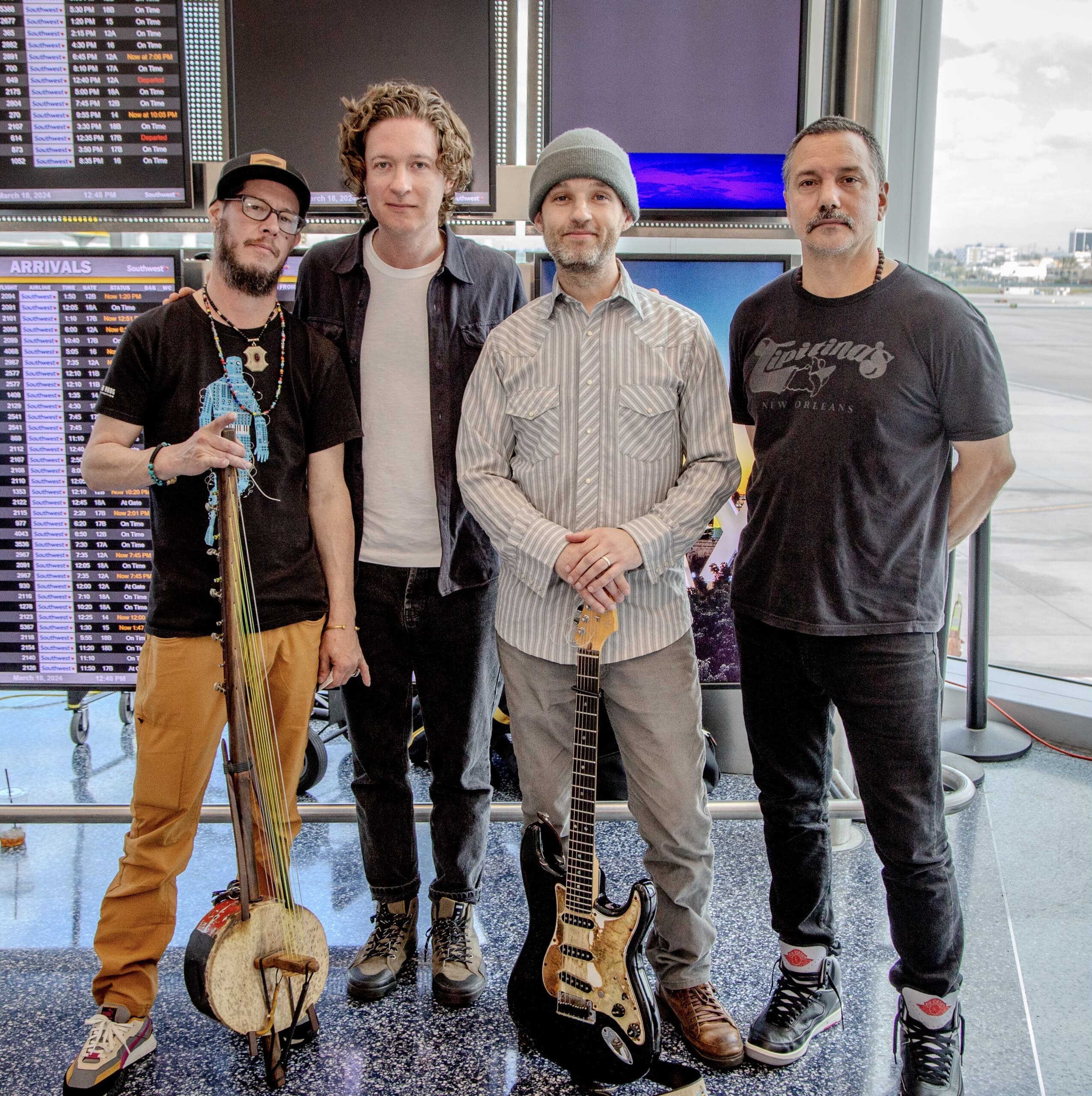
This group of friends, who’ve been performing together (in some form or fashion) since childhood, have been on a generational adventure of learning, creating and crafting highly unique and unabashedly infectious music. And this Thursday (July 9) they return to The Wonder Bar in Asbury Park, NJ to perform. We caught up with Drew Heller to discuss the origin story of the band’s sound, their love of creation and more.
Drew Heller and Justin Perkins are proud residents of Asheville, North Carolina. The town was hit by Hurricane Helene in 2024 resulting in over 100 deaths and massive destruction of the city. While Asheville is recovering help is still needed. If you want to help the residents of Asheville via donation or by sharing the word via social media, please check out the Beloved Asheville charity.
Talk about the wild array of sounds that Toubab Krewe incorporates into their music, and where you got inspiration from?
We’ve been playing together a long time since we were in elementary school. Justin Perkins and I, and Luke Quaranta, since the late ’90s. We grew up playing so many different styles. We’ve been immersed growing up here in western North Carolina with old-time Appalachian music and Piedmont Blues styles. So much traditional music has its roots in early Black American music—the repertoire, styles, and even the instruments themselves.
Skipping forward a little bit we got introduced to it by great teachers and friends. I was initially introduced to this style by my little brother’s drum teacher, who gave me the album Gongoma Times by the band Fatala. They’re a group from West Africa, and it’s just a drum ensemble with one electric guitar. That was the first time hearing traditional West African music. Then in high school we had this great friend Gordon Ray, who was leading drum workshops in Asheville. He’s a drum builder as well and was bringing artists through Asheville to teach. He shared with us the more orchestral ensembles, like percussion from Le Ballets Africains also based out of Guinea, West Africa. So during all that time, we were playing in instrumental music ensembles usually in a trio format, but some larger bands.
We were playing everything from like, surf rock to gypsy swing to Hendrix. We had our older siblings, record and tape collections [so we listened to and played] Zeppelin and psychedelic rock mixed in there. Also being 13 in 1993, you can imagine all the influence from such a great era of hip-hop. Production and instrumentals and grunge and ’90s rock and all that bombast and angst and stuff was pretty influential at that time. Around ’98 was when we met Luke Quaranta, our drummer at Warren Wilson College here in Asheville. Luke had similarly grown up listening to West African drumming and music. So we started playing music together pretty much immediately after meeting.
We had a traditional drum and dance ensemble that we played in together a lot in ’98. We just kept experimenting and collaborating. We had the great fortune and opportunity to travel together to Guinea and Cote d’Ivoire. We were invited by friends and teachers who had come through Warren Wilson College to teach drum and dance. It was an amazing experience in 2001. We all traveled together to Conakry, Guinea, and then to Abidjan, Cote d’Ivoire.
I initially thought I was going to study. I was interested in studying kora, the 21-string harp, and the balafon. I initially started out studying those instruments, but I’d brought a guitar. I realized very quickly that I was just as much of a beginner on the guitar, even though I’ve been playing it my whole life. In 2001, we met Lamine Sumano and he’s become a really good friend and an amazing teacher. He’s been our mentor since we met. He immediately gave us such wonderful advice musically. He told us there are no borders in music. It’s “sans frontier.”
We were learning traditional music and forms, but he wouldn’t teach us any soloing. We learned solo phrases and solo accompaniments, but not the soloing. He encouraged us to trust our own voice and be real with ourselves, and not learn anyone else’s soloing. That was such great advice and it was also very freeing from potential mental stumbling blocks for a young musician trying to learn a new music and new style. And, I’m eternally grateful for that. In 2004, we had spent a pretty long time in Bamako, Mali. I’ve been playing in some other instrumental ensembles, but we just started feeling that we wanted to start a new band to bring all of these influences together. All of this energy focused into one place and so it’s still the project that is a continuation of of this thing we’ve been doing creatively since we were kids.
There’s no fixed direction exactly. We’re just trying to nurture it and let it evolve as the years go by, and take care of the music as much as possible. That’s some other great advice we got — take care of the music and the music will take care of you.
That’s interesting because your debut record is 21 years old. I talk to bands and they look at their debut album as a jump-off point, but they change so much and comment on how raw that first record is. However, with your band it seems like you were tasked with a stewardship of this music where you have to nourish the album you create.
I think so very, very much to always respect the music and their tradition and to be direct and true with our our spirit in the participation in the music. I remember our teacher, Lamine Sumano, came to the States to tour with us. There had been a few years that we had been touring since he had seen us last. We had been playing non-stop, year-round and our live show was high-cylinder. It felt great, but he also pointed out, the importance of being able to improvise. There’s always been a lot of improvisation in it but we’ve also been very influenced by and love the arrangement side of things—the breaks and composed sections. That was also advice we took very deeply: to allow ourselves and remind ourselves that it’s okay to deconstruct things or let go of the idea that even if we spent months or years building a song in a certain direction. It’s okay for things to evolve in a different way, and try things and not worrying about about recitation.
It’s interesting because you guys are very learned, learning from all these masters of the craft. So when he tells you that, how hard was it to be like, “Okay, I guess we gotta try and improvise now.” Was it difficult or was it a light bulb moment?
It was great. It felt great because we started out improvising so much that it felt natural. It felt like we were sort of being reminded of our gravitational center. I think it was more of a teacher noticing a student and helping us continue to learn and grow.
I was reading this interview Luke did with the Santa Cruz Weekly and he mentioned new music was on the horizon. That was from early last year. So now, here we are in the middle of 2026, is there new music that’s been recorded? And can people coming to The Wonder Bear hear it?
I think as far as it being ready to release … I think another season away.
So it’s more of an autumnal release?
We’ve recorded a lot. It’s possible that we’ve started too many songs, and we just have too many irons in the fire, and we just need to get back in the studio and make some tough decisions about what we’re not trying to work on.
You could totally pull a Use Your Illusion 1 and 2 this one if you want, so no one’s stopping you in this day and age.
Yeah we could do “December Rain.”
If you have a song that comes out in your next album called “December Rain,” I will laugh my ass off in the best way possible. But going with that nurturing vibe. It’s been a long time since you’ve had a new record so how do you feel this continues the band’s musical journey? Is it like, ‘Hey, if you’ve heard the first record you could expect the same,’ or is there some new stuff that you guys are bringing in? I know you guys are prolific musicians.
There are definitely new songs that we’re performing. For example, there’s key synth, key bass, and our bassist also plays another keyboard, so he’s got two keyboards, and I’ve got one. So we’ve sort of started adapting some different timbres than we’ve had in the past. Our drummer’s setup has evolved a lot. This whole sound has changed a good bit, depending on when the last time someone’s heard us.
If you heard us last year it won’t be like a shock what it sounds like. The core feeling of the band is the same, but the music itself has been changing a lot. We just never exactly know what it’s gonna be like. We have a group intention that’s not spelled out; it’s an adventure, basically.
And is that a joyful one for you?
Naima: It is my favorite thing. I love it so much. Creating space for new things to happen that you could not have predicted — it’s the best. And it’s worth the risk. A lot of times the most magical musical experiences seem to happen on the edge of failure or in the embers of failure that just occurred.
If you’re really pushing yourself and allowing something to move in the music that hasn’t happened before it can be a little awkward. Or a little off balance. But I find that’s usually when things most come to life: out of when you’ve let go enough. You’re not trying to control it anymore, and the music’s just kind of happening. It’s a thrilling experience, and I really do love that very much.

What is it that you love about being in Toubab Krewe that’s kept you going for over 20 years?
I’m so grateful to be doing this. We grew up dreaming of it. So, just to be living this amazing, wonderful experience for all of its ups and downs, it’s amazing. To have the opportunity to travel and visit with people and places, all across the world … primarily North America is where we mostly tour … I love it now, as I did when I was a kid.
We’re great friends, so it’s a joy to be in a creative environment with your best friends that you’ve been playing music with forever. It’s a wonderful thing, I’m very, very grateful.
Alright, this is my last one, this is a little bit of an easy one. So, outside of obviously playing Asbury Park this Thursday, what are five things that you’re stoked for for this band for the rest of this year?
I am excited for all of it. We’re playing a light touring schedule. We’re not doing any long tours this summer. It’s a handful of shorter runs, and I’m excited to spend some time practicing and writing with my bandmate, Justin Perkins, who lives here in Asheville as well. This time of year is a great time to sit outside by the river or wherever and and just pick tunes
We’ve got some Asheville hometown shows coming up. That’ll be really fun. We’re headed out to Oregon a couple times. We love being out west. It’ll be great. And of course, this coming weekend, we’re very much looking forward to being in the Northeast.