Written by John Aspler
As House of the Dragon Season 3 comes to a close, Tumbleton explodes when Westerosi WMDs go off. In an action-packed finale that is largely a return to form after some less engaging outings, we’ve got everything: parleys, mutually assured destruction, resurrections, witches, treachery, dying for the dragon queen, descents into darkness, and so much more! Without further ado, let’s dive into the finale and reflect back on an exciting if at-times uneven season – spoilers abound.
This season’s central themes (or perhaps warnings) can be summed up like this:
1. Beware the corrupting influence of power.
2. Beware the hubris of rulers and their disdain for the smallfolk.
3. Beware the futility of trying to control the uncontrollable.
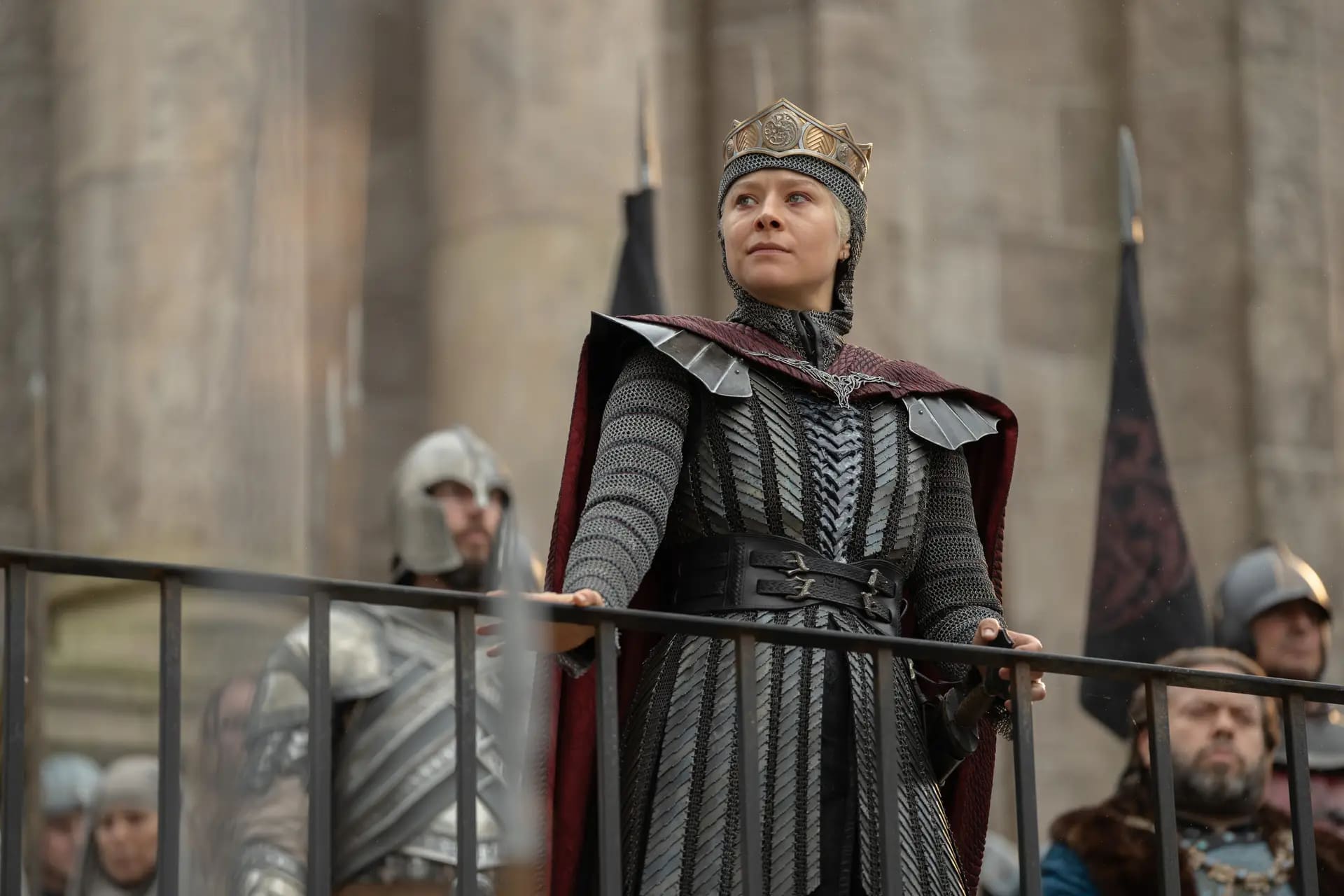
As it turns out, dragons are tied to all three! Dragons are power made flesh, and access to them has convinced the Targaryens that overwhelming force can solve their political problems – something that Rhaenyra (Emma D’Arcy, Truth Seekers) comes to believe in this episode. Her graffiti-fueled paranoia reveals the hubris of a ruler who increasingly treats those around her as expendable. As Baela (Bethany Antonia, Get Even) bluntly argues: “If a person is useful to you, you wield them. But if not, you abandon them…”
At the same time, dragons are an expression of power’s limits – it’s hard to avoid killing innocents when deploying nukes. Every attempt to use them as instruments of statecraft has ended the same way: dragons resist, panic, or kill and destroy more than their riders intend. In the very first episode of House of the Dragon, King Viserys (Paddy Considine, MobLand) told Rhaenyra that “The idea that we control the dragons is an illusion. They’re a power man should never have trifled with. One that brought Valyria its doom.”
The more power Rhaenyra accumulates, the less mastery she appears to possess – not only over dragons, but over herself. As Alicent (Olivia Cooke, Katie Says Goodbye) told her near the start of the season: “You may not rule and remain yourself.” And as Helaena (Phia Saban, The Last Kingdom) told her last episode: “You now have many dragons. Are you… not altered?”
But the season’s themes extend beyond Rhaenyra and those attempting to rule. Characters with significantly less power have each sought a certain kind of death as the only means of taking control in a world of dragonfire and destruction. Criston Cole’s (Fabien Frankel, Task) nihilism, Roddy the Ruin’s honour, and Helaena’s despair all lead them to the same end: each seeks death on their own terms. This is a somewhat grim conclusion, that for those without meaningful political power, death becomes one of the few forms of agency they can still claim. Even then, not so for Criston Cole, for whom no songs will be sung and who did not die gloriously in battle.
Roddy the Ruin (Tommy Flanagan, Sons of Anarchy) is an instructive example of both this season’s weaknesses and the strength of its narrative focus. Roddy, the leader of the Winter Wolves, exploded onto the scene at the start of Season 3 by memorably shouting “We’ve come to die for the dragon queen!!” after throwing Jason Lannister’s (Jefferson Hall, Oppenheimer) head at Daemon Targaryen’s (Matt Smith, Doctor Who) feet. The Winter Wolves are older “greybeards” from the North, sent by Cregan Stark (Tom Taylor, Doctor Foster) last season at the request of Prince Jacaerys (Harry Collett, Casualty), Team Black’s only competent diplomat, RIP.
They are ready to die gloriously in battle rather than become a burden to the people of the harsh, frigid North. And yet, viewers barely spent any time with Roddy; despite being a series regular, he had almost no screen time or dialogue. He is also one of only three familiar faces in his camp, the others being Oscar Tully (Archie Barnes, Stonehouse), the boy Lord of the Rivermen, and Black Aly (Annie Shapero, Red Skies), the archer who shot and killed Criston Cole. The show was likely banking on viewers’ having warm fuzzy memberberries about Winterfell and the Starks, with the Winter Wolves serving as shorthand for ‘honourable warriors;’ after all, they’ve come to uphold an oath to Team Black, the side most viewers were rooting for at the start of Season 3.
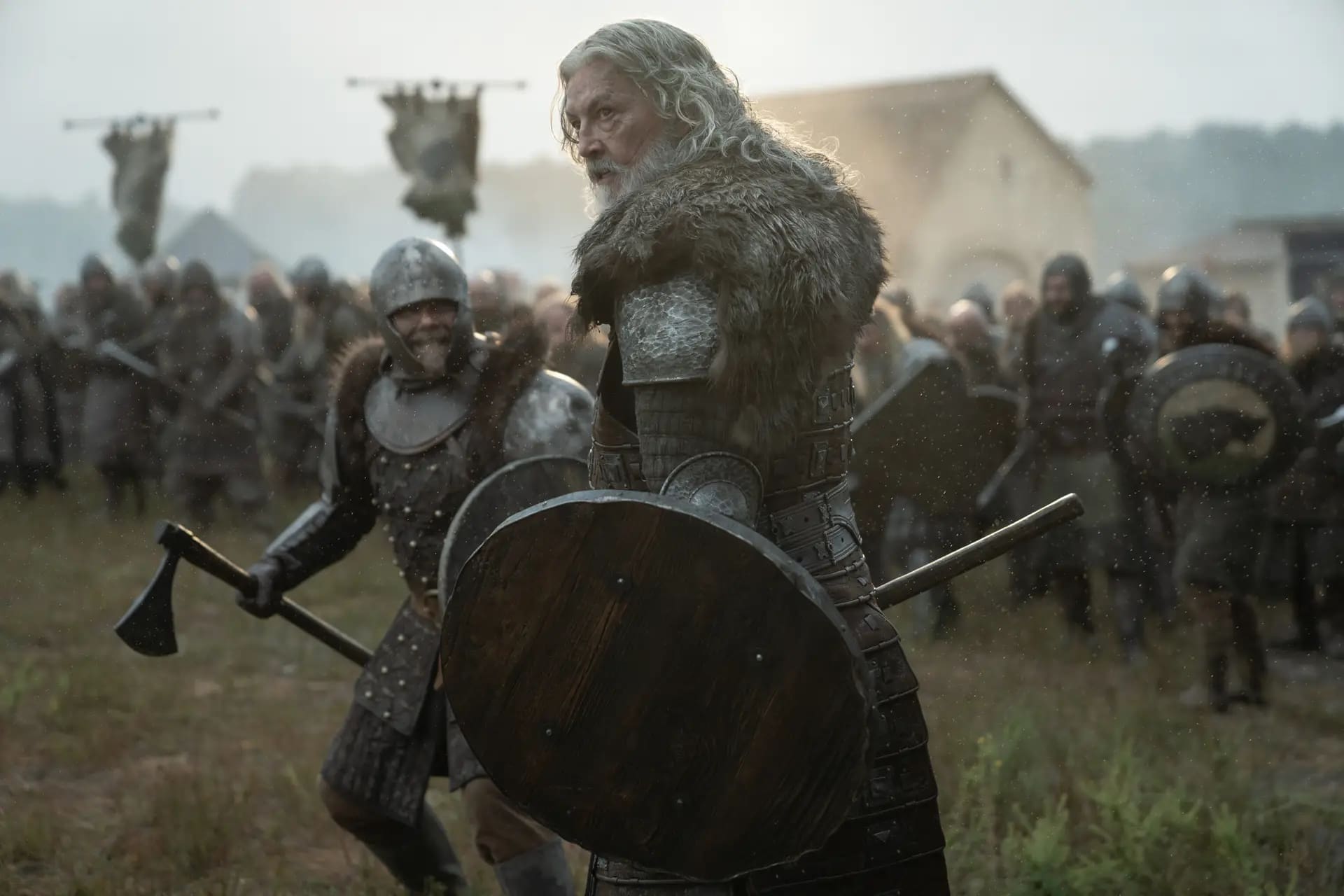
What doesn’t work is Roddy’s characterization – he just repeats his catchphrase all episode until he dies smiling in dragonfire, after shoving his sword up Ormund Hightower (James Norton, House of Guinness). It’s a flat characterization that provides a few laughs, but which mostly provides stilted and repetitive dialogue. What does work is how the show employs our positive memories of Ned Stark and Northern honour against us. We only see one person purposefully and unmistakably kill a meat-shield child (even Daemon hesitates and gives the children time to escape before Caraxes burns the gate down); that person is Roddy the Ruin, who axes a terrified child in the face after the boy hits him weakly with something like a small club.
Roddy axing a child serves as a microcosm of Season 3’s main narrative function: muddying the waters and moving audiences away from uncomplicated loyalty to Team Black. Before this season, there was no particularly compelling reason to support the Greens and King Aegon over the Blacks and Queen Rhaenyra, the latter of whom was clearly written as The Good Guy. Yes, she lacked empathy for the smallfolk in her youth, but our other option was Aegon: a serial abuser, a potential sociopath, and the physical embodiment of the Patriarchy – the show’s true villain, which Rhaenyra, as the potential first Queen of Westeros, was positioned to overthrow.
With notable exceptions, most of Team Black (e.g., Corlys, Rhaenys, Jace) were more sympathetic than most of Team Green (e.g., Cole, Aemond, Larys). And while Team Green remains awful, thanks largely to the introduction of Ormund (Season 3’s Big Bad), the focus on Daeron (Benjamin Evan Ainsworth, Son of a Critch), Helaena, and Gwayne (Freddie Fox, The Great) has provided viewers with people to root for on that side of the civil war. Meanwhile, almost everyone on Team Black except Corlys (Steve Toussaint, Before We Die), Addam (Clinton Liberty, Touchdown), and Baela comes away looking terrible, from Ulf the White (Tom Bennett, After Life – whose dragon explodes all over both sides) to Alyn (Abubakar Salim, Raised by Wolves – who does his duty and kills the High Septon) to Roddy – a funny, affable man, presented as a good guy on the right side; except, no, he’s a bloodthirsty old warmonger.
Final Thoughts – Hits and Misses
But nevermind the themes, what about the episode – was it any good!? Yes, thankfully, and audiences have much to look forward to in Season 4. But for now, here are the hits and misses:
- Hit: Spectacle! Tumbleton! Swords, fire, and treason – no one wins, war is hell! “If this be victory, I pray I never win another” – Corlys Velaryon (HotD 3×02).
- Hit: Sunfyre and Aegon’s (Tom Glynn-Carney, Dunkirk) not-so-graceful entrance and reunion with Aemond (“I’m alive, imbecile”). The best moment of the episode, which somehow took place at Harrenhal – a place almost no one ever has best moments – featuring the worst people you know. Alys and her tragic backstory can come too!
- Miss: Helaena’s death; to be clear, Helaena’s Season 3 arc has been tremendously well developed, and this writer certainly shed a tear when Alicent witnessed the butterflies. However, the moment is centered on Rhaenyra’s cold and unfeeling reaction, which makes it hard for a viewer to latch onto the sadness the moment should have evoked.
- Hit: Everything Rhaenyra – from the makeup and armour, to the horrific way she grasped Baela’s chin, to her deluded speech on the steps of the Sept. Amazing!
- Miss: Where was Alicent? For a show that has bent over backwards in very awkward ways to get Rhaenyra and Alicent into a room together, her absence from the episode was a glaring oversight – even just a glance to end the episode would have worked.
- Hit: Everything Daeron, Gwayne, and Ormund (RIP to the latter, but not really).
- Hit: Ulf’s treason(s) and his entire arc this season. Extremely believable betrayal! Was that a twinkle of Targaryen madness we saw in his eyes at the end of last episode?
- Miss: Hugh’s whatever he’s doing (sure, sure, he’s going to check on whether his wife has been fridged). He has not been well characterized this season and then he was pretty horrible to his wife who now is dead (RIP Kat, another regular with few lines).
- Miss-arya (haha): Mysaria’s sudden dismissal just did not make sense. Interviews with the showrunner seem to suggest that the war of wills between Mysaria (care about the smallfolk) and Daemon (burn them all) was won by Daemon, but after last week’s hookup, more was needed to motivate and explain this particular turn. Don’t fire the person who knows all your secrets! Even with severance pay! Bad move.
- Hit: Daemon may finally, of all Targaryens, understand the cost of dragon warfare. Centring Daemon’s perspective in Tumbleton, as everything slowly falls apart around him, was a smart move – especially when he began the battle so cocky and bloodthirsty.
- Miss: A bunch of character arcs did not have a resolution or cliffhanger this season (e.g., Rhaena, Larys, Tyland). Some of these secondary arcs were just not well served. This could have been a knock-on effect of the first two episodes of the season feeling more like the end of Season 2, leaving not enough time for Season 3 to breathe.
So, did House of the Dragon Season 3 succeed – did its arcs focused on power, control, and death feel earned?