Written By John Poveromo
If you were a child of the 1960s, Shelley Fabares may have felt less like a celebrity and more like someone you grew up with
She was Mary Stone on The Donna Reed Show, appearing in American living rooms during one of television’s defining eras. At 18, she somehow added pop star to the résumé when “Johnny Angel” went to number one. Eat your heart out Taylor Swift! Then came three movies with Elvis Presley — Girl Happy, Spinout and Clambake. There was Brian’s Song, One Day at a Time, and eventually another generation came to know her as Christine Armstrong on Coach, a role that earned her two Emmy nominations.
That’s the part of her life that belongs to everyone.
I was lucky enough to get to know a little bit of the part that didn’t.
About five years ago, when Dystopia Tonight was still relatively new, I had the chance to interview actor and activist Mike Farrell, best known as B.J. Hunnicutt on M*A*S*H. I hadn’t met Mike before, and I certainly hadn’t expected the interview would also introduce me to his wife, Shelley Fabares. She was there with him, mostly off camera, listening while we talked.
At one point she got up and crossed behind him toward their kitchen, and I instinctively called out, “No, don’t go!” Mike laughed, “I’m losing my audience!” After we finished recording, the three of us stayed on and talked. Shelley told me how much she had enjoyed the interview, and what began as a conversation with Mike became my introduction to her too.
We became fast friends, so not long after that, Shelley and Mike agreed to join my first annual 24-hour benefit stream I held for the National MS Society. Both carried themselves with a kind of humility that’s rare in this business. They donated, gave us their time and, instead of politely signing off when their allotted segment ended, stayed well past it just to help keep us all going, coming back in subsequent years to do it all over again for a good cause.
Booking and producing a 24-hour benefit with 80-plus celebrity guests is one thing. There are schedules that need to be rearranged last minute, outdated headshots that somehow still get used, etc. But nothing prepared me for people calling after the official poster went out and going, “Shelley Fabares is doing it?? Put me in her time slot!”
(Lookin’ at you, Bruce Vilanch.)
Shelley, meanwhile, talked to everyone as if the room contained no hierarchy at all. She listened, laughed, asked questions and gave other people space. I’m sure she knew how famous she was. She just never seemed to think fame entitled her to take up more of the room.
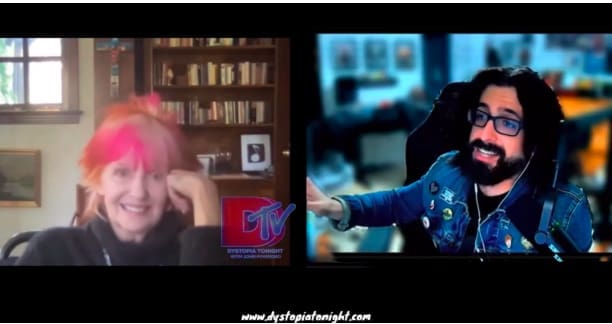
That became even clearer when Shelley eventually joined me for her own episode of Dystopia Tonight. The conversation lasted well over an hour. We talked about television, Elvis, her lovely marriage to Mike, old Hollywood, insecurity, grief, her health, activism and mortality. Shelley would occasionally stop herself after taking some wonderfully circuitous route through a story and apologize for going off in different directions.
(I kept telling her that was basically the point of the show as well as my favorite type of conversation.)
During the episode she told me about asking George Sanders for an autograph when she was young. He signed it, “To Shirley.” She kept the book for years and never forgot how that small mistake made her feel. Later, when she was the celebrity signing autographs, she made a point of writing real messages to people, even when staff tried to hurry her along. She never forgot what it felt like to be the person on the other side of that autograph table.
Shelley’s career began so young that she barely remembered deciding to have one. She told me her mother, who had been painfully shy herself, initially put Shelley and her sister into modeling because she thought it might help the girls overcome their own shyness. At three or four, Shelley found herself in a neighborhood fashion show. From there came extra work, television and movies. She joked about one early appearance in Bandit Queen, where she and her sister were essentially “the two girls on the other side of the fence with the cows in between.”
Then, at 14, came The Donna Reed Show.
She remembered those years with enormous affection. Looking at old publicity photographs during our conversation brought memories “flooding back,” and she talked about Donna Reed, Carl Betz and Paul Petersen not simply as castmates but as a family.
The remarkable thing about this was, Shelley, whose career looked, from the outside, almost impossibly assured, never experienced it that way.
When I asked whether there had ever been a point when she finally felt secure in the business, she didn’t hesitate.
“No. Never.”
She talked about periods when she considered walking away entirely. At one point she described herself as “an old penny” that just kept turning up.
That is an extraordinary description for Shelley Fabares to give of, well, Shelley Fabares. But to be fair, anyone who has spent their life in entertainment understands exactly what she meant. The résumé looks inevitable only after it’s written. While you’re living it, you’re still wondering if the phone is going to ring.
For someone who had spent most of her life surrounded by famous people, Shelley also never seemed to lose her own capacity to be impressed by somebody else.
Despite beginning her career as a child, Shelley remained incredibly shy. She idolized Sandra Dee and once became so nervous meeting Charles Kuralt that she could barely tell him how much his work meant to her.
And then we touched on Elvis.
Shelley wasn’t one of the screaming Elvis fans before they worked together. Jimmy Stewart was her guy. But she remembered the first time Elvis walked onto the soundstage. Nobody announced him. He wasn’t performing. No lip curling, no “One for the money, two for the show…” or anything particularly Elvis-like. He was simply walking across the room to come to work, and the room changed.
Everyone became quiet.
Shelley said he had so much charisma that his presence felt almost explosive. She remembered looking at him and suddenly understanding, “That’s Elvis Presley.”
What mattered to Shelley after three movies together wasn’t that she had been an Elvis leading lady, and it wasn’t some salacious story about a secret affair either, despite people apparently spending decades hoping she would give them one.
There wasn’t one to give. What there was, she told me, was a friendship. She called it “one of the most meaningful relationships of my life.”
Somewhere along the way, without ever seeming to behave as though she knew it, Shelley had become someone else’s Elvis walking across the soundstage.
She knew what it felt like to be awed by someone, and somehow never lost that perspective when she became the person others were awed by.
That humility also existed alongside a toughness Shelley sometimes had trouble recognizing in herself.
Her mother developed Alzheimer’s disease, and Shelley’s involvement in Alzheimer’s advocacy eventually forced this profoundly shy person to find a public voice. During our conversation, she recalled that work teaching her how to stand in front of people and express an opinion.
She also survived a devastating health crisis of her own. Shelley underwent a liver transplant after becoming critically ill. She told me doctors had made the stakes very clear: without the transplant, she was going to die.
The experience rearranged things.
“When you’re right in it,” she explained, “You don’t necessarily recognize the change happening. It’s afterward that you begin realizing the things you thought were important sometimes aren’t, and things you overlooked suddenly are.
Then there was Mike.
When Shelley spoke about Mike Farrell, you could hear what her marriage to him meant to her.
Their love story, appropriately, didn’t begin with some giant Hollywood gesture. They were attending a CBS affiliates event in San Francisco. Their last names put Fabares and Farrell near each other alphabetically, so they wound up talking. Later Mike asked whether she’d like to ride a cable car with him.
Shelley’s internal response was apparently sheer panic. “Catholic upbringing. Man. Cable car. What exactly are the rules here?”
Then she caught herself. “Shelley, he didn’t ask you to go to the South Pacific. He asked you to ride a cable car.” So she said yes, and that cable car ride became the beginning of their romance.
Dating apps today would kill for that kind of success story, and CBS did it with the alphabet and an affiliate event.
Shelley questioned so much about herself throughout our conversation, but never the love they shared. Meeting Mike wasn’t simply another chapter in her life. It was the moment the story changed shape. There was the life before him, and then there was the life they made together.
Toward the end of our conversation, I asked Shelley one of the questions I often use to close the show: What advice would she give her younger self if she could somehow go back and speak to her?
“Have courage,” she said.
She wished she had worried less. “If you have courage,” she told me, “you can kind of go ahead and go through things.”
Then came the deliberately ridiculous, very last, Dystopia Tonight question.
If this really were a genuine dystopia, more so than it is today, zombies, aliens, a comet, climate catastrophe, whatever finally does us in, and tomorrow was the last day on Earth, how would you spend it?
Shelley knew the answer.
She had mentioned a poem but quickly wanted us to know she had also thought about her last meal. A cheeseburger, quickly changed to a turkey burger, champagne and, importantly, real French fries.
Then came the really important part. She remembered a short poem she had carried around in her mind for years about knowing you would die tomorrow. She recited it from memory. It was about spending those final moments with the person you love, noticing a butterfly, looking at the stars and being conscious of the “silver seconds passing by.”
“I’ve kept that forever in my mind,” she said.
I had no idea when I asked that question that one day I would be sitting here listening to her answer after she was gone.
Earlier in the very same conversation, Shelley and I had talked about the strange immortality film and television give people.
I mentioned that sometimes I’ll be watching someone who has died and, for a second, forget they’re gone. They’re moving. They’re talking. They’re laughing. They’re so present that the brain briefly refuses to reconcile the image in front of you with the reality you know.
Shelley understood exactly what I meant.
She experienced it watching Elvis. She said she would find herself remembering all the things that happened outside the frame, the moments on set that the rest of us could never see. For a second the person isn’t historical. They aren’t somebody who was.
Shelley admitted she wasn’t very good with change. She said the most intense change of all is when somebody is there and then suddenly they’re not.
Now Shelley is the person on the screen.
I’ll be able to press play and there she’ll be again, telling me about Elvis, laughing about George Sanders calling her Shirley, talking about Donna Reed, the cable car ride with Mike, her old phone book, her shyness, her work, worrying that her hands are moving too much on camera and periodically forgetting whatever question I had originally asked her.
And I’m sure, for a second, I’ll forget too.
Because she’s right there.
That’s the strange gift of what we do.
But I don’t think I’ll remember Shelley primarily for the television shows, the number one record, Elvis or Coach. Plenty of people can write about those things better than I can.
I’ll remember her thoughtfulness, how she always asked after my mom, who had been a fan of hers long before I ever had the chance to know her. I’ll remember her generosity, returning again and again to our 24-hour MS fundraiser, always giving more of her time than we had any right to expect. I’ll remember her patience, her kindness, and the strange grace of watching the biggest star in the room behave as though that distinction belonged to someone else.
Of everything Shelley said that day, I keep returning to those two words she would have given her younger self: “Have courage.”
I’m not sure she ever fully realized how much she had already shown.
Maybe that’s why, in a business built around getting people to look at you, Shelley Fabares seemed far more interested in making sure the person in front of her knew she had seen them.
She gave people her attention. She gave them her kindness. Most importantly, she gave them her time.
I feel incredibly fortunate that, for a little while, she gave some of it to me. Rest in peace Shelley. Thank you for every silver second.
Editorial contributed to The Pop Break by John Poveromo, a nationally touring comedian, cartoonist, writer, actor, and the host of Dystopia Tonight with John Poveromo on ApplePodcasts, Spotify and YouTube. John’s been seen on
Gotham Live, written for Newsweek, and has a short film on Amazon Prime titled, “Duppet.” Subscribe on www.dystopiatonight.com follow on Instagram