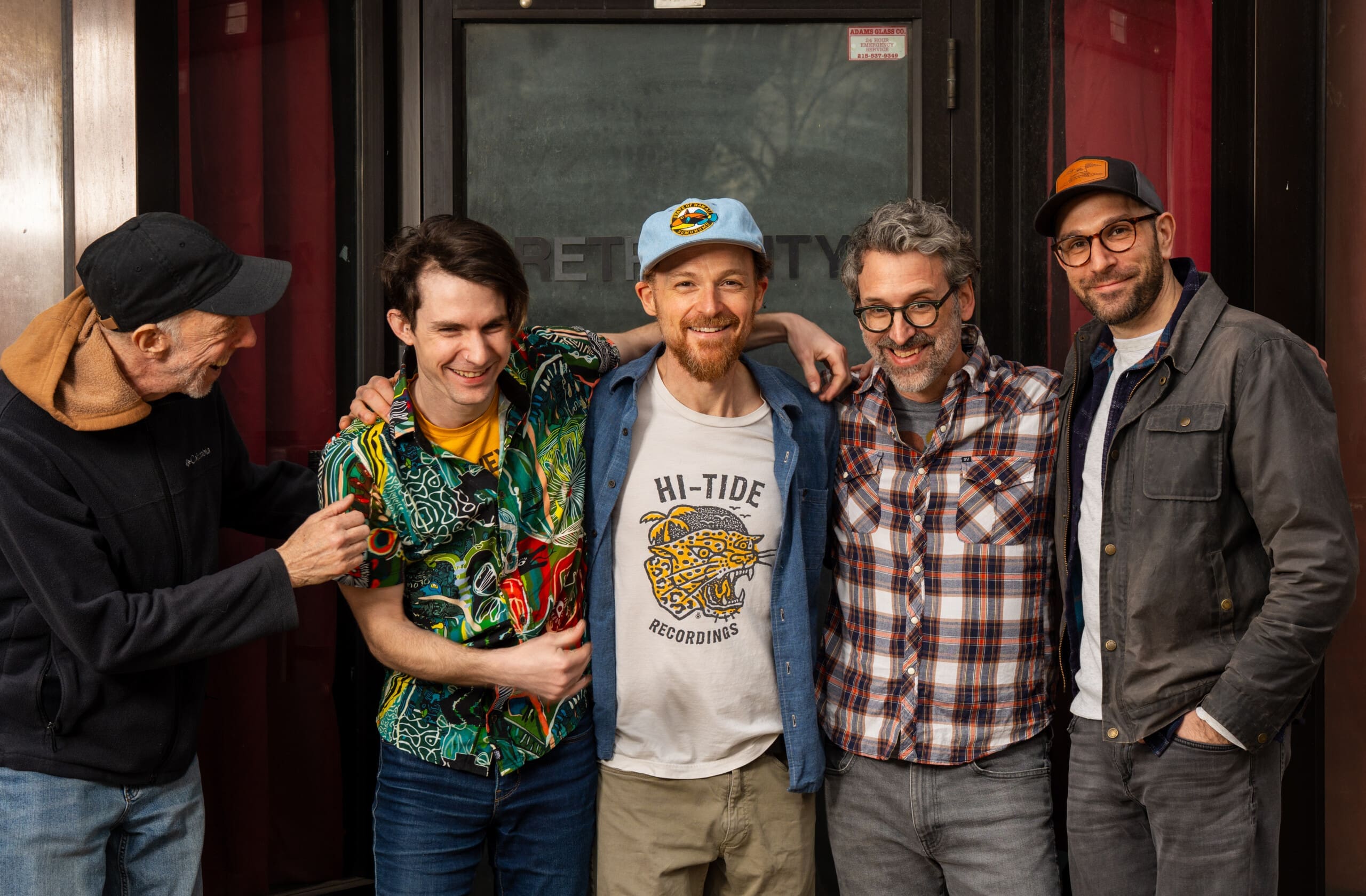
Ever hear the one about the five-piece Hawaiian jazz band out of Philadelphia? Sounds like a wild idea the gang from It’s Always Sunny would conjure up to make a quick buck.
Thankfully, this is not something Mac, Charlie, Dee, Dennis and Frank came up with at the bar. No, Slowey and The Boats is the genuine article — purveyors of beautifully intricate Hawaiian and tropically influenced takes on repertoire and songbooks ranging from Christmas to Country Western to jazz standards. They’re a fascinating band that defies expectations with each new album they drop on Hi-Tide Recordings.
We caught up with Isaac Stanford, the lap steel guitarist of Slowey and The Boats, to discuss the concept behind their new album Slowey After Dark, the beauty of carrying on musical traditions, and the creative and collaborative spirit of Hi-Tide Recordings. Tonight, the band performs at The Hi-Tide Mini Holiday at The Asbury Lanes with The Messer Chups and Black Flamingos.
You’re a Hawaiian jazz band. There are thousands, if not millions of jazz bands out there. But very few Hawaiian jazz bands. Can you give us the origin story of why you chose this sound for the band?
I’m a steel guitarist. I play lap steel, no pedals. It’s a Hawaiian instrument. The tuning I use, C6 tuning, sounds very Hawaiian. It’s so evocative of Hawaii, and comes from Hawaii. There’s a whole songbook of repertoire, a Hawaiian steel guitar songbook that we draw from. So there is actually a whole Hawaiian music craze of the 1920s, where that music was infused throughout all popular music. The steel guitar kind of spread throughout every genre — it came into country, rock, and blues. But it’s a very specific thing originating in Hawaii.
I’m not Hawaiian. My dad went to high school in Hawaii. Both of my parents were music lovers and had a bunch of old Hawaiian music. So that’s the Hawaiian thing, coming from the instrument and some of the repertoire, and then the soloists in the band—David Streim on keys and Brennan Ernst on guitar—are such jazz players. They’re so fun to play with. They’re such great improvisational minds. It really is hard to label it, and Hawaiian jazz does the best because it has that instrumental steel guitar and we play some jazz standards. For me, it’s a lot of just picking old repertoire and songs that I would think it’s cool to walk into a bar and see a band doing. That’s what I’m trying to make.
The steel guitar is not an everyday instrument, so what drew you to it and why did it become your instrument of choice?
I do remember the first time I heard it live at a band in a barroom. I remember it just stirring something. It’s like this kind of comedic-sounding thing. It’s almost cartoony and over-the-top sentimental, but it also has a super sincere, evocative vocal tone. I was just totally bowled over seeing it. I had heard it on records, but didn’t really have the wherewithal to kind of put together what it was.
I was probably in my early 20s when I saw it in this bar, but I loved it. I didn’t start playing steel until I was in my late 20s, like 28. So I’ve been at it 20 years now. When I first started playing it seemed like I was kind of in the wilderness. There weren’t many other players locally, so if I learned a little bit, people would be like, “Oh, that’s a cool sound.” I don’t see anybody else playing, and I got invitations to play with people that I wouldn’t have otherwise.
I just love the sound of it. I was listening to a lot of Ray Charles country records that had Buddy Emmons playing on them, and that’s really what hooked me on the pedal steel. It’s just like steel guitars it’s this ocean [of sounds you can play] … there’s acoustic, there’s bluegrass, dobro. I’m kind of trying to do a little bit of everything. I play some bluegrass with some guys, but the Slowey Project is really rooted in lap steel repertoire, and I’m trying to figure out how some of these old melodies sit on the tuning, and just, you know, working through some old music to try to bring it back to life.
So, take me through the process of Slowey After Dark. It’s a heck of a name. I was actually listening to it on a ride home, with my wife last night, and it’s a pretty cool soundtrack for driving in pitch black on the Garden State Parkway. But tell me about the inspiration behind the concept.
The concept came together in the studio. Every album we do, in some sense, is a concept record. When we did the Christmas record, it was like, “Oh, this is cool.” There’s just repertoire. It’s not even that I always wanted to do a Christmas record, but the idea of this band is versatile enough to, like, say, here’s a group of songs that maybe works together. Then we did the Slowey Goes West thing. We had this German artist who did this hilarious cover of us in a boat, kind of riding West.
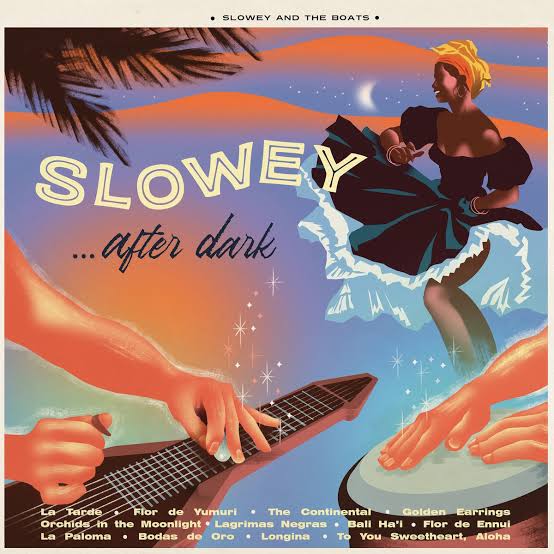
So we were looking for a cool concept, an idea that tunes would converge around. We had studio time, and I was talking with Vincent (Minervino) and Magda (O’Connell) at High Tide and the songs took on this nocturnal [vibe]. There are some songs on the record, like “Orchids in the Moonlight,” that have a nighttime theme in the title. We did some hand drums on this record, which was a different sound. We had Freddie playing some percussion that he doesn’t usually do. So we were trying to make it different enough. I was also reading this great book, Havana Nocturne, about music in Havana in the 1940s and ’50s about the nightclub scene there before the revolution, and of course, how corrupt it was and all that, but just the evocativeness of that whole thing.
The record had just kind of a nightclub scene vibe. There ended up being five Cuban composers that we have songs from on the record. It’s just a vibe type of thing. We had this artist, Chris Wilkinson, in California and we gave him a mood board with some really cool Xavier Cugat records, from which we even get a few arrangements. And just that idea of a nightclub band—we’re a bunch of dudes from Philadelphia playing in bars here but we’re trying to pay tribute to that while also tying it to the other stuff we’ve done. The concept, Slowey After Dark just seemed like a funny thing, but it had legs enough to give Chris something to work with thematic-wise on the cover. I think he nailed it, he’s fantastic.
Any thoughts for your next concept album?
I’ll tell you that I think the next one, there’s a band, this guy Steve Dawson in Nashville, he’s got a podcast called Music Makers and Soul Shakers. It’s been a while since I’ve listened to an episode, I need to tap back into that, but he’s great interviews, and he’s also a great steel player. He plays these, like, pre-war Hawaiian melodies, acoustic stuff. I think an acoustic Slowey album. You know, Mike [Hlatky] already plays the upright bass. And Brennan is, a first prize-winning bluegrass flat picker, in addition to the stuff he does with us and his jazz playing. He took first prize in the Mount Airy Bluegrass and Old Time Fiddlers Convention this year. As far as I’m concerned, he’s a world-class acoustic musician. Not to mention his piano playing, of course, is amazing. We had David, our keyboard player, bring his melodica, it’s like a piano that you blow through. So we could do some really cool, just more stripped-down acoustic stuff.
This is your fifth record on Hi-Tide Recordings. Talk about the collaborative and creative process with them.
[Without] Vincent and Magda, we wouldn’t still be doing this. We recorded the first record Set Sail and I was able to self-produce and put it out on CD. They heard it, saw it, and loved it. They were early believers in us. They have such a creative vision. When we first met them it was the Asbury Park Surf Music Festival before Hi-Tide Recordings. Then I remember going down there one summer, and Vincent and Magda were like, “We’re cooking up something cool you’re gonna like.Through their own force of will, they created this global record label, and our aesthetic fit perfectly.
I think we were the second band on the label after Vincent’s own band, Black Flamingos. They just have really shaped the band in terms of their whole aesthetic, their belief in vinyl, putting out vinyl, and the artists. They pay artists to create the artwork, which gives the albums their distinct vibe. So, it really is a creative collaboration where they trust us enough to deliver a group of songs, and then they use their artists’ vision to make it work with everything else. We visited them in Freehold at Boro Records, which was really cool. The shop is awesome and they’re always up to something cool, like the show at The Lanes.
For 10 years they did the festival there in Asbury Park, and now this is kind of bringing it back. Asbury Park has changed so much in recent years; it’s crazy. Every time I go there my jaw is on the floor. I think when I first started playing down there, I don’t know if you know a guy named Jet Weston, but he had this great cowboy act and I would play steel guitar. We played at the Asbury Hotel when it was an abandoned Salvation Army building.
What is it that you love about this band?
Man, there are always more songs. I’m learning, and then hanging out with these guys. They’re friends. We get together even if we’re not putting out records and we’re gonna be playing music until we die. We’re lifetime musicians. I have my day job teaching, and I do love doing that, but the music is my creative outlet and I need a creative outlet. This one in particular has sustained itself in terms of gigs and repertoire. For me, there’s always more music to learn, and then me thinking, ‘Oh, this would be fun, let’s try it with the band.’ I don’t think that ever gets old for me, for some reason.
I know that feeling. Yeah, 18 years of doing this, and it’s just like, why do you keep doing it?
It’s fun. It’s amazing. That’s the joy of it, and that’s the gift of it — it’s an infinite project. I can spend a whole day working on one song, and if I’ve learned the song, I feel like I’ve accomplished something. Carrying on musical traditions is part of the human endeavor of keeping the music going.