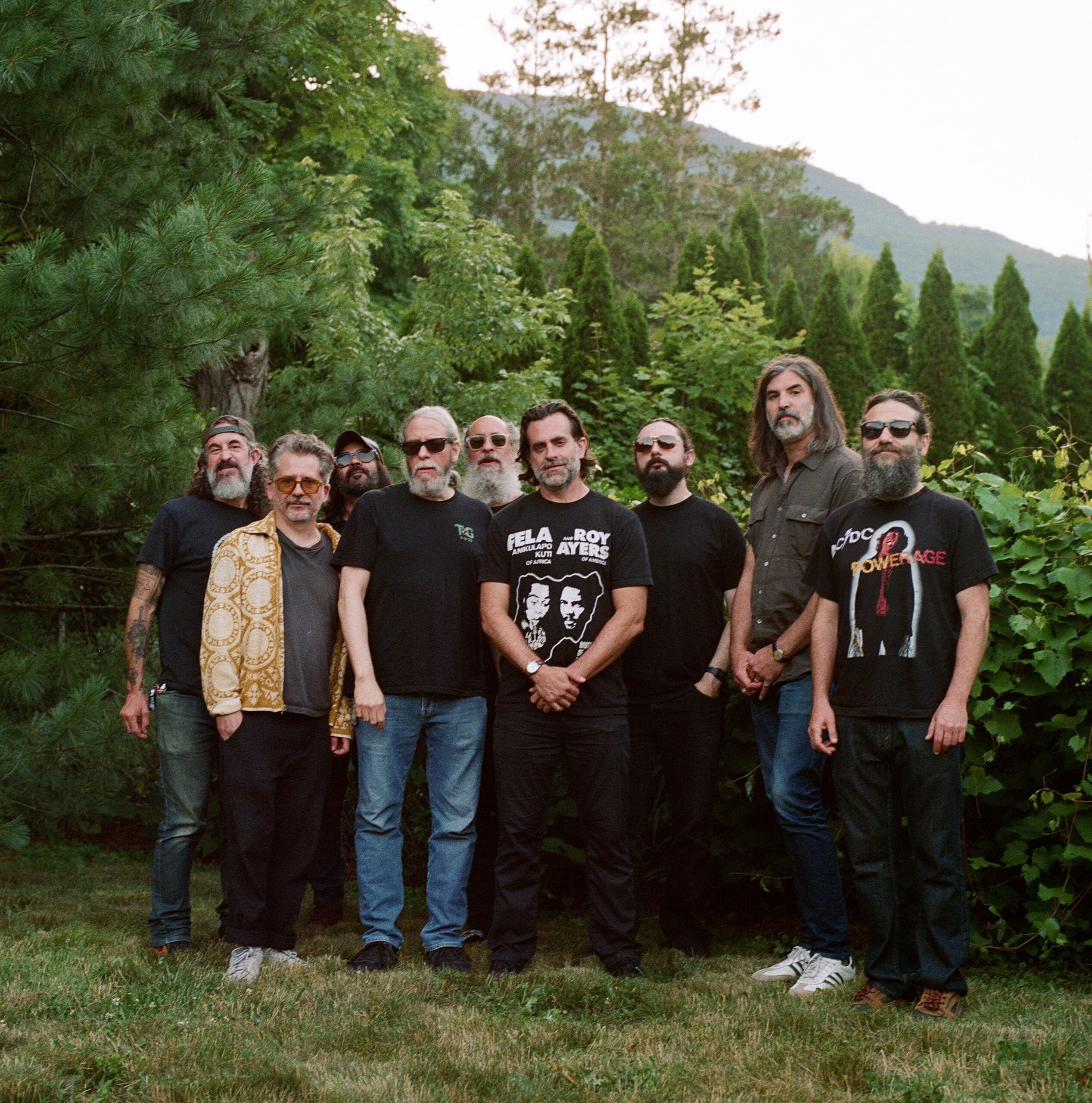
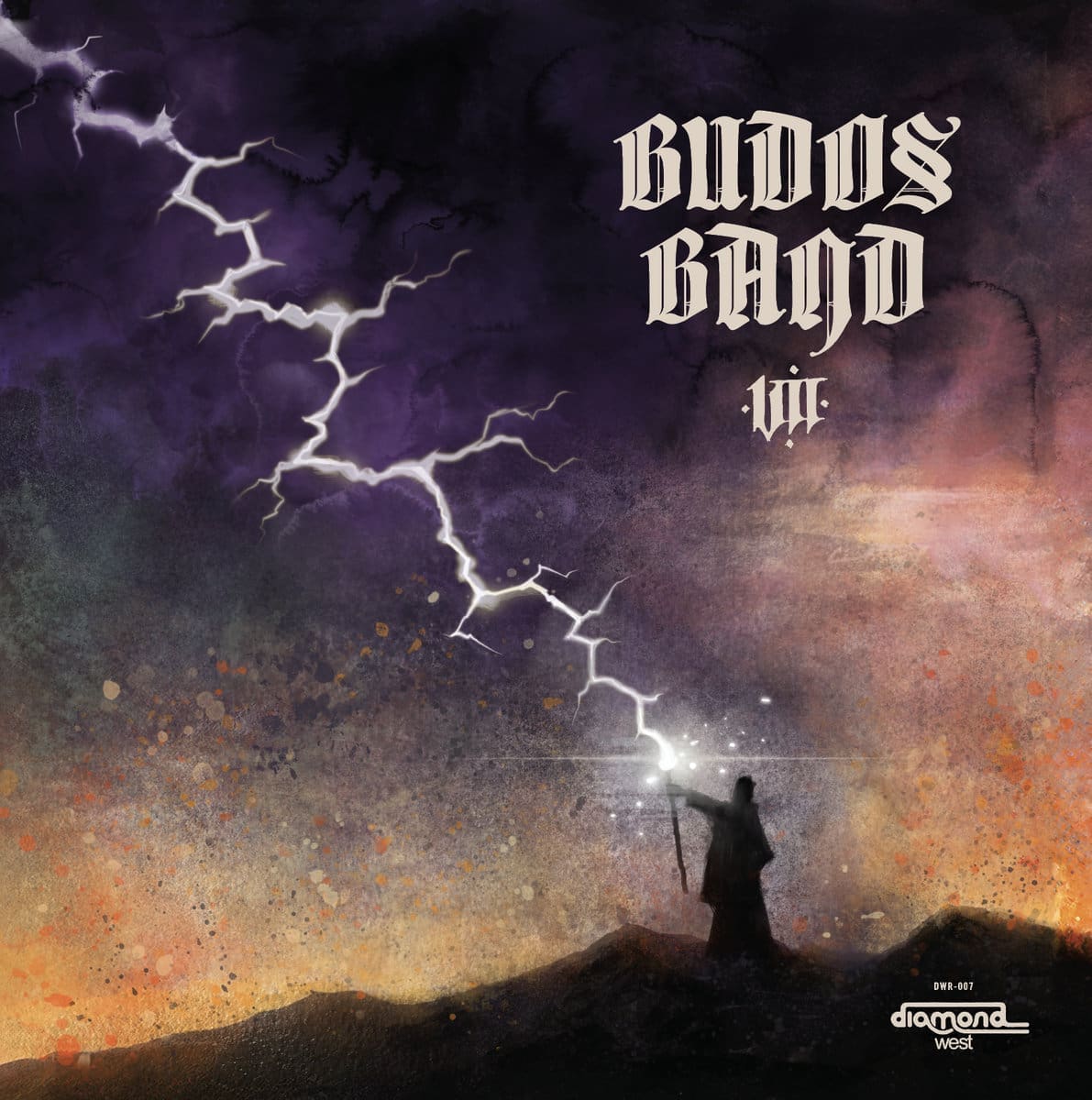
The Budos Band is a brotherhood of musicians who have spent the past 25 years creating richly atmospheric, genre-smashing instrumental music. The band, which released Budos VII in 2025, has found a way to take disparate (on paper) influences ranging from Antibalas and Fela Kuti to Ethiopian Jazz to hazy stoner metal and psychedelia to produce highly evocative, cinematic sounds.
A record from The Budos Band is as much an audio experience as it is a mental one. The thick, hazy riffs, combined with an impenetrable wall of brass and a gargantuan groove, can transport you from any room you’re in to a fantastical, apocalyptic journey filled with with wizards and goblins, or to the world of a gritty ’70s crime drama within minutes.
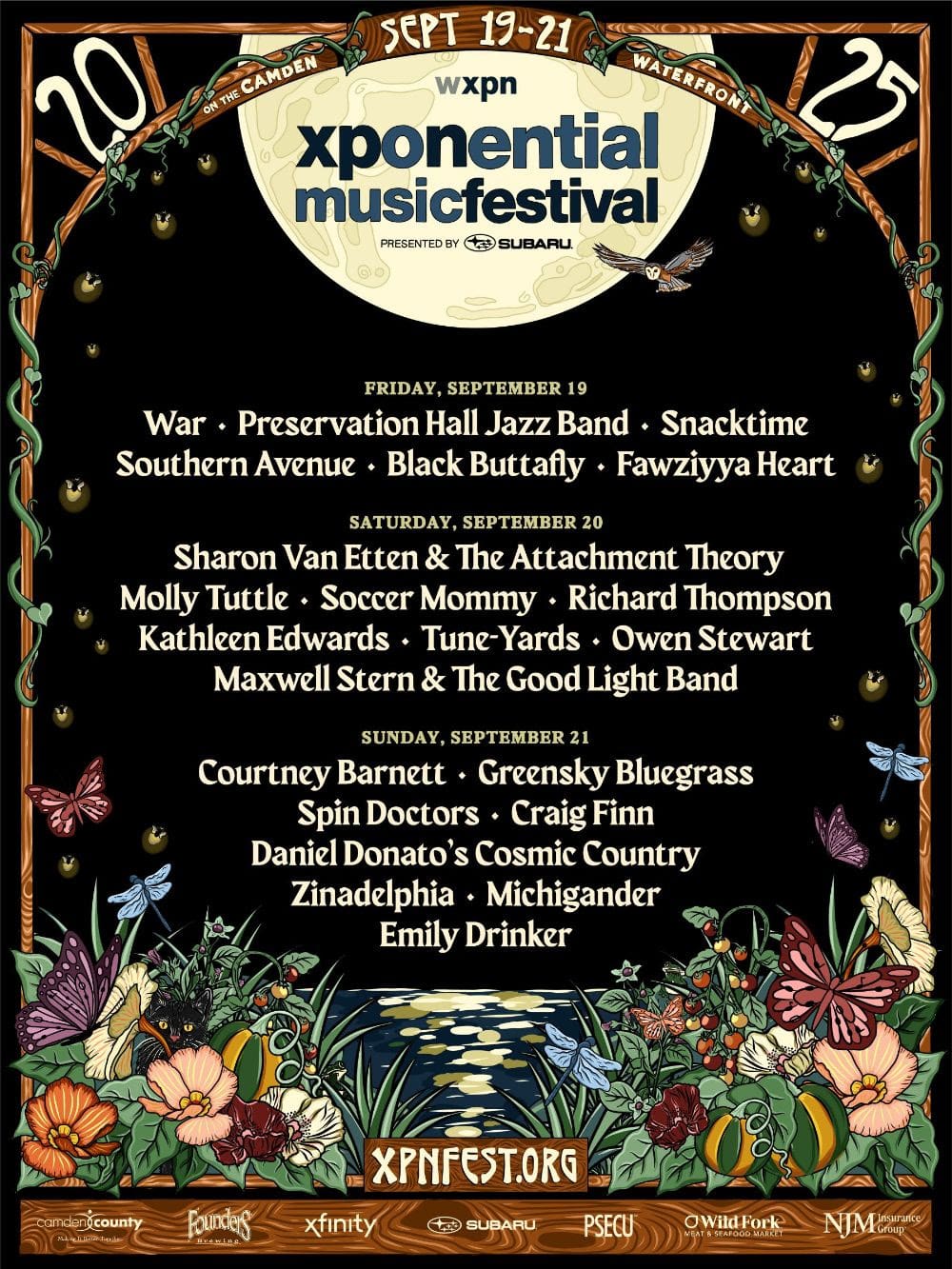
We caught up with Jared Tankel, who plays baritone sax for The Budos Band, as they get ready to perform on the Saturday installment of WXPN’s annual XPoNential Festival in Camden, New Jersey. Tankel spoke with us about the evolution of the band’s sound, running their own record label (Diamond West), improv or not improv live, and what has kept the band together for over 25 years.
When Budos Band started in Staten Island, the band had an Afrobeat sound, but if you listen to the new album, it’s got this cinematic psychedelia mixed with stoner metal and funk. Can you talk about the evolution of your sound?
When we first got together and started playing music, we were very inspired by Antibalas and Fela Kuti. The core guys [of Budos Band] really came together around old Antibalas shows, when Antibalas was playing in New York around the 2000s. So the band was founded and inspired by that initially. We were going for an Afrobeat sound, a Nigerian funk sort of sound. We quickly realized we don’t have a vocalist, and we don’t want one. We like the all-instrumental thing. There are enough of us as is; we don’t need to add another person to the mix. The instrumental thing works, but Afrobeat songs are typically pretty long. We felt it was better to distill it down a little bit. We took it from Afrobeat to more Afro-funk, in terms of being inspired by American funk and soul music and the tight arrangements those songs have.
By the time the second album came around, we were really starting to be influenced by Ethiopian jazz and Mulatu Astatke, and people in that world. So the sound turned on the second album, and that’s where we really found our footing and our voice. That made us a little bit more distinctive. And from there we’ve followed and trusted our gut and what we love, and what each of us grew up listening to, and what we listen to collectively in the van when we’re on tour — which is more of that hard rock, psychedelic rock sound, while incorporating these more worldly influences as well.
There’s never a feeling like we’ve gotta follow some strict guidelines of “No, we’re an Afrobeat band,” or “No, we’re trying to do Ethiopian jazz.” It’s more like, “Yes, that’s where we came from. That’s still part of our sound, but we love psychedelic rock; we love heavy rock. Why not make that part of our sound?” It speaks to us, and it is natural for us to write songs together that are in that vein. So it’s really just trusting ourselves and trusting our guts to take us there.
When it comes to songwriting, do you all road test songs before taking them into the studio, or do you grow them in the studio and then tinker with them on the road?
With our first couple of albums, we rehearsed religiously on Mondays and Thursday nights on Staten Island, playing a lot of gigs around New York. A lot of those songs were written in rehearsal and then tried out live. Then, when we got the form down, that seemed to work. We’d go in the studio and record. But ever since the fourth album, it’s been more of come to the studio with ideas, figure it out, record it, and then take it on the road. I think it’s due to everybody getting older, some of us moved to different parts of the country, and have kids and jobs, all that. So we can’t just play music all the time anymore.
But, in terms of the process, though, there are a couple of things at play. One is that even though we don’t come into the studio with songs that have been written and then vetted live already, we do spend a lot of time in the studio writing before we press record. We are not a band that does hundreds of takes, then cuts things up, chops things up, and makes a song. We get a song, we press record, we do a take — good take, bad take — do another take … maybe three takes, but that’s it. We’re not taking from lots of different takes and making one track in the end — we’re doing full takes to tape. So, because of that, we spend a lot of time writing and arranging together in the room before we press record.
It’s the fact that we’ve been together for almost 25 years at this point, so there’s a level of trust. There’s a level of healthy criticism that we can share to make sure everybody’s on the same page, that we get to the right place with a song, that everybody’s voices are heard, and we’re comfortable together in the room. We can call each other on whatever. We can build off each other really seamlessly because we know how our sound fits together. We know how each of us plays particularly well in a certain way or whatever. That allows us to build a song pretty organically.
It’ll start with Brian [Profilio] having an idea on drums, or maybe Tom [Brenneck] on guitar, or Daniel [Foder] on bass, with just a little seed of an idea. Then it builds, and by the end we add the horn parts on top. Again, because of the time we’ve been together, we know how all those pieces fit together well, and what’s going to work and what’s not. [We can say] ‘This guitar riff is cool, but it needs to be a little bit different, or a little bit longer, in order for the horns to have space to play their part, and not for everything to be on top of each other.”
I was reading an interview with Tom in Relix where he talks about the discipline and patience the band has, which was even more apparent on this record. Does that come from this newfound approach, or is it more because the band has been doing this for 25 years?
We’ve been together a long time, but when we recorded Budos VII in California at Tom’s new studio in Pasadena, everybody flew into LA. We got rooms at a shitty motel nearby, as opposed to when we made albums in New York, we’d finish up, and everybody would go home. We’d come back to the studio the next day and keep going. That’s what we were there to do. It was almost like we were on tour except we were making an album. I think that allowed for a different level of focus.
We were there together all day, and we weren’t going back home to our families or normal lives. We were all there, aligned with the same purpose. It wasn’t like I can’t be in the studio till 3 a.m. because I gotta get up in the morning for the kids.
The band also launched a label, Diamond West which has become your home. Can you talk about the decision to move on from Daptone Records and launch the label?
Starting with Burnt Offering, our fourth album, we started recording and producing the albums ourselves. For Budos 1-3, we recorded at Daptone; Gabe [Roth of Daptone Records] produced them, and it was an amazing experience. I love those albums. But it also felt like they were a trilogy, one through three of the band’s early days. Burnt Offering, sonically, was certainly a new thing. It departs. Ever since then, we’ve been recording and producing our own, and really taking ownership of the process ourselves. That mentality started way back then, and now Diamond West is about four years old.
Between Budos and Tom moving to California and setting up his own studio, and starting to record other artists who are now on Diamond West as well… it was a natural evolution for us to go out and do this thing ourselves. It’s all love between Daptone and us. They are friends and family forever, but a couple of factors made us feel like we should give it a go and do this ourselves. We’ve already been doing a lot of the creative stuff ourselves, so let’s do the whole thing and start a label.
Does that also support the “Let’s get down to business” mindset, since it is more on you guys to get the record done and out to the masses?
We have a distribution deal with Secretly Distribution, but outside of that it’s all in-house. It’s all on us to do everything to get the releases ready to go. So, there’s a little less [of a feeling of] we can’t rely on anybody else. We gotta get these records out, and it’s on us.
You’re playing WXPN’s XPoNential Festival in Camden, NJ this weekend. For those attending, talk about the Budos Band live experience. Do you leave yourselves space to improvise and cut loose, or do you adhere to what we hear on record? In short, can we expect a 55-minute version of “Old Engine Oil” this weekend?
We stick pretty close to the album arrangements. We don’t want to be a jam band. None of us listen to that genre of music. It’s not really in our diet and what we’re about. We’re gonna keep things pretty lean and mean in the arrangement of the records. But with that said, the Budos live experience is noisy, chaotic, interesting, and evolves in its own way. Our records are fuzzy and distorted. They’ve got complete reverb. They’ve got all this extra-sonic experience, but they’re pretty tight. They’re pretty clean recordings. Whereas our live experience it’s noisy, and it’s raucous. We’re not playing 25-minute excursions, but a different kind of raw energy comes with a live show. If you didn’t know the band, you might think the live show feels more like a jazz show just by the sound of the records. But it’s not. It’s a rock show. We bring it. It’s high energy. Every show has its own curveball to it. There are eight of us on stage, and everybody’s bringing a lot of energy that bounces off each other and into the crowd. Even though we don’t have a vocalist, we get the crowd going. We like to really amp it up.
How do you feel about the current state of touring? This summer we saw so many tours cancelled due to the realities of blue dot fever – how do you guys navigate all this?
We are fortunate to have a healthy fan base that’s been there a long time and continues to show up, and we’re really fortunate for that. We’re also lucky in that we do have day jobs. This is not how we’re eating. This is not how we’re providing for our families. If we were, it would be a different story. So for us it has remained, and we’re lucky that it has remained a fun, passion project that sustains itself. It’s not like we’re going out of our own pockets for it. It sustains itself, which is great. We also have less pressure if a run of dates doesn’t do particularly well for whatever reason. It’s not gonna bury us. We can keep going on to the next one, and 80 to 90% of the shows are a blast. We still love it. We still love getting together, seeing each other, and playing music together.
That goes into my next question. You’ve been doing this for 25 years, probably more than half your life. What is it about this band that you love?
There’s something about this group of guys that we have fun. We respect each other. We call each other on our shit when we’re not meeting the standards that we have for ourselves, and that happens occasionally. We’ve had a collective experience at this point, playing however many shows it’s been all together. We’re brothers that love to come together and hang. Honestly, if it weren’t for the band, we’d figure out some way, some excuse to still get together and drink beer and hang out.
And finally, what’s something you’re stoked for Budos Band in 2027?
We’ve been working on new music, so we’ve got plans for more records. Personally, I’d love to put out at least 10 albums by the end of this thing. So that means a few more, and we’ve already got another one that is well along. I’m hoping there’s new Budos music out in ’27. In 2025, we played almost 50 shows, which is our most in a very long time. We have the new album out; it’s time to do that. This year’s been a little bit more scaled back, just because we didn’t put out any new music this year, so I think next year maybe some new music, getting back to some of the cities that we didn’t visit this year, and more of the same, a few more shows and more new music.