
The Testaments, the sequel series to Hulu’s beloved adaptation of The Handmaid’s Tale, follows two young women in Gilead. Our protagonist Agnes Mackensie (Chase Infiniti, One Battle After Another) is the estranged daughter of June Osborne (Elisabeth Moss, Mad Men). From the get go we see the parallels between the journeys of Agnes and June.
In the first episode both are obedient and resigned but then forge a connection with a peer who they see as performatively pious, Ofglen (Alexis Bledel, Gilmore Girls) in June’s case and Daisy (Lucy Halliday, California Schemin’) in Agnes’s. Both June and Agnes also engage in quiet acts of rebellion where they confess their transgressive thoughts to the audience. The Testaments matches The Handmaid’s Tale in cinematography, and world building but suffers from a similar lack of intersectionality and heavy-handedness.
The series opens with a doll house being used as a heuristic to explain the social hierarchies of Gilead and Agnes’s daily life. The dolls eerily do not have faces reflecting how Gilead does not see its citizens as people but rather as figures who need to perform certain roles for their society to function as it ought to. It is also a great example of how the show balances depicting the trappings of girlhood alongside the dark underbelly of a fascist society, without coming off as didactic.
The writers do not shy away from punishing Agnes despite her well-off position. In the end wealth, fertility, and good behavior are not enough to shield one from the violence of authoritarianism. While on the bus to school Agnes engages in her brand of quiet rebellion by peeking out at the world she’s been sheltered from. The defiance reminds her of being made to hold a sign that read “slut” for two days after smiling at a boy. Purity culture is a looming threat for these girls, it is what leads to their punishments.
At the end of Episode 1, a guardian on the campus of Aunt Lydia’s school is found masturbating. The girls are blamed for making him turn to sin. In response to this shame and guilt they scream for him to be punished when asked. The hand the boy was using ends up being sawed clean off. We get to clearly see the way these children have become accustomed to violence and their complacency in it. Modern dystopias sometimes end up holding women up on a pedestal. The Maze Runner film series is a prime example where a group of girls has a more difficult maze yet manages to get out of it faster. The Testaments doesn’t fall into this trap and lets the girls succumb to the mob mentality built by the environment they are in.
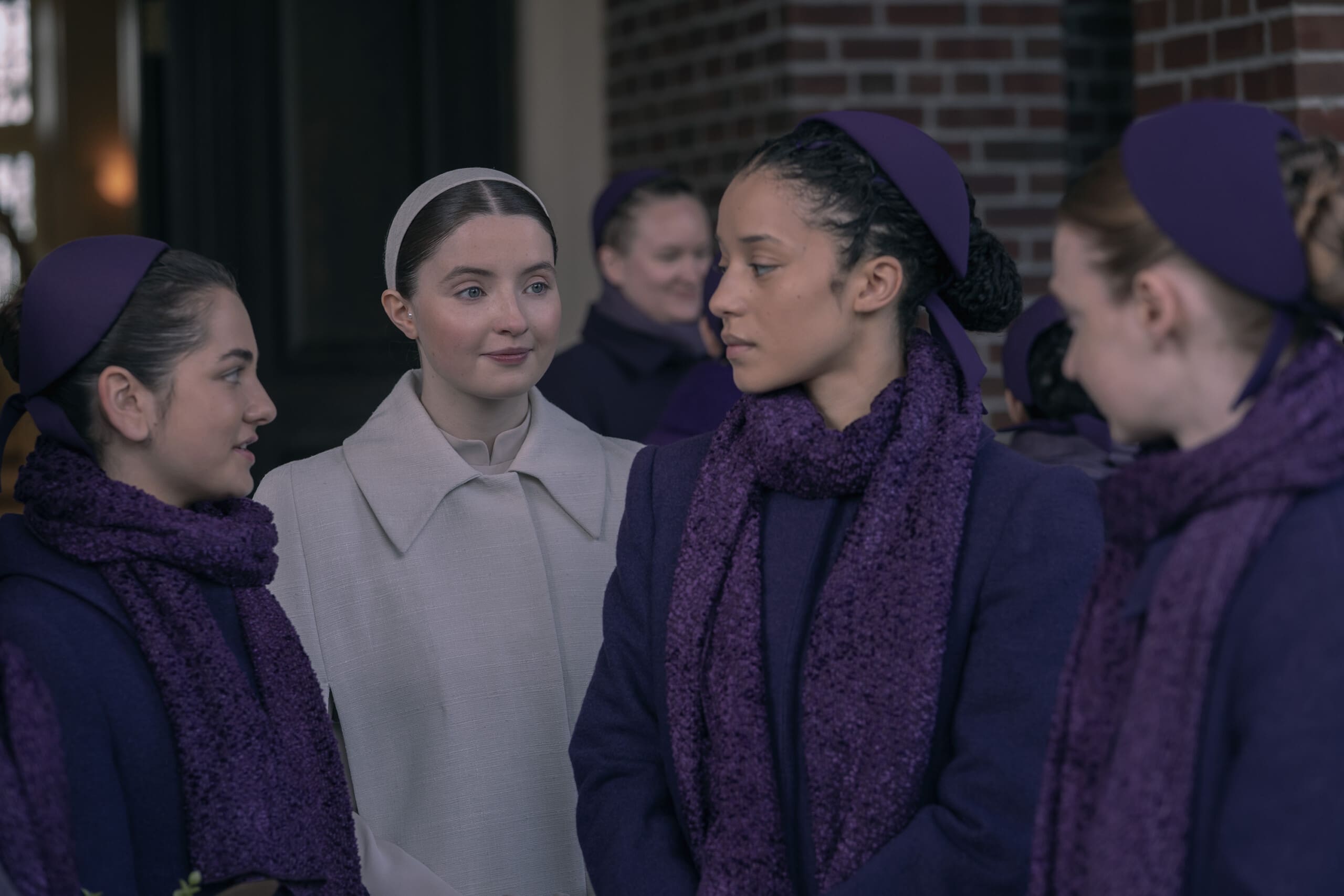
MATTEA CONFORTI, LUCY HALLIDAY, CHASE INFINITI
(Spoiler) Episode 1 features a cameo from Elisabeth Moss reprising her role as June. Thankfully, the show runners make June play an active role in the series rather than just include her as fan service. June recruits Daisy to work for Mayday, the resistance in Gilead. Seeing June interact with a teenager the same age as her daughter feels both fulfilling and heartbreaking. June clearly sees her past self in Daisy, someone who is forced to fight because of Gilead’s violence.
While June is now a mentor and motherly figure for Daisy, her daughter Hannah Bankole is still in Gilead. Speaking of Agnes Mackensie’s real name, we know that Agnes did remember her name for a long time. In Season 5 Episode 9 of the original series we see Agnes writing Hannah in childish writing during a failed rescue mission. At the beginning of this series Agnes has not gotten her first period meaning she is in her early teenage years, not that far off from how old she was in Season 5 of The Handmaid’s Tale.
Episodes 2 and 3 blend together, but Episode 3 is where we start to unravel the mystery of Daisy. Lucy Halliday does a wonderful job of narrating — it sounds like she’s winking since she knows how this ends and we don’t. However, she doesn’t undermine the severity of the situation she’s in and emotions in the moment feel real. Most impressively she manages to hold her own in scenes with Elizabeth Moss.
Chase Infiniti plays the haughty rich girl well, but she is too restrained. The side characters outshine Agnes in emotion, and personality-wise she just falls flat. It is difficult to write a passive character as the protagonist of a dystopia, which is probably why Margaret Atwood chose to make Agnes one of three narrators in the novel.
Nonetheless, this adaptation is disappointing since there is so much opportunity to add complexity to Agnes. Most obviously, she is one of the few Black girls at the Aunt Lydia School. The show does not engage with how Agnes’s race impacts her prospects in Gilead. Like many other feminist works, intersectionality is not a priority of The Handmaid’s Tale. The original series does show how queer women are unfairly targeted by Gilead but race was not considered. There are many places in the narrative where a conversation about Agnes’s race could naturally emerge. Agnes’s new stepmother does not like her, it’s unclear why but the reason should be that she doesn’t want a Black stepdaughter. This would both make the resentment Paula (Amy Seimetz, Pet Semetary) holds make sense and help the audience better understand how race is conceptualized in the upper echelon of Gilead.
Overall, the writers of The Testaments lived up to the legacy of The Handmaid’s Tale. We once again follow women forced into impossible situations by a theocratic state. These stories teach us how the average citizen can make a meaningful change, and that the bastards will never grind kindness out of you.