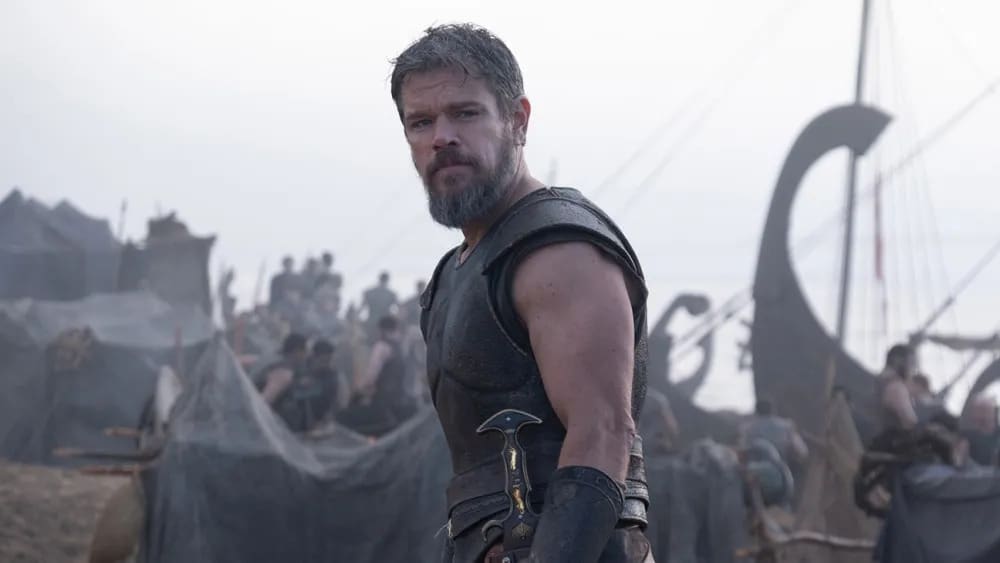
Homer’s The Odyssey is arguably the longest-awaited literary adaptation, well, ever. Sure, it’s been the inspiration for countless films, including the Coen Brothers’ O Brother, Where Art Thou and Uberto Pasolini’s The Return, but the full story itself has never gotten the full Hollywood treatment. With a star-studded cast featuring Matt Damon, Anne Hathaway, Robert Pattinson, Tom Holland and director Christopher Nolan at the helm, the Greek epic is in extremely capable hands. Nolan and his team have created a timelessly beautiful classic that feels approachable for a wide modern audience, yet stays fairly true to the source material.
In case you slept through high school English, The Odyssey centers on Odysseus (Damon) as he journeys home from the Trojan War, fighting monsters, wrangling his men, and battling his own conflicting wills along the way. Meanwhile, his wife, Penelope (Hathaway), and son, Telemachus (Holland), have been waiting nearly 20 years for the return of their King. Convinced his father is still alive and knowing Ithaca has been without a King for too long, Telemachus sets off to learn of his father’s fate. In true epic poem fashion, much of the story is told in flashbacks, voiceovers and even rhythmic meter spoken by a palace Bard played by Travis Scott. It’s a storytelling technique that at times can remove the audience from the immersive experience, but Nolan uses it to continuously move his nearly 3-hour film along as quickly and concisely as possible.
The film is absolutely beautiful. Production designer Ruth De Jong (collaborating with Nolan for the second time after Oppenheimer) had the daunting task of bringing to life some of the most well-known stories, taking place in the greatest civilization known to man at the time. De Jong and her team have not just created beautiful set pieces, but have grounded it in the harsh reality of the story in a way many films set in the classical Greco-Roman world are unable to achieve. In a time of CGI, green screens and tennis balls on sticks, De Jong and Nolan’s commitment to real sets and locations pulls both the audience and the actors into the world.
Ironically, one of the film’s biggest marketing points may end up costing the film the full adoration it’s capable of achieving. A star-studded cast can do wonders for a modern-day rom-com, but I wonder if a classic epic is the place for these stars (being hyper-aware that Anne Hathaway is the woman at Paris Fashion Week is far less jarring than realizing she’s an ancient queen). Damon carries the film so well and embodies Odysseus so expertly that this isn’t a problem for him. But in Hathaway’s scenes, it’s hard to suspend belief that she truly is Penelope. I hesitate to say it’s an acting issue, and it certainly won’t ruin the film, but it’s hard not to wonder if every scene needed a highly recognizable celebrity.
It’s surprising it took so long for Homer’s The Odyssey to find its way to the big screen, but it is worth the wait. The film comes at the perfect moment in Nolan’s career—not only is he in the long plateau that is the peak of his career as an artist, but he’s at a place where studios trust him enough to give him what must have been the budget of his dreams (every last dollar of which you can see on screen) and actors respect him enough to hike up mountains in full costume just to get to set. The care and passion the cast and crew had for the making of this film shine through in the excellence of every scene. It’s an epic in every sense of the word.