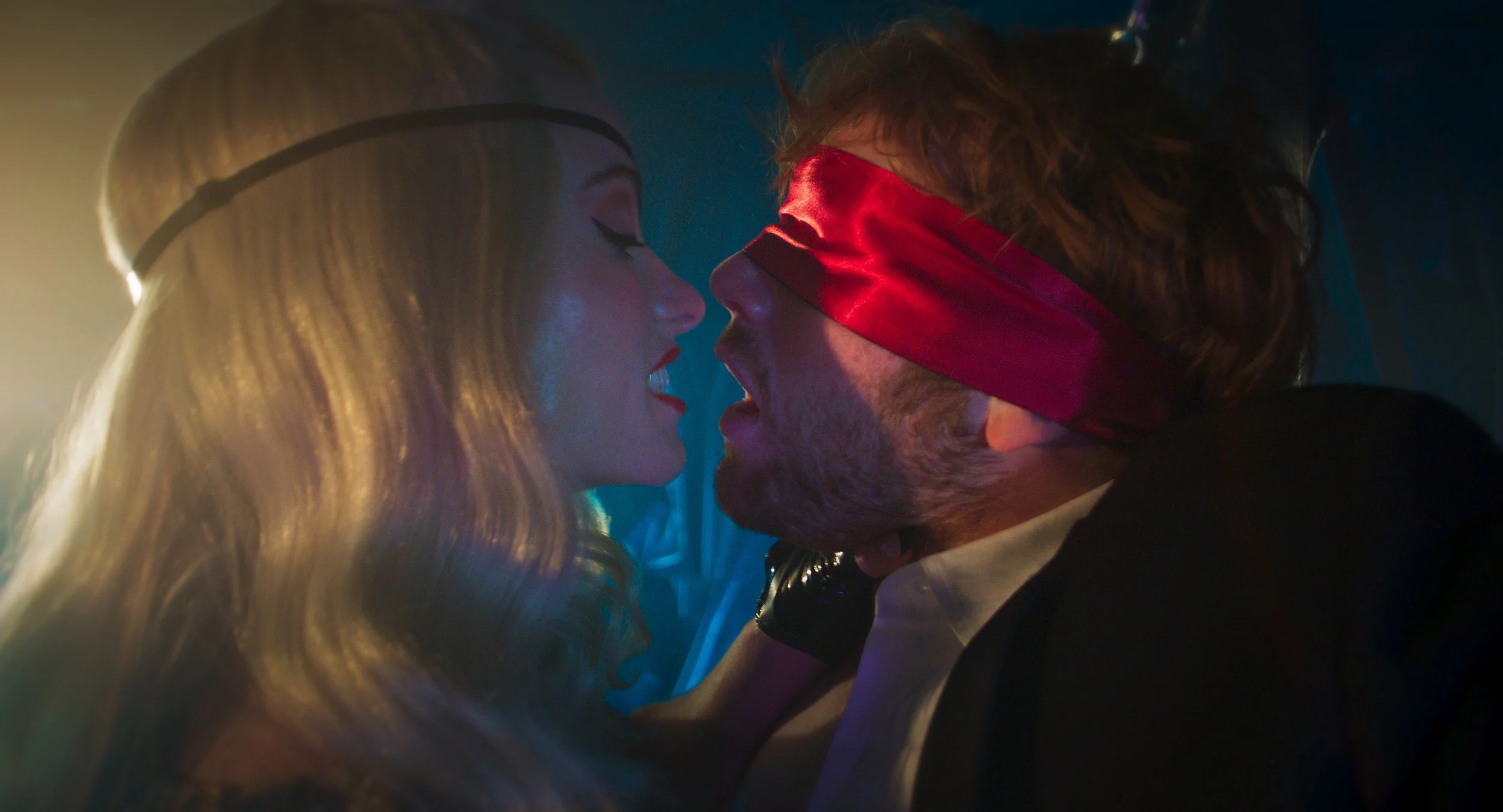
Writer-director Gregg Araki’s new film, I Want Your Sex, is the second sex farce starring Olivia Wilde in as many months. In it, Wilde plays contemporary artist, Erika Tracy, who has a reputation for transgressive, often sexual work. We first meet her seemingly after she’s been murdered by her employee/lover, Elliot (Cooper Hoffman). From there, the film flashes back and forth between Elliot and Erika’s past sexual escapades and the two investigators questioning him about that history. The result is a somewhat chaotic but consistently funny romp with more on its mind than it first appears.
From its opening shots, Araki’s film is, as Lady Gaga once put it, “unafraid to reference or not reference.” We first see Wilde’s Erika floating face down in a pool, the shot of her face from underneath the water recalling the similar shot that opens Sunset Boulevard. Almost immediately after, a title card appears that says “9 1/2 weeks ago”, a clear reference to the boundary-pushing relationship in Adrian Lyne’s 1986 film of the same name. Later, we’re told that Erika got her start when she, “fucked Vincent Gallo,” at The Brown Bunny premiere, a film infamous for a scene where Chloe Sevigny actually performed oral sex on Gallo, the film’s director. These throwaway references aren’t merely meant to draw laughs (though they all do, to varying degrees), but to place I Want Your Sex within the context of a filmic history of sexual exploitation.
Indeed, it feels as if Araki is courting a certain level of controversy with the film. Yes, Erika is the bad boss taking advantage of her fresh-out-of-college subordinate, but Wilde is also the most objectified and explicitly nude person throughout the film. Sure, we see Hoffman’s bare ass constantly and his trussed up, mostly bare body in any number of BDSM scenes, but there’s an inherent silliness, even humiliation to those scenes that feels far from sexualization. By contrast, Wilde bares her breasts just as much, constantly embodying a lustful male gaze. Whether it’s red lingerie, a skin-tight white tank top with no bra or the leather waist trainers that she wears on top of nearly every outfit, Erika and therefore Wilde are meant to be gawked at.
However, Wilde is, after all, a director herself—one who even explored sexual exploitation in her deservedly much-maligned, Don’t Worry Darling. Instead, the audience’s knowledge of her history, and frankly, her performance, only enhance the film’s satire. There is both a casual sociopathy and an alluring confidence in Erika’s no-nonsense domination of Elliot. She takes what she wants in defiance of convention and Elliot is in thrall to her simply because he’s so surprised she would want him at all. That said, it’s not entirely clear whether the audience should share his feelings throughout.
When Erika declares early on that, “contemporary art is a scam,” or we see the way she first tests Elliot’s boundaries by suggesting a sexual relationship, only to immediately backtrack and pretend it was a joke, we are meant to be entertained by her wiliness but fully aware of her danger. However, when Elliot eventually grows tired of the way her machinations are impacting his life, it’s a little hard to understand his sudden turn. Why he chooses that moment to suddenly establish a boundary isn’t quite earned because the film is so tonally playful and absurd that the audience doesn’t believe the character becoming serious and upset without more justification.
Unfortunately, that is I Want Your Sex‘s biggest weakness. It is so clearly a heightened comedy that it never really does much character work. Elliot is the most complex, to be sure, but even so, he has no motivation outside of lust. We don’t really know how committed he is to art or the potential podcast he mentions in passing. Perhaps it’s a weakness in Hoffman’s performance that he never makes Elliot seem anything but eager, anxious, horny and oblivious, but that doesn’t account for why the rest of the cast is also essentially playing caricatures—albeit funny characters.
In the end, I Want Your Sex is probably too shallow to really say anything insightful about harassment in the workplace or cancel culture. Araki is too busy making us laugh or titillating us or throwing too many ideas into his script. Still, the sum total, while slight, is fast and fun. Every performer lands their jokes and perfectly commits to the tone. The film doesn’t give us answers and it doesn’t try to. It’s an edgy popcorn flick, let’s just have fun and not overthink it.