Sometimes starting over means leaving the past behind.
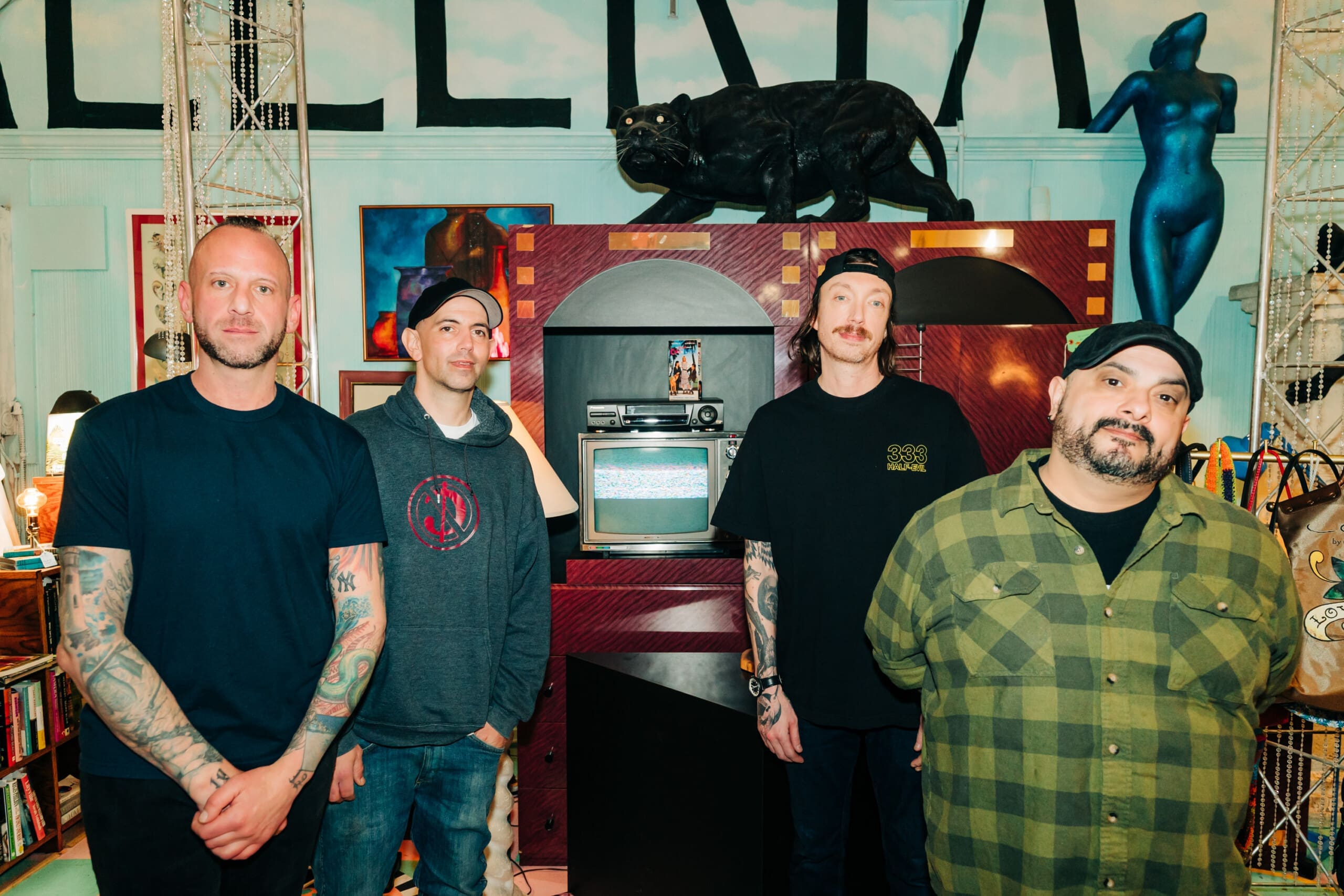
For ME., the new alt-rock band featuring former members of Taking Back Sunday, it meant building something entirely new.
The formation of ME. was anything but conventional. Drummer Mark O’Connell and guitarist Eddie Reyes, who performed together in Taking Back Sunday for four years, reconnected at Reyes’ wedding after nearly 10 year of not performing together.
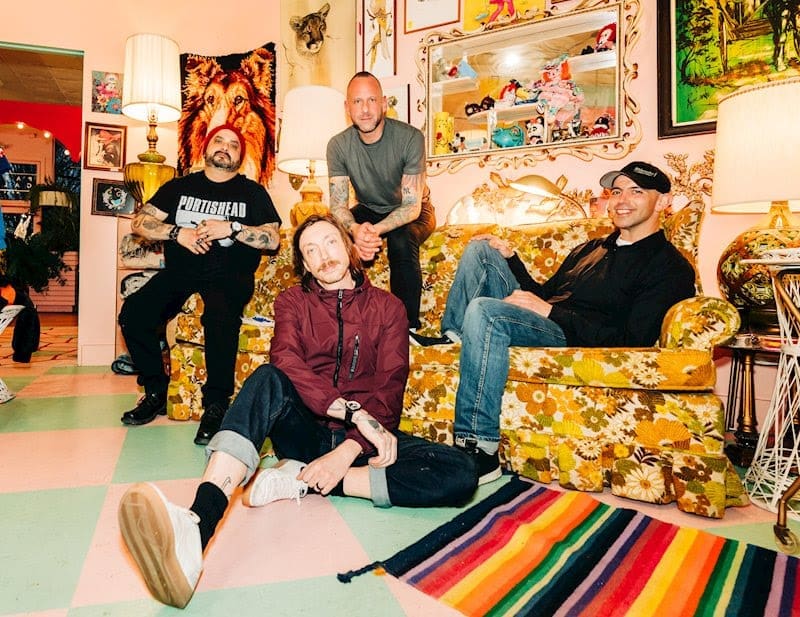
An open casting call would bring Chicago vocalist/guitarist Mike Jansen to the band. The trio along with O’Connell’s longtime friend and bassist Neal Amiruddin formed ME. and have stepped outside the shadow of their previous bands to create a sound and identity all its own.
Earlier this summer, ahead of the release of their debut album, All Good Things, I spoke with the band about how the project came together, what it was like collaborating with both new and familiar musicians, and why vulnerability can make for the best music.
Let’s start out with the name ME., because I feel like it’s a very personal but also universally relatable name. How did you land on that name, and why did you choose it to represent the band?
Mark O’Connell: I was throwing a couple of things around with Ed [Reyes] to try to put a name to it. We wanted to put a name to it; we wanted to make it official. We didn’t know what we were doing at the time. I came up with a couple of ideas, but then we were saying, you know, it’s Mark–Ed, Ed–Mark, whatever. And then the next day he was like: “ME. with a period at the end. Mark–Ed, but then me.” It was that simple and that easy, but then it kind of turned into this whole thing since that happened. It’s taken on a bunch of different things, but that was the original.
What has been inspiring you guys to create music for ME.? Any themes that keep resurfacing throughout this whole process of making the album?
Mike Jansen: Multi-part question, I think. Mark [O’Connell] and Ed getting back to the place where they’re writing freely was a big part of the project from the beginning, before I was ever a part of it.
For myself, I was able to lyrically put in parts of my life that have just been journal entries — things I’ve always been afraid to talk about, or kept very personal. When I found myself in a really happy place, it made it a lot easier to reconnect with those old feelings and figure out a way to say it where it wasn’t necessarily specific to one viewpoint. I think that’ll be a recurring trend with the band pretty much forever. The openness to write how they feel, and my excitement over exploring different topics without being limited.
O’Connell: For the music side of it, the way it really began was me and Eddie just coming together and kind of filling this void that we both had. Filling this void we had by making music and seeing if we were good at it still, if we could do it and enjoy it together…and we did.
Neal Amiruddin: Just honesty. Really, just honesty in a million different ways. I don’t know how to really describe it, but you know, I’m 45, and I haven’t played in a band since basically high school. So it’s like new journeys, recovering, becoming, just changing, and honesty. Growing, and no limitations. I think that’s what it is for me, anyway. For myself.
Did you have any specific goals or intentions going into making All Good Things? And looking back now, do you think you accomplished them?
O’Connell: Oh, definitely accomplished them. The main goal was reconnecting with Ed. This has been a step-by-step, learning-as-we-go process all the way through with everybody. With every member, Casey, our manager, and everyone that we’re working with that’s riding with us and behind it.
The first time Eddie and I talked [after a long time], he told me he was getting married. So we solidified that I’m going to that wedding; I’m gonna be there, and I can’t wait. That was that. Then the more talking we did, we finally met up and saw what we had. The first two songs that we wrote together in two days in a small studio on Long Island ended up being “Bloodsport,” the first song on the album, and “Violent People,” the fourth song. We were like, “Holy shit, this is really exciting.” Everyone that we showed it to was like, “Oh my god, you guys…that sound, that beauty is there.”
Second, [we had to think] do we want to do it, and do we still have it? So it’s been really just tiny little small steps.
[Recently] we did an interview where, I don’t know what they asked, but I explained it like: we have all these new little goals we’ve set throughout the process. Every time we get through one and it ends up being something that we’re really proud of, it’s that “Oh thank God” feeling every step of the way. Right now I feel like we’re finally starting to … I don’t know, being able to talk to you and being able to just hang out with the guys on the interview and be relaxed.
Vulnerability, man. Being able to be vulnerable in a band, in a creative environment, is really the most important thing. Like Mike [Jansen] was saying, in the future, writing whatever it is he wants to write about, he has to express himself freely. If he doesn’t, you’re going to be able to tell. You can tell when a band is making an album and the heart really isn’t there, or there are rules or restrictions or whatever it is.
I always thought: how could one band write such a dope album and then three albums later they’re so horrible? They completely lost themselves and forgot who they were in the beginning. I’m going off on a run-on sentence, but this is really all a part of it—being vulnerable with your bandmates, treating them with respect, and respecting their creativity to make sure they have their outlet. Everybody. That’s how you make an album, and that’s how you make an album as dope as the one that we think that we made.
What has been the biggest difference between writing with longtime collaborators and bringing new creative voices into this process?
O’Connell: With Eddie and I’s story, there’s so much history. So we had a lot to untangle when we were writing. But with bringing Neal [Amiruddin] and Mike in, man, you couldn’t ask for better bandmates, really. I’m being honest when I say that.
Neal and I have been friends our entire lives. I don’t remember living without Neal being there in my life. So that’s beautiful right there. And then the fact that Mike came in as a good person, and then is top tier at what he does, it makes it really easy and really fun.
Amiruddin: Well, when the product is good, that’s where the reward is. When we like our own stuff—that’s the goal. And then everybody else liking it too? That’s extra.
Jansen: In the past, for me, I had friends that when we decided to jam, then we decided to create a band, and then we started slowly writing songs in a space together. With this project, it’s kind of worked backwards. I met these strangers and started working on something extremely personal with them without knowing them, without them knowing me.
Through that process, I got to know them, and now we’re good friends. But in the past, it was the safety of good friends first, and then being vulnerable. This was like: dive straight into, “All right, let’s get naked.”
It’s definitely been a different way for me to write, and I think being put in a situation where it isn’t the same as it’s always been has made it easier to be creative. I get stuck in my ways—same bag of tricks—and I play with people and I know the things they like to do. With this, everything’s a curveball. I don’t know how they write. It’s familiar because I listened to their projects in the past, but writing on the spot with somebody, I’m not sure what they’re going to do next. So everything’s like, “Oh, well, I could do this or this.” I don’t have something that I’m stuck doing; I get to explore a bunch of different options. It made it a lot easier to write something like this record, in the way and time that we did it.
So why did “Special” and “Grown Man” feel like the songs to introduce listeners to this band or this album?
Jansen: With “Special,” that was the first song idea they had introduced to the world to find people to sing on the album. It’s the first thing that I’d heard from them and written to. In the studio, it really was us figuring out what the band could sound like. I only had a day to record the song at the time, so a lot of the ideas were flowing on the spot—throwing darts, seeing what sticks.
What we came up with, if we had spent more time on it, might have sounded a little different, but what we came up with is great the way it is. So why not show the world that song first? As we put more songs together, the sound evolves and grows, and I want people to hear it the way that I first heard it. I heard this song and went, “Okay, what else could we do? Where else could we take this?”
“Grown Man” was the second song that I sang for the record. At that point we were all just like, “All right, that’s a different side of us—what else are we trying to accomplish with this?”
Our next single comes out in a couple of weeks, and then the album comes out. From there, I think it starts to paint a picture that this isn’t a one-dimensional band. This isn’t one specific sound. It’s a collection of feelings that come across really well, blended together as an album.
What can fans expect from All Good Things—sonically, emotionally, or any surprises they can look forward to?
O’Connell: It’s a good rock album. You don’t really hear those, in my opinion, as much as you used to. In fact, actual real data is that rock and roll is just not nearly as popular as it used to be—and for good reason. It’s losing its something: its heart, its grit, its danger.
With this album, we made it a rock album. There are loud drums and loud guitars and singing and beauty. It’s real. It’s absolutely real. You can hear what we’ve gone through in life, bad and good, on this album. I really believe that. You can also hear the sound of liberation and being vulnerable, like I said before.
Jansen: I’ve done records where I wrote 20 or 30 songs for an album, then we cut it down before we go to the studio and we record maybe half of those. I’ve heard of bands doing 50 or 100 songs for an album and then figuring out what makes an album breathe the right way.
That was not the case with this record. What we have is what we’re working with. Once Mark and Ed had come up with an instrumental that they were fully on board with, there was no “maybe.” They did the yes-or-no’s early on: “This is not something we’re doing right now” or “This is what we’re working on.” Once the song was finished, it wasn’t, “Well, maybe this will be on the record.” It was: this is the record.
It’s like when you’re watching Netflix and you can’t find something because there’s too many options. But if you had to choose from 10 movies, you’d find something quickly.
I didn’t have the option to be like, “Maybe this song would be better for this feeling.” It was: these songs evoke certain feelings. These are what we’re working with. Let’s see if it works. And it just worked so well without feeling like we had to fight anything.
At the end of it there wasn’t, “Oh, we’re missing this song or this feeling.” It’s all there, which was exciting for us. I think that’s part of the writing process for this album that’s different from anything we’ve done or what most bands would do, because of that time restraint.
O‘Connell: When you were saying that, it made me think of the Beatles. Paul McCartney talks about how he attributes time crunches early on in the Beatles to the songs being as good as they were, because they didn’t have time to overthink it to where it’s a pile of shit.
It was what it was supposed to be, what the initial idea was, and it’s out. Sometimes that could be horrible, could work terribly for a band, but for us this time, what Mike was talking about really gave an energy to the album that’s cool.
Do you each have a favorite song from the album, or a favorite story associated with a certain song?
Jansen: Every day I have a different answer. I think everyone is that way.
We have a song called “Nuzzo” on the record, which is one of our heavier songs. The song’s about me talking to some birds in the yard, in my wife’s mother’s backyard, and I’m talking to them.
It was fun to write a heavy song that has undertones of life and the political system and yada-yada, but it’s basically about me telling these birds to watch out for the yard cats. It’s fun because it doesn’t have to be this angry song just because it’s heavy. That’s why I like it, there is an element of angst to it, but I’m not that angry anymore. I’m reflective, and I’m having fun with this project. That song could have easily been a really angry song, and it didn’t need to be. It balanced out the heaviness with being whimsical.
O’Connell: You know, Mike, that’s a really cool thing, what you said. With music, you can really make a song be what you want it to be, within restraints. With that one, you can find the anger in that song if you want to, and it’s there. It’s a really cool song; that’s one of my favorites on the album as well.
Amiruddin: I’m gonna go with “Bloodsport” and “Sun Poison” right now, but it changes every day. I practice the songs every day; I pick a different one I like better. But right now, “Bloodsport.”
O’Connell: If you heard “Bloodsport,” as soon as it kicks in you’re gonna be like, “Oh my god.” I think that’s how I feel about it. I want to make sure I’m as humble as I can be when I talk about it.
This is more about the music industry. What do you think audiences underestimate most about what it takes to be a band making music in the modern world, in 2026, with AI and everything like that?
O’Connell: We don’t fuck with it. I mean, we don’t fuck with it to try to make music. But AI is good. AI is good for things.
I got my iCloud ripped from me. I lost everything that I had, which included music. Because of AI, a producer friend of mine was able to get into Dropbox, take the tracks, and then track them out. I got my songs back, and my mind was blown. So that’s a good part of AI.
But then if people are cheating and doing corny shit and being weak people, which is what weak people do no matter what, they’re gonna find a way to make AI bad. It’s becoming a divisive thing, a tool—it’s just another Google almost now.
Jansen: I could go and start a song session and tell the computer to write me something in a certain way, but that doesn’t help creatively; it just copies what somebody else has already done. Your own experiences and your own level of playing should influence how you write something. Being a better player doesn’t make you a better musician; it doesn’t make you more creative or less creative. Something sounding perfect doesn’t make it better.
All the music that I grew up listening to was more raw-sounding and not polished, and that’s part of the music cycle. People get tired of the really raw thing, then they want the super polished pop, and then they go back and forth. It’s going to continue that way.
But like Mark said, AI is not necessarily the enemy. To think that you could just write something as good as people that spend their lives playing music and working on stuff, and that’s not really how it works. There’s more I could go into with AI, but it’s here, it’s not going away. I’m hoping that the government starts to put restrictions on streaming and stuff like that with Spotify. Certain companies are taking a stand against it already.
As a musician, the more tools I have doesn’t make me a better writer. You could write the best record that comes out this year with one instrument in a bedroom, if that’s what you have. If you have one keyboard and not the other sounds—so what? We’re so used to “more is better” and “more makes it easier, more convenient.”
It doesn’t. It makes it harder. I could come up with a keyboard sound, and I have thousands of keyboards now digitally; I could sit for days just figuring out the right one. Now I’ve lost the idea. The idea I was excited about is gone because I’m worried about the right sound. Just simplify the amount of gear you’re using to write something, and you’re gonna come up with a better product.
After the album is out in the world, what are you most excited about—touring, people hearing it, stuff like that?
Amiruddin: Exactly. Yep. People hearing it and liking it, and then touring. Yeah, that’s the goal.
O’Connell: We have a song coming out soon [at the time of the interview] called “Sun Poison.” It comes out a couple of days before the album.
“Sun Poison” is such a good song, and I’m really excited about it. I think everybody that hears it is going to really, really like it..and the album’s great.