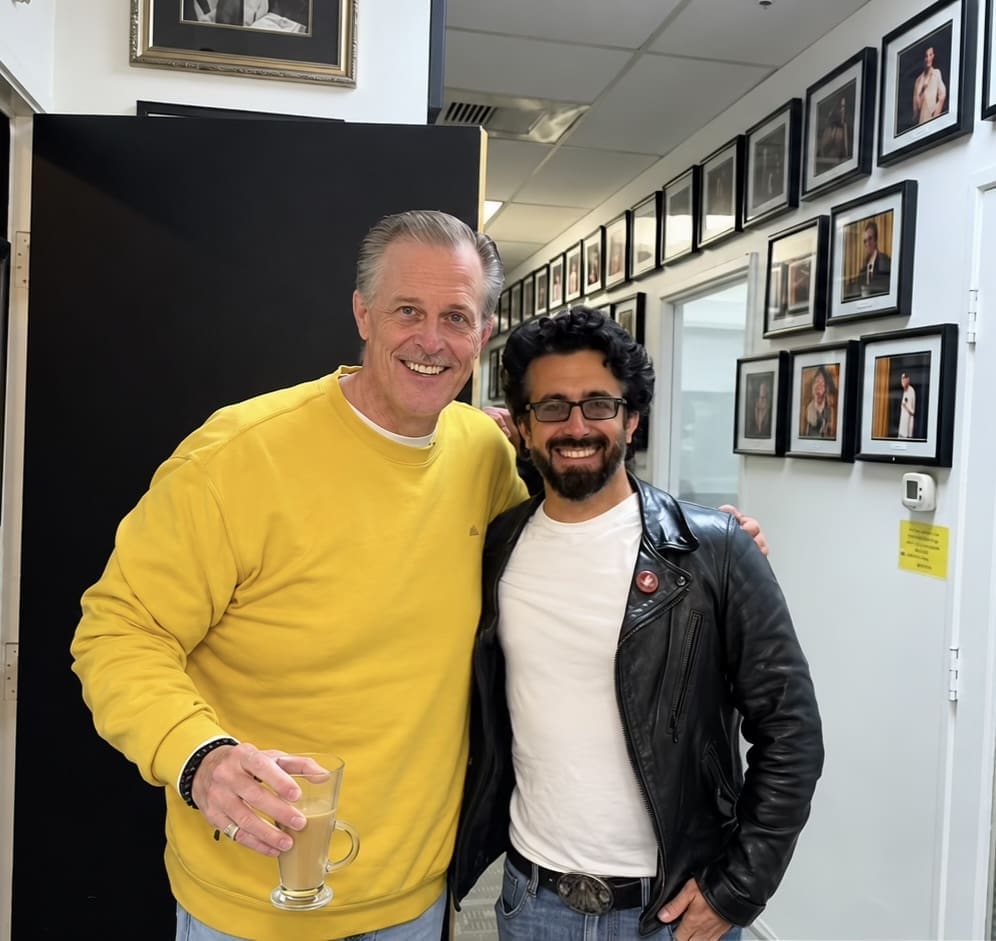
Written by John Poveromo
Billy Gardell has spent much of his career playing people we recognize. We know their families, their frustrations, the way they try to hold everything together and occasionally make a complete mess of it all. As Mike Biggs on Mike & Molly, he brought a warmth to the screen that made the laughter feel like it belonged to us. Spend an hour talking with him and you begin to understand where that comes from.
There is a lifetime behind the timing: a grandmother who believed in him, a father who taught him how to keep going, comedians who showed him kindness, and hard lessons about what success can and cannot repair. He talks about journaling as a way of “clearing the highway,” getting the noise out of his head so he can reach what matters. That also applies to the conversation we had.
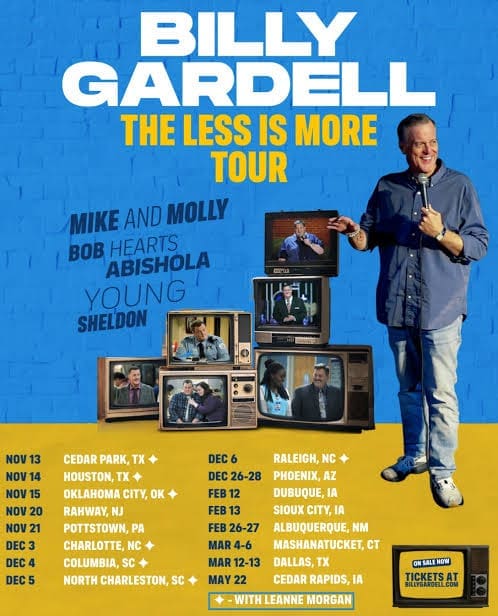
On November 20, Gardell brings his Less Is More tour to the Union County Performing Arts Center in Rahway, carrying that same affection for the working-class people who have followed him from comedy clubs into their living rooms. When we spoke on Dystopia Tonight, we talked about finding his voice, learning to be kinder to himself, and giving an audience an hour away from whatever is waiting outside. But with a Jersey show approaching, I wanted to begin with a an iconic Garden State memory. I was expecting the usual, a drunken boardwalk story, an “I lost a fortune in Atlantic City” tall tale, or even a pork roll/Taylor ham debacle. But Gardell had one to top them all involving a television rehearsal, an unexpected introduction, and a dinner conversation he is unlikely to forget.
You’re performing in New Jersey on November 20th at the Union County Performing Arts Center so I gotta ask. Any Jersey Stories?
All right, I’ll throw down the big one. One night at Mike and Molly, well, actually that day, Jimmy Burrows was directing work rehearsal. And he’s got a young kid shadowing him, kind of seeing if he’s interested in directing. His name’s Sam. Nice kid.
So we’re sitting talking at lunch, you know, “What do you want to do? And “I’m not real sure yet. I just was checking this out, because, you know, my dad knows Jimmy really well, and so I wanted to see if this was interesting, “ and We were talking about a book, and I gave him a recommendation for a book, and really cool meeting the kid, right? So that night, for the taping,
I’m getting ready to go out through the curtain call where they introduce you for the shows. And Burrows comes up and taps me on the shoulder, and I hear, uh…(if Jimmy liked you, he called you honey) So he’d go, “Hey honey, I want you to meet Sam’s dad.” And I turn around, and there’s Bruce Springsteen standing there.
Oh my god!
And I wish I could say I played it cool, but I yelled like a schoolgirl who had hot water thrown on her.
I couldn’t believe it. Um, he stayed and watched the show, and I’ve actually become friends with him and with Nils [Lofgren], his guitarist… Nils came out to see me and spent some time when we were in Phoenix together, and uh… talk about cats that are spiritual and true to their art.
Beautiful.
And don’t compromise, but in the best way, without arrogance. It’s powerful to be around those people. And two nights later, Jimmy had invited my wife and I up to his house for dinner, and Bruce and Patti [Scialfa] were there.
And it was probably one of my most incredible memories in my entire career because I got to sit and talk with him man to man. And we talked about everything, man. We talked about the working class. We talked about, you know, how do you stay in touch with your audience when you get successful, and, you know, how do you go about those things, how do you stay inspired, and I got to have that night. So, that’s probably my best Jersey story.
Your tour is called Less Is More. Beyond the physical change, what does that mean for you?
Same guy, less calories. Obviously, I address the elephant that’s not in the room anymore. That’s the first part of it. But the less is more thing is about slowing down and being an example for our kids. I got a 23-year-old who’s the most important person other than my wife in my life.
I’ve tried to remind him and his buddies since probably 11th grade that life is up here, (away from your phone) it’s not down here. And less of that is more life. That’s just kind of what I try to bring to my show.
I just spent the last few hours without my phone because it’s been updating.
I make a practice of at least once or twice a day leaving the house without it.
Wow, that’s bold.
I’ve started reading books that you hold in your hand again. I’m like, my generation’s last of the old knowledge. “You hold it and you turn the pages.”
But what it’s done, it’s re-lengthened my patience and my focus as well. When I first started coming back on the road, I didn’t realize how much that thing had affected me. I sat down to start reading a book, and I hadn’t done it in a while. I’d read a whole page and go, “What the hell did I just read?” And I’d have to go back.
But the practice of getting that book, opening it, sitting quietly, and reading it has really lengthened that focus again for me, which is good. And I try to journal every week, too. I think it’s pretty important to move the pen across the paper.
When you journal, are you trying to get what’s in your head onto paper, or are you still in comedy mode, thinking some of it could become material?
I like to journal to clear the highway. Maybe I have a few things that I want to journal on. But I find that if you get those random thoughts out of your head beforehand, it’s kind of like clearing the highway. And then you can write on the things you’re trying to write on.
And then when I’m really stuck, a buddy of mine who was a mentor of mine, Ben Creed, gave me an exercise 30 years ago. It still works today, and that’s just the simple thing of taking a piece of paper out and drawing a line in the middle, and then on one column, putting, “I hate.” And then putting on the other side, “I love.”
And he said, don’t try to be funny, just write down the things you hate and the things you love. And then go back, and when one of those things sparks an idea, try to run on that a little bit.
There’s this idea that comedians all come from the same dark place. How did you find your way into it?
I think everybody gets in for a different reason. Every expression of art is a way to heal yourself. There’s an old quote: “If your art has helped heal you, you’ve already survived.” And I really dig that.
By the time I was nine, I knew I wanted to be a stand-up comic. I used to watch Johnny Carson with my grandmother on the weekend. The house was chaotic, so that was a safe place. I asked my grandmother, “You think I could be a comic?” And she said, “Yeah, I believe you could if you want to put the time in.” And I loved her so much that I never bothered to ask anybody else.
The other side of that was my father. My father was an artist at heart, never got to realize his dream. His big phrase was, when something bad happened to you, he was always like, “So what? Now what?” And his other one was, “You can quit tomorrow,” because tomorrow never comes. So you can quit tomorrow. Do whatever the hell you want tomorrow. It’s not today.
He also had a wealth of great films in his head, and his comedy records were a big influence on me. I learned early that laughter could get you out of a fight, laughter could calm the situation down. If you had the gallows humor, and you could make fun of a dark time, you could kind of get through it with a buddy.
You talked about performing as a way of being of service. How did your relationship with the audience change?
When I do stand-up now, it’s not for me. It used to be just for me. And what I found is, when I switched that onto the service plane, and I started thinking about my audience, which is usually a very working-class audience, maybe, especially in today’s economy, maybe I’m their one night out for the month.
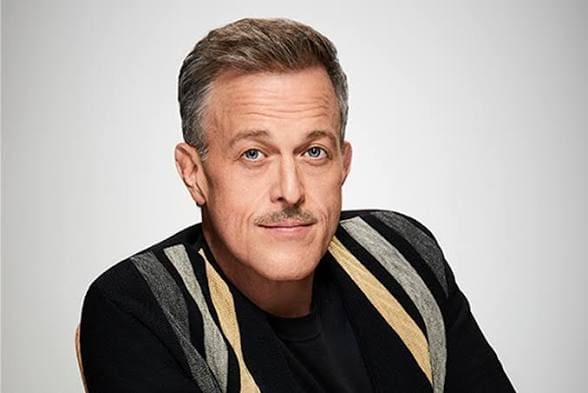
So I don’t need to change who they are or how they are. I need to let them forget their problems for an hour.
We were recently at the Comedy & Magic Club together. Being there felt rejuvenating to me. Do you still get that feeling from certain rooms?
That’s one of those special gems that’s still left in the comedy world, where you’re like, “I’m an artist this week. And I’m hanging around other artists.” There’s a vibe down there that’s always been great.
There’s a few diamonds out there. Denver Comedy Works. Hilarities. I’m a fan of Comedy Off Broadway in Lexington. It’s another legendary club. Good quality always. You had to work your way up into those clubs.
What I would try to do is I would try to find those gigs that really made me feel like that. When I booked my schedule, to the best of my ability, I would try to put one in there every six or eight weeks.
Because comedy at the beginning is such a lonely ride. When you’re in the car driving to the gig, your mind starts to work on you. What am I doing? Is this crazy? That sucked, I’m not any good. I got no money. And then you roll into one of those weeks, and you’re like, “I can do this for the rest of my life.”
I always found it was important to drop those in the calendar, just as a reminder: this is where you’re headed, this is what you want to get to.
Who were you coming up with, and how did those relationships shape you?
Our open-mic night was me, Darrell Hammond, Larry the Cable Guy, Carrot Top, Wayne Brady. This is all of us on a Wednesday night. Tom Rhodes and Larry the Cable Guy, who was Dan Whitney, they were out on the road on feature acts, but they would come hang out on open-mic night.
I give Rhodes a lot of credit for turning me on to Kerouac and Arthur Rimbaud. Tom’s a very literate guy. And then my other mentor, Ben Creed, really taught me how to not take myself so seriously.
Me and Darrell Hammond still go to lunch now, once or twice a week. And we just talk about what hurts and what we can’t eat. But back in the day, it was a great group of guys to be with because everybody was kind of rooting for each other. None of us knew if any of us were going to ever make rent doing this.
But everybody had a different voice and there was room for that. And not only that, it was encouraged. It encouraged you to really find your voice.
Joey Kola took time with me the week I emceed with him, and just talked to me with so much respect and reverence for what I do, and was so kind. I immediately thought, if I ever have an opportunity with a young comic, I’m gonna be like that guy. And I’ve held true to that.
I think it’s just important to be a veteran and walk in and go, “Hey man, great job. Nice work. Really good stuff.” You remember that. I remember all the guys that were nice to me, man.
Did you have people you emulated early on? How do you take those influences and find your own voice?
It’s your version. It’s okay, you’re gonna have influences. This idea that you’re not gonna be influenced by other artists is absolutely delusional.
One night I’m watching an interview with Carlos Santana. He was talking about his guitar, and he said, everybody has to play the same notes. E, A, G, B, C, B-flat, C-sharp. He goes, it’s how you tune your instrument.
It’s the same note, but it’s my sound. And they got that sound by hearing a sound and then changing it to their own personal effect, but it’s still the same note. We all have to play the same notes, but how do I tune my guitar so it sounds just like me?
My early influences were George Carlin, number one. Richard Pryor, live at Long Beach, probably the most perfect performance by a stand-up that I’ve ever seen. Bob Newhart, The Button-Down Mind. Dennis Miller’s Mr. Miller Goes to Washington. Eddie Murphy, Delirious.
And then acting, it was always three guys. It was Jackie Gleason, because my dad was a big Honeymooners fan. John Candy, because he was my era, SCTV and his movies. And then Paul Newman was probably one of my favorite actors of all time.
One of the things I learned from him watching his work: nobody listens better than that guy. That guy’s fucking interesting when he’s being talked to because he’s so present in the scene. So I kept that, but I didn’t take any of his personality or his traits. I learned the lesson and technique from him.
You knew you wanted to do stand-up at nine. When did acting become something you wanted to pursue?
I wanted to be an actor from probably 10th grade on. I had a great drama teacher in high school. This guy took it so wonderfully serious. He really wanted to convey this to anybody who wanted to listen. Tenth, 11th, and 12th grades, this guy was teaching us about , and Meisner, and Chekhov.
He always picked these depth-driven plays, and then made you look for that. At a young age, that had a big impression on me.
When I got to L.A., I went to a cold-reading class, which is where you kind of learn to prepare quickly, then do your audition in front of the class. They put you with a scene partner. Here’s a couple pieces of dialogue. Go outside for 20 minutes, come in, perform it for the class, then get your critique.
I did that twice a week for probably the first two years I was out in Los Angeles. And then I started to just book jobs. You learn to listen. And that’s the most important part about acting, is listening naturally. Because then you react naturally.
Know the words so well you never have to reach for them, so you can be in that moment.
What does a stand-up have to learn about being the lead in a sitcom?
You had to understand you weren’t going to be the funniest guy in the room if you’re the lead. Number three is the funniest. That’s the funny guy, or girl. Comes in, drops the line, disappears, everybody laughs.
As a lead, you have to react to everybody’s insanity. Your job is also to be believable enough to push the story forward.
One of the things that keeps you from doing a hacky sitcom is emotion. Chuck Lorre believes in the Norman Lear method, which is the more you make an audience care, the harder they will laugh when you ask them to. So you have to do the emotional work. If I don’t care about these characters, I’m not watching this.
Nobody lives in a world where it’s funny quip, funny quip, funny quip, commercial. No one lives on that planet. We have to see some heartbreak and some fear or some disgust or some anger. And then the comedy allows us to escape that.
What we would always say on the Mike & Molly set, Burrows would always say, “We need one ‘Baby, you’re the greatest’ moment every week.” The moment in The Honeymooners that made you realize all his barking was just blowhard shit, and he didn’t mean any of it, was when he had to apologize to Alice for messing everything up and tell her he loved her.
When you bring the audience down into that, now you got their soft underbelly, and then you can hit them with a laugh, and it makes the place explode.
Are you auditioning again? What are you hoping to do on the acting side?
Once you get stamped as something in Hollywood, that’s what they think. My manager, Judy Marmel, can see. What she spent the last year and a half doing is getting me in front of dramatic casting directors who cast high-level stuff.
I’ve taken a couple guys into the playoffs, where it was just me and one other guy, and the other guy got it. But I get that. That’s part of the game. The win in that is, this casting director who may have looked at you as just a sitcom actor, now they see a good audition, one that gets noticed and almost gets down to the wire. Then they go, “I didn’t realize he could do that, so keep submitting him for our projects.”
I’ve always played this really sweet guy, which is part of me. I try to be that guy. But I’m also a kid who survived a lot. I’ve survived obesity, I’ve survived drugs and alcohol, I’ve survived abuse when I was a kid. I left the house at 17 with 26 bucks.
I want to play a guy who’s got those kind of layers. I love a flawed hero. I love a bad guy. I love a guy with redemption. That’s my favorite, is a guy with redemption.
You gotta build it a brick at a time, and then all of a sudden, people go, “How did we miss this?” At this point, I do it because I love it.
If you could go back and talk to your younger self, what advice would you give him?
Learn to be kinder to yourself.
I hired a food nutritionist slash therapist to help me on the other side of my bariatric surgery so that I could stay consistent after the surgery. And she said, you have to learn to love yourself. And I was like, yeah, yeah, yeah, yeah. And she goes, no.
She said, if you can’t be kind to yourself, there’s no way you can change anything. You have to do that with love. You can’t do that with criticism.
She said, how much do you love your son? And I said, there’s nothing. I would lay my life down for my son. She said, I need you to love yourself 10 percent of that.
And she said, every day when you look in the mirror, all I want you to say is, “I’m going to take care of you the best I can today. I love you.” Now, as cheesy as that sounds, that’s the reason I’ve been able to stay thin.
What had to end in your life, good or bad, that led you to where you are now?
Drinking. Had to put the bottle down, man. I almost lost everything. I almost lost my wife. My kid was five at the time. And I just could not stop drinking.
And I had a wise old man who was sober a lot of years tell me, he said, “Billy, I’m just gonna tell you it like this. You can have a drink. Or you can have everything else.”
And I chose everything else. I couldn’t stop it on my own. And I got some help.
I’m great, dude. I don’t even think about drinking. I have no desire at all to drink. That’s a miracle, man. And that comes from being of service.
Last question, tying into Dystopia Tonight: if we had 24 hours left, what do you think would end the world, and how would you want to go out?
Bad men and greed is how I think this thing ends. Until we learn that a man is only strong when he is kind and compassionate, and knows how to be strong and secure in that, I don’t ever see us getting out of this. But I have the hope that that will happen.
If there’s 24 hours left, I live in Los Angeles, man. You’re not getting on the 101, the 405, the 5, Beverly Glen or Laurel Canyon at 9 a.m., so I already know I can’t go nowhere.
I’m going out back in my pool, and I hope the bomb hits my house, because I’m not built to forage, or search for fucking water, or eat powdered milk. I’m not doing any of that shit.
Just get out in the pool, have a lemonade and a floatie, and just watch the big orange ball head towards me. I’d be fine with it.
I’m not built for the aftershock, man. That’s all.
Billy Gardell’s Less Is More tour comes to the Union County Performing Arts Center’s Main Stage, 1601 Irving Street, Rahway, on Friday, November 20, 2026. Doors open at 7 p.m.; the show begins at 8 p.m. Tickets are listed at $51–$97 with all-in pricing. Visit ucpac.org for tickets and information.
Editorial contributed to The PopBreak by John Poveromo, a nationally touring comedian, cartoonist, writer, actor, and the host of Dystopia Tonight with John Poveromo on, ApplePodcasts, Spotify and YouTube. John’s been seen on Gotham Live, written for Newsweek, and has a short film on Amazon Prime titled, “Duppet.” Subscribe on www.dystopiatonight.com fol