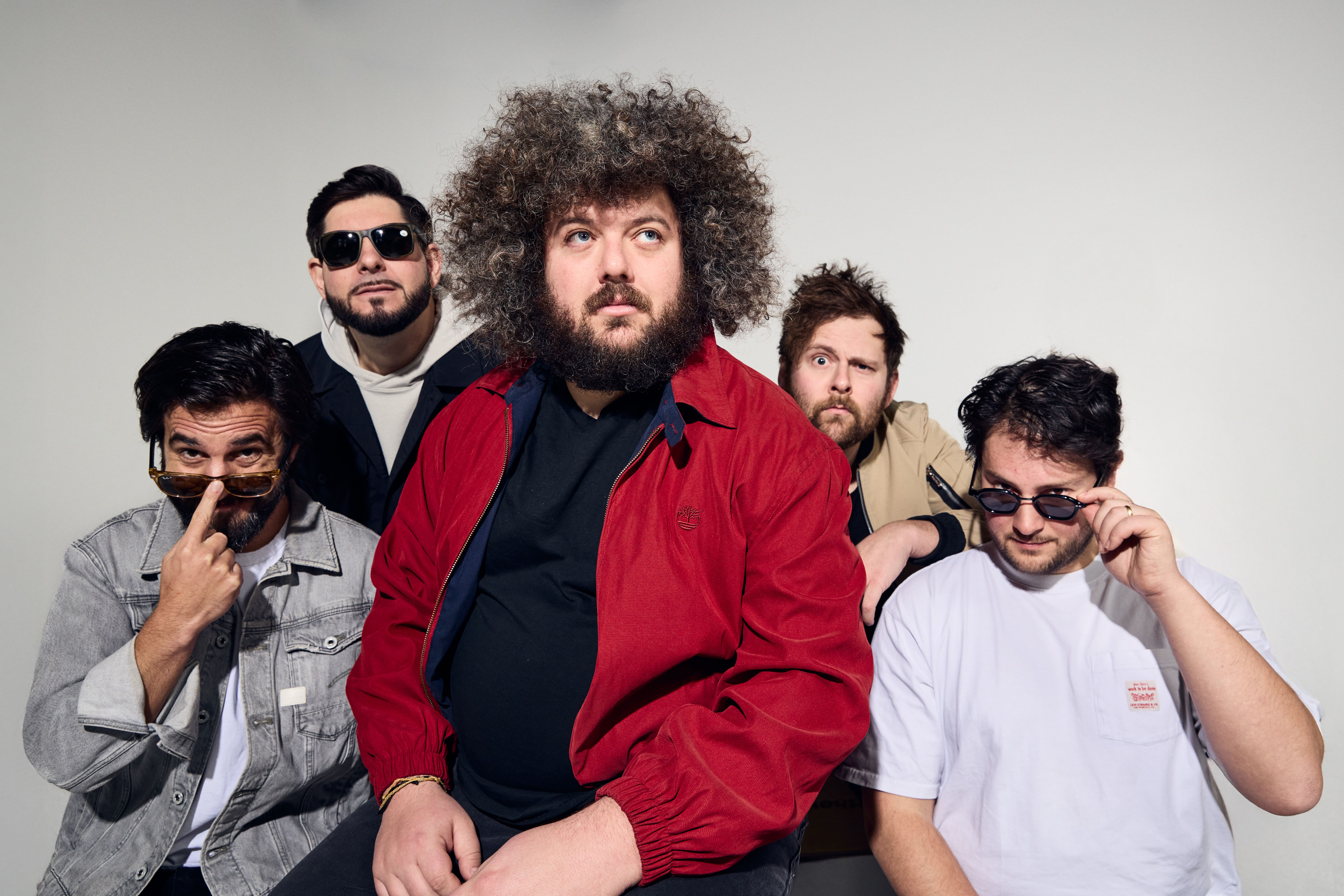
In 2019, a wild-haired man and his band rolled onto the stage at the Sea.Hear.Now Music Festival in Asbury Park, New Jersey. Before their sun-scorched set began, the audience knew little of this band. By the end of the set, the crowd would never forget the name, Ripe. No longer a way to describe fruit ready to eat, or if someone hadn’t bathed — Ripe was now a word synonymous with the joyful explosion of sound that washed over thousands of people, and converted them to fans of this Boston-born band.
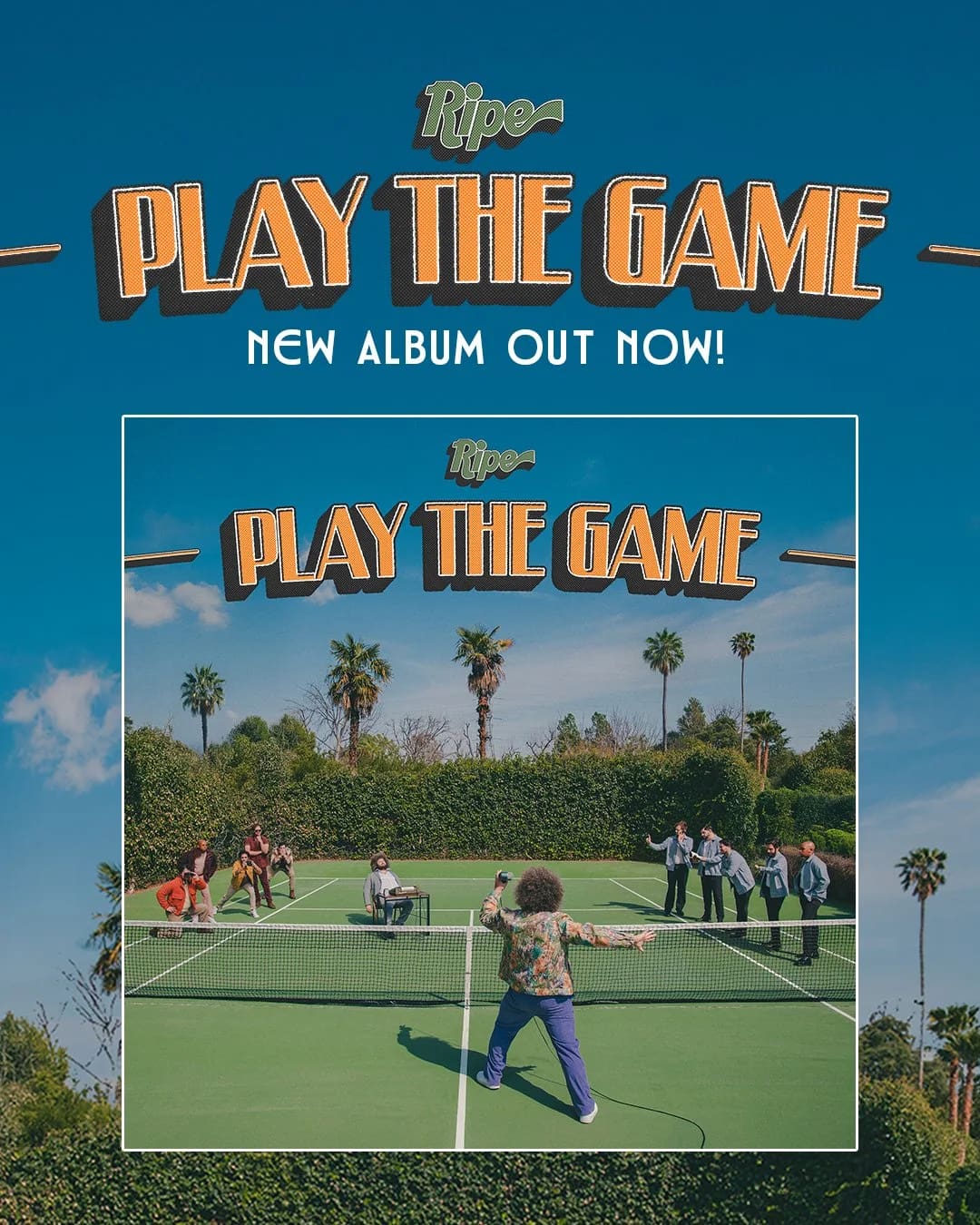
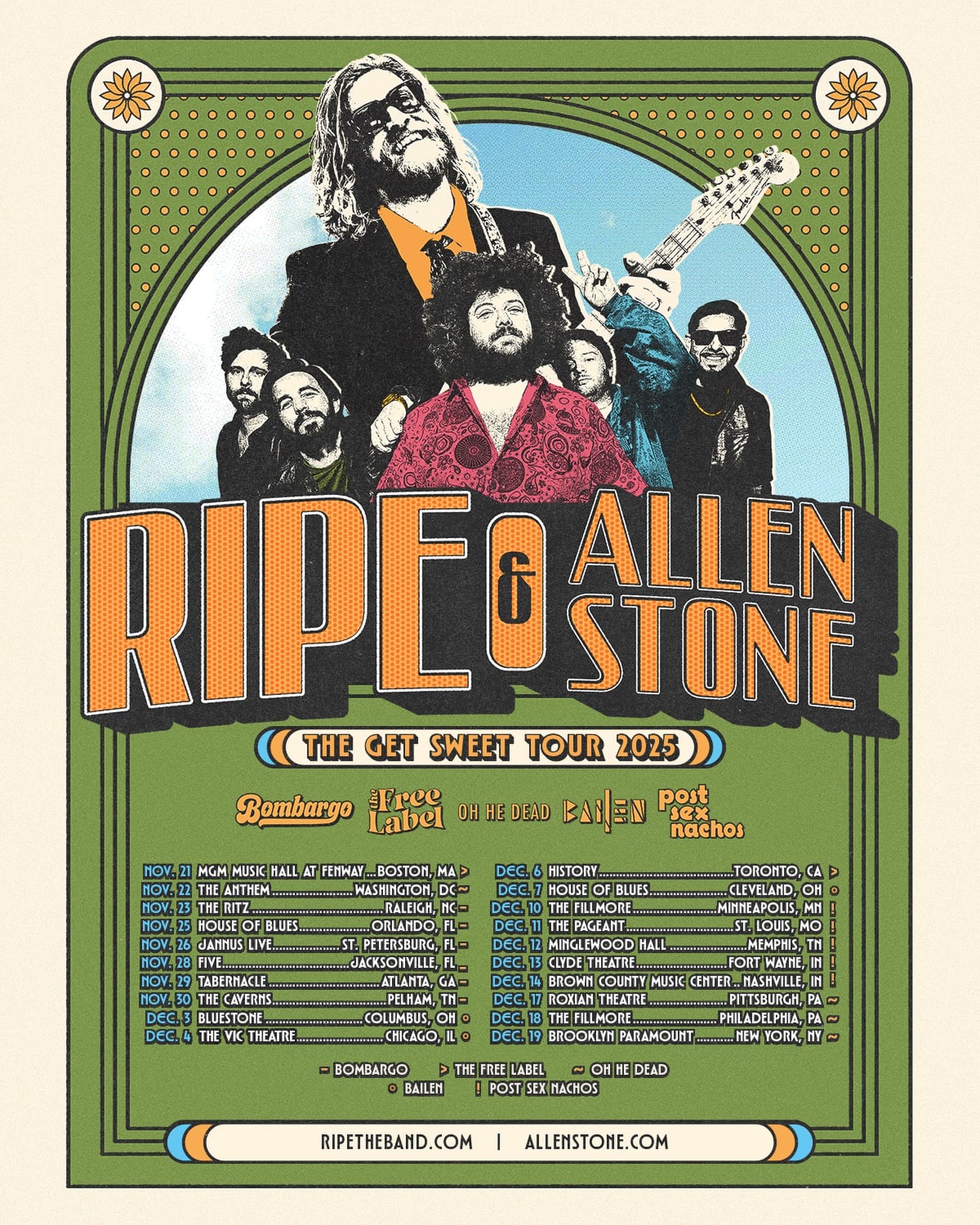
Since that fateful day, Ripe, like many bands of the time, has rode the waves of the pandemic and lineup changes. Yet, that joyousness as well as ever-evolving belief and understanding of themselves in the world of music, buoyed them through every storm. This year, the band dropped a brand new record, Play the Game and embarked on a nation-wide tour with soul savant, Allen Stone.
We spoke with Robbie Wulfsohn about the creation of Play the Game, Robbie’s chance encounter with Neil Young, grappling with the idea of nostalgia, finding themselves within the music world and more as the tour winds down for a stop at The Brooklyn Paramount on Friday December 19.
I was reading your bio on your website and I think it was one of the most striking bios I’ve read because of how I felt with such heart and sincerity in it. I really wanted to unpack some of the things in regards to this album. I want to start with how you feel like every album you have to tell a story about the band. How do you feel like you’ve been talking about the band throughout the years, and in this record how it’s different?
I think the way I would phrase it more is that, when you’re making a record as a band, you are inevitably telling the story of the band at that time. Even though not every song is explicitly about, ‘Here’s where I’m at right now.’ We were constantly traveling over this ground of ‘We’re making an artistic statement to the best of our abilities.’ And the only real thing that’s changed since last time is that time has elapsed, and that in that time X has happened.
I’ll just talk through the three records where it’s like Joy into the Wild Unknown (2018)was the capstone of the entire life of the band. Up to that point we’d finally gotten the resources and the runway to make a record. We finally had the songs from the entirety of our career up to that point that we wanted to make something with and we punted for the producers that were the biggest reaches we could at the time. We wound up connecting with Corey Wong and making the record with him. It was sort of our first time of even being able to put language behind the sort of ethos of trying to make music that was cathartic and joyful on purpose and build that world. It was sort of the ability to finally give this, at that point very grassroots live following, something to sort of attach themselves to that was of like larger artistic intent.
Cut to Bright Blues (2023), not to jump on what I’m sure everyone else says about records made in this time, but that was our pandemic record. We had major membership changes. We had like a total overhaul of the process by which we focus on our songwriting. We brought in outside friends for the first time in that way. It was really about the sound of a bunch of friends tap dancing for their lives. Also the idea of just that this music gets to exist is a miracle — so we’re going to do all these things that might not be how we envision record two coming together. So much of it was cut with the producers in California while the band was in Massachusetts because that was the world at that point. I think that Bright Blues feels like it was trying to capture a moment of the band and was very self-aware of its own survival. It was trying to pull itself out of the muck through love and through the feeling that the music gave us.
Play the Game, to me, feels like we get to marry the best of both previous worlds. We did not view this as a record like we might not survive to the end of. We’ve read this as a record where we were finally allowed to take everything we’ve learned and take the fact that it doesn’t feel like we’re going to fold at any minute and put that into a really big swing for the best record that we know how to make. We were able to reach out for bucket list producers and work with one of them. We were able to get into studios that weren’t even on my bucket list because the idea that I’d be able to get into them at some point in my life was foreign to me. When I was a teenager this was a real swing for the fences of just like what does Ripe sound like when Ripe is self-consciously trying to do the best they can with the actual ability to do things that we want to do rather than just being hemmed in by what’s possible in a given moment.
A lot of our friends were involved in the writing process, and we had more collaborators than we had prior, but we all filtered it through one guy that we trusted because of his experience working with bands. We were able to have parts of that record come together with everyone making eye contact and other parts really use full studio wizardry to get the sounds that we wanted.
It’s our heaviest and lightest record within the songs that we recorded for this body of work. This is the sound of a band. That feels like it was tasked with, ‘You can do whatever you want. You just need to make something good and real. What does that look like for y’all?’ I think it comes to be about the process by which that record gets made, and also the feeling. It’s more complicated than we thought it was to play the inner game where you’ve removed a lot of the external obstacles to make something great. I think that there is a bit of “necessity as the mother of invention” to the first two records.
I think that the necessity of this third record is inherently different from the other two. Now we need to do this because we feel incredibly driven to make these artistic statements, to continue to make music that feels like an extension of us and feels like something for us to share with our community and to kind of build the world that we’re always going to be trying to build with this band. But it’s not like, if this doesn’t happen, we are dead. It’s like, we really, really, really want to do this, and that internal drive feels so powerful that it winds up feeling necessary. But in a way that is still somehow fundamentally different than the last time it felt necessary. Does that make sense?
Actually, I 100% understand all of those sentiments. Another sentiment, or rather I should say theme you touch up is nostalgia. We talk about a lot of it in the world of pop culture, and how it’s such a complicated thing. I want to dive into the concept of nostalgia and how it applies to what you talk about on the album.
I think that I have a fraught relationship with nostalgia myself. I think that the main thing that is kind of obvious, but overlooked in conversation, is that nostalgia is an active thing. The past is the past, but nostalgia occurs in the present and. My fear with nostalgia is that you have your back to oncoming traffic because you want to look at the road you’ve already taken. I think that people use nostalgia as an escape …that slope sometimes feels slippery where it’s like you can’t actually re-inhabit the past moment. So that form of nostalgia feels like it almost inevitably fails if you look at it for more than a few minutes.
But, I do think that the idea that life is sort of like a movie, in the sense that it’s a bunch of still images that the eye confuses for one contiguous thing … I think that can be really nice. The idea that nostalgia — as in thinking that a moment captured something that you think makes a lot of sense — is worth reinterpreting for the present day.
I’m going through a weirdly massive phase with Bruce Springsteen’s Born in the U.S.A. right now. It’s a record I was not alive for, but the feeling of sort of nostalgia that that record gives me, even though it’s not my nostalgia, is inspirational to create new frameworks and new thoughts in 2025. The up and down arc of tiny hopes and massive hopelessnesses of that record. The way that it was created, and the way that it was contrived [especially with]. The relationship between Bruce and Little Steven during that time, at least the way that’s told in the public eye. For my own head, sometimes that feels like you’re making more of a history of something than a nostalgia of something.
I still think that that framework for this past event yields new things for the present and future, and that feels really important to hold onto. I don’t know exactly how to use the language, to separate one thing from the other, but I think when you’re using it, to put up walls between yourself and the present and future, I get scared. But when you use it to kind of give yourself a map to the present and the future, I think that it’s really good to be grounded in a history and a past. The idea that you’re striving for the best days of your life, because you remember what those are makes a lot of sense to me. It’s just don’t be hopeless in the fact that because they were good in the past, they can’t necessarily be that kind of good again.
You mentioned working with a bucket list producer, and in a studio not even on your bucket list. Was this intimidating, or was it exciting?
Both fully. It’s like you put yourself in a situation where all you need to do is be great. You’re going to trigger every insecurity you have about. What if I’m not actually great? And I’m going to tell this story often because it lets me say that a really fun thing happened to me.
A few days into recording at the first studio, we’re at Sunset Sounds. We walk in, and we see two extra nice cars parked there. It turns out that Neil Young and Steven Stills are in the studio next door because they found a lost CSNY concert. Then … the entire building’s A/C failed. So we’re all in the basketball yard outside chatting. And speaking of complicated nostalgia, I got to tell Neil Young the truth, which is that the first song I ever wrote in 8th grade was essentially a bald-faced rip off of “After the Gold Rush” so I could get a girl to like me. I got laughed at by him for that story, because that story is frigging funny.
But again,I hold on to that memory as if it isn’t funny how something so childish and so endearing in that way can turn into the rest of my life. And now that’s in the present moment because I held on to it. I got to share it with the person who made it possible under completely surreal circumstances. And now I have my warped memory of his laughter in response to that, as him, and Steven Stills mock us at our basketball skills because none of us are good at basketball.
We make music. It’s fine. It was just one of those things where I think there were so many moments of like, even in that interaction, it’s like ‘What the fuck am I going to say to Neil Young?’ And then I tell him a story that’s actually very close to my heart, and I’m sure not all that different from what people have been saying to him for 70 years. You actually dive into like, what if I wasn’t afraid? And it turns out there’s more going on than just like my insecurities about whether or not I actually have great music in me.
So did it work for the girl when you wrote that Neil Young rip-off?
I mean in the sense that I’m now in a relationship that I love to death in my thirties. Yes, it was exactly what I needed at the time, in the sense that this 8th grade girl liked the song that I never even showed her. No. I didn’t know what I was doing long enough that I got time to figure out what I was doing.
Getting back to dream producers I’d love to know who you got and what they brought to the table.
It was a guy named Joe Ciccarelli. He’s done all sorts of work. The record that was probably the one that we most agreed upon that we loved was, he is the primary producer on Angles by The Strokes. I think that the major thrust was, we knew we wanted to do this record more like a band than [we did on] Bright Blues. Not because we have any issue with how Bright Blue sounds, but like I said, the producers weren’t able to be in the room. Jon [Becker] and I did a lot of our most important recording in California and in a pod there, while the band was doing stuff in Massachusetts.
We just wanted to bet on, what if we made things that are most makeable as a band and that informed the writing that we did around the record. Then, when it was time to make the record, we were looking at people who we felt had captured a really exciting and immersive band sound, and he was one of the names on the list. Through working with Glassnote, and some wonderfully serendipitous connections, next thing we know, we’re talking to him in his little studio setup attached to Sunset.
He was right in the process of moving out, so I think we wound up being the first band to record at his new space in East West. We got to split our time between Sunset Sounds and we recorded in the room where The Doors did their records. Then moved to East West, and when we did horn tracking it was in the room where Frank Sinatra cut, “That’s Life.” Again, the only pressure is to make something great, but that’s some damn serious fucking stakes to work with. Pardon. The swearing.
No fucking problem at all. Was there a conscious effort to try and push the envelope on how you sound by dipping your toes into different sounds and genres?
I don’t think it was self-conscious, necessarily. I think it was more about trying to refine the way each song breathes as an individual song. The genre conversation is always an early stumbling block that we eat shit on because we are trying to be a bunch of things at once, and that means it’s not easy to put us into a box. And there was an epiphany kind of thing where it’s like we just want to be a rock band. We think that, the history of that word, probably slots nicest into what we want to be, where it’s like everything from Rush to Chicago to Creed. But right now, trying to make it like capital R, Rock music in 2025.
The people that are doing that the most successfully don’t necessarily feel like our biggest peers in the music world but I think it’s the feeling of what if we stopped worrying about the way these things are going to be perceived and just pulled from the sort of totality of the catalog that we pull from. Because even the bands that we pull from that are not rock, but are from genres that have informed rock music for the entirety of their existence. From stuff at the front edge of Hip hop, as a more experimental genre when it was first coming out to whatever alternative is to the fact that everyone’s always pulling from R & B and the blues. We’re also pulling from the folk traditions.
It just kind of kind of made sense to, at least to me, that we’re just a rock band making rock music, and the fact that we don’t sound like other bands claiming to be rock bands making rock music is not for us to make any more sense of like. Let’s just make stuff that feels like the music. We want this band to make the loudest and quietest songs we’ve ever made in this period of recording. I think that to try and make the music and the artistic statements and the songs that we think are most individually resonant rather than making a song that’s an acoustic ballad, and saying that doesn’t really fit the ethos that we’ve decided that we’re in. If you wrote a compelling song…
Exactly. It’s why you put yourself in a box. Just put good stuff out.
Yeah, and at the very least, let the box be choosing songs. You got to the finish line. We have a little bit more recorded than we’re putting out with this record, and that’ll probably see the light of day down the line. Be intentional in the way that you tell the story, but don’t like kneecap ideas because they’re not feeling the arbitrary top down right shape before they exist. Let them exist. And then, if you really don’t like them, it’s very easy to not put something out. I’m doing it right now.
When I first saw the band perform at Sea.Hear.Now in 2019, I was struck by how positive, happy and joyous the band is. I was struck by this right off the bat, and I can hear that throughout the entire album. Is this something intentional the band does, or did this just spring from the creative font?
We did not come into being Ripe and into the first number of years as Ripe, with a clear head of an idea of what we were building. I think we were moving, based on what felt right and what spilled out was what felt most correct. I think it wasn’t really until the world around Joy and the Wild Unknown, which is still 5 years into the story of the band, that we started to even arrive at some of the basic tenets of what we now talk about as the ethos of the band. That’s why I think you’re always telling the story of the band because I wouldn’t want to have that stuff be forced into being. That stuff has to arise naturally. But then, in terms of Where do you go? From? What arises?
Naturally, I think there’s something nice about being able to learn from what came about spontaneously and build it into something else. The same way that I think that songs that arrive out of improvisation but eventually become actual songs are amazing. I think that it doesn’t have to be that one is superior to the other. It can be a constant handing off from one to the other and back again. So I think that right now even as we sometimes have the lyrics be darker, or even as we sometimes pull into some darker sound palettes or quieter sound palettes we can take those risks because we have a clearer sense of what the ethos is, and we know how to bring it back.
My hope is that we can pull from a bunch of different genres, be inspired by a bunch of different writers, and even fold sad things into what we’re doing. Because we now have a clearer North Star than we did 10 years ago, we’re gonna get to the other side of that and still find a way to marry that to the longtime ethos of the band. So I think it’s because it’s become the second thing. We can now allow spontaneity to go in whatever direction it’s gonna go and be inspired by the stuff we’re inspired by in 2025 and not feel married to this older version of what was going on. We know how to build the bridge back to what we’ve been doing since day one. And so we can sort of allow our attention to go wherever it wants to go.
You have dedicated so much of your life to this band. What do you love about this band so much that you dedicate so much of your life to it and have for so long.
It always comes back to the people. Man, I love the people I get to do this with. And that has luckily been true at every junction, even as the lineups have changed. I think that I say this often, and I think people think I’m joking more than I am, but I have so much respect and so little understanding for people that feel like they’re doing this alone.They’re literally cut from a more intense and badass cloth than me.
This is crazy enough to do when surrounded by a chosen family and I think that I always come back to it just like I’m doing. I’ve literally become a more alive person through choosing to value this artistic process with these close people. I just think that it’s made me more of myself in a way that’s not that easy to explain beyond that. I think it’s true for the people that really get to throw themselves into it. I found kindred spirits. It’s like getting to try and push this forward with these people, and in the process discover what the thing even is, and also discover these people in the most intimate settings that I’ve ever gotten to spend with anybody.
Slowly me and my girlfriend are catching up. But it’s taking years. I just think that like the fact that it is something that is still rooted in like intimate human connection is something that like, I’m not trading that for anything.
I feel that I’ve been doing this. This site has been around for 16 years with different iterations, and as more as we take the journey. I really understand what you’re saying.
Yeah, it was one of those things where when we first started out, we were surrounded by so many bands because we were another group in college trying to do it. If you told me that, like the band-ness of it, might be a differentiating or unique factor down the line I might have legitimately laughed in your face. And now, I really think it is one of the things that has sustained us like a thing that makes us us is like there’s no smoke and mirrors, or like a quiet contract sign that says any difference.