Written by Matt Swanson
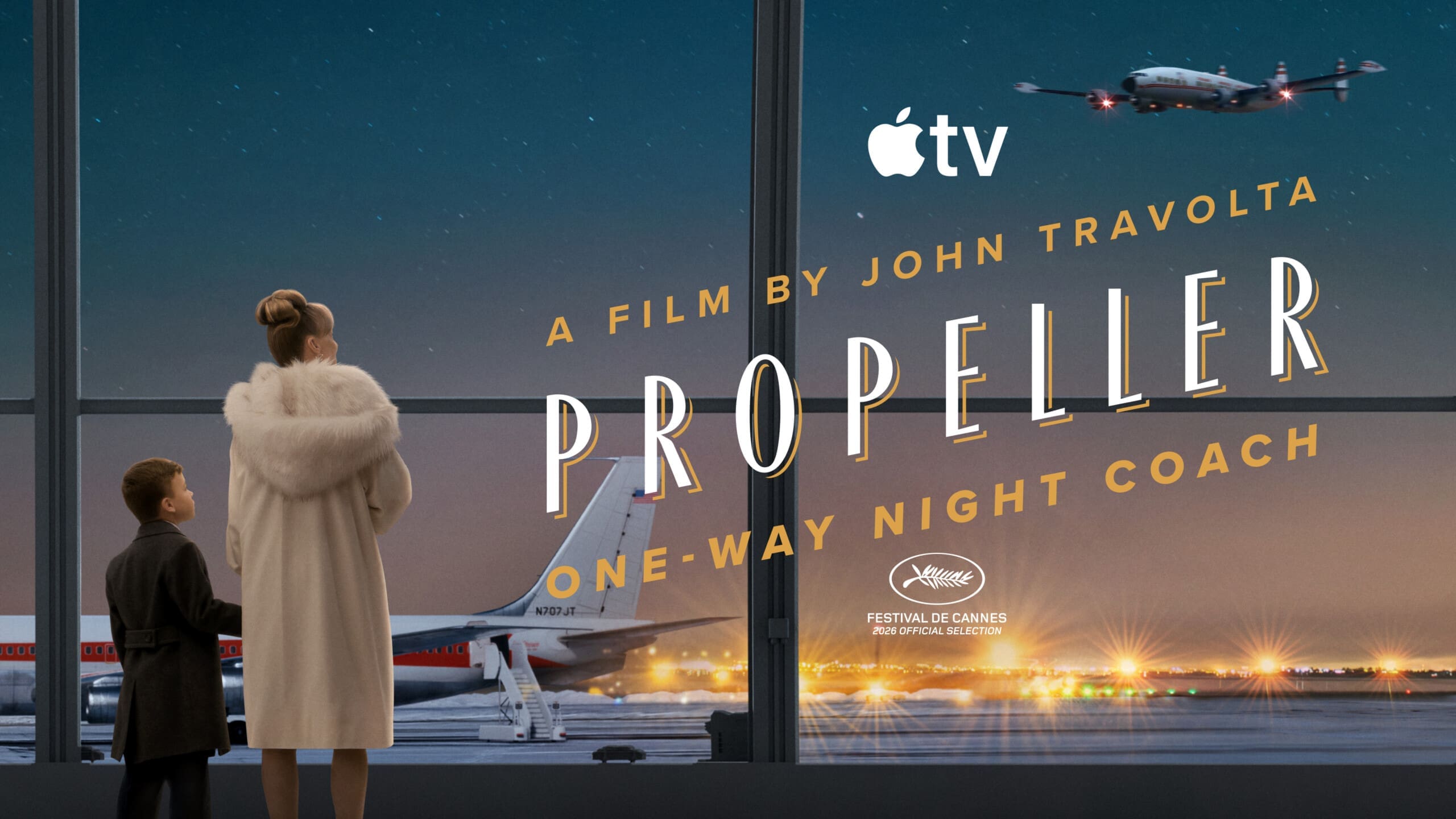
John Travolta loves planes. You’d be hard-pressed to find anyone working in show business who loves aviation more than the Grease legend. In 1997, he wrote a semi-autobiographical children’s book called Propeller One-Way Night Coach about an eight-year-old aviation enthusiast’s first flight. In 2026, John Travolta adapts the book for AppleTV in his directorial debut. The film adaptation is a short and sweet journey, and with a 60-minute runtime, it doesn’t overstay its welcome. It captures the beauty of the golden age of air travel, back when you could buy a ticket at the airport, walk onto the plane, and chain-smoke cigarettes for four hours. However, the film suffers from a thin plot and mostly unimpressive performances.
The film opens with the eight-year-old Jeff (Clark Shotwell) entering an airport with his mother Helen (Kelly Eviston-Quinnett). The film follows a narrative style similar to A Christmas Story, in which Travolta narrates the story as Jeff in adulthood. The narration explains that Jeff’s mother is an aspiring actress and that they are moving from New York to Los Angeles in order for her to pursue more acting opportunities. However, unable to afford a non-stop jet flight, the two have to take several connecting flights on propeller planes spanning multiple days and overnight flights. Jeff’s narration captures a sense of childlike wonder quite well upon his arrival at the airport. He is amazed by every minute detail in the airport and is in awe of the beauty of the propeller plane.
The entirety of Propeller One-Way Night Coach follows Jeff and Helen’s journey from New York to Los Angeles. Along the way, there are minor adventures for Jeff: he is extremely patient with his mother, he falls in love with a flight attendant, and he even makes a new best friend. But as far as driving conflict goes, do not go into this film expecting any high stakes. It is a cute and relaxing movie where you can turn your brain off a little and just feel Travolta’s affection through the screen. Considering Travolta wrote the book and script, produced and directed the film and is the narrator (plus makes a cameo in the film) — it can come off as a bit self-indulgent at times. Given how personal this story is to Travolta, it doesn’t earn the audience’s engagement as its style tries to compensate for the thinness of the plot. But for the most part, it succeeds in making the audience share Travolta’s nostalgia for the passion and innocence of youth and for an era in which flying was something special.
The film has style; it has a cozy, jazzy vibe to it and it effectively reproduces the sleek designs of the ‘60s in the airport, plane, and cabin. It is clear that Travolta yearns for the days when airlines put soul into their planes. In the current era of maximizing airline efficiency, gone are the days when air travel seemed designed to inspire wonder rather than simply move people from one place to another. Shotwell’s performance is effective at capturing Jeff’s amazement toward this airborne world. Travolta cast relatives in the majority of the peripheral roles, including his daughter, Ella Bleu Travolta, as the flight attendant Doris. The result is a credits sequence that looks like a Travolta family reunion. Casting family members is not automatically a bad decision, but it helps explain why many of the performances come off as underwhelming or even discordant with the film’s polished period design.
Travolta does a great job at capturing the beauty of the world through the eyes of an eight-year-old. It’s a special time when a flight embodies dreams. To a child, any destination that requires a flight is a journey into a whole new world. To Jeff, the pilots in the planes are genius heroes, shepherding the passengers through the hostile skies. To a boy, a beautiful flight attendant is impossibly enchanting.
It seems that Travolta didn’t go into this film with intentions of creating a compelling story with any challenging themes. Propeller One-Way Night Coach is most successful when it treats aviation as a child’s object of wonder and delight. However, the film never proves that Travolta’s nostalgic memories are dramatically rich enough to sustain a narrative feature film.