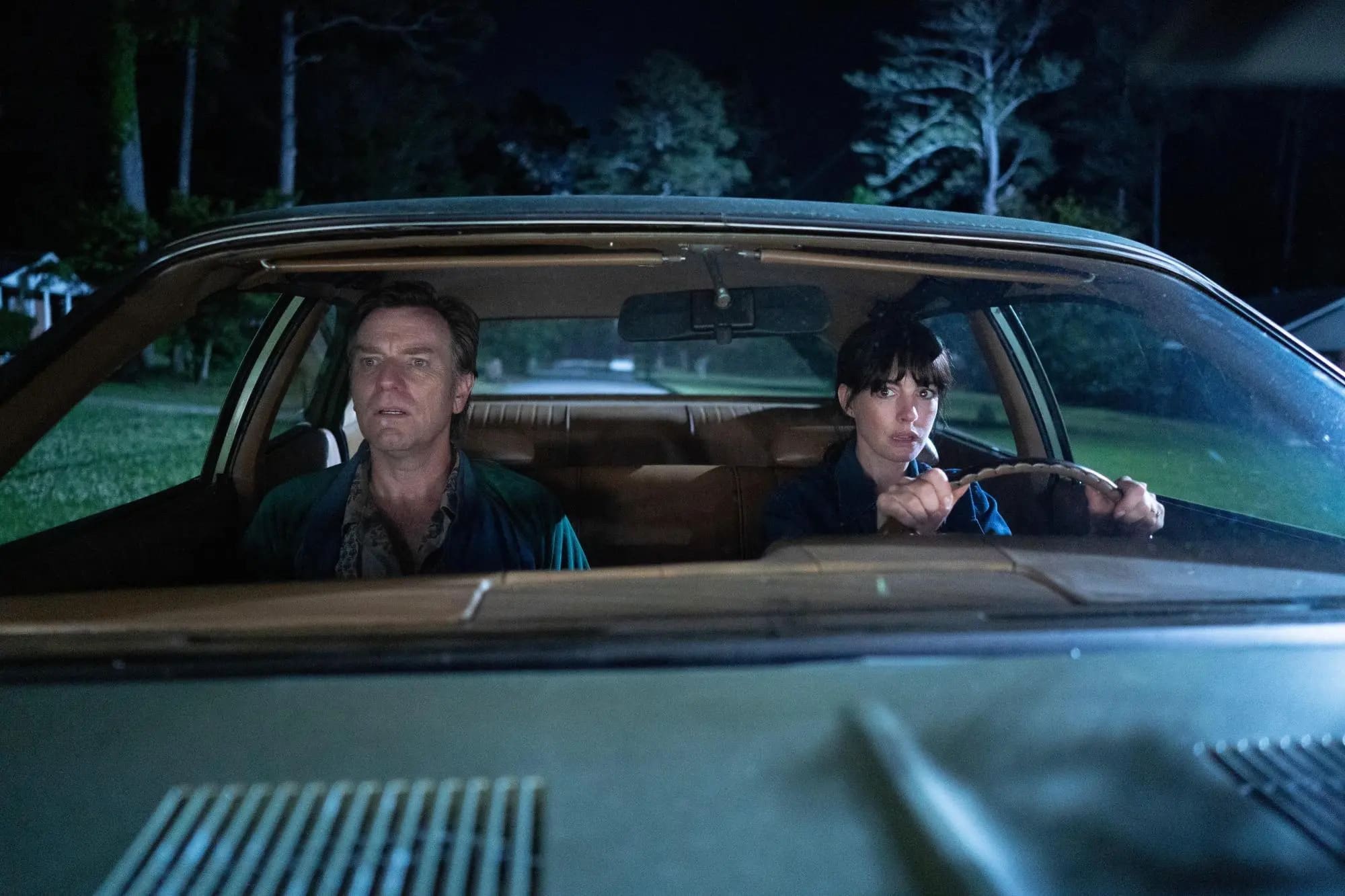
Imagine if the events of Jurassic Park happened to an unassuming Michigan neighborhood rather than a group of scientists. That’s exactly the scenario the Platt family finds themselves in in The End of Oak Street. When an unknown cosmic event transports the Flowerville neighborhood to an unfamiliar, eerily prehistoric place, the Platt family, armed with a rifle, a sledgehammer and a toy bow and arrow, is forced to band together to survive.
The film opens on an idyllic neighborhood barbecue complete with potato sack races and limbo competitions. It’s the summer of 1982, and it’s the picture of nostalgic Americana. But life is anything but perfect for the Platt family. Denise (Anne Hathaway) and Greg (Ewan McGregor) have been putting off discussing a divorce for too long, each hiding their own secrets from the other. They’re staying together for their kids, Brian (Christian Convery) and Audrey (Maisy Stella), who, in an unfortunately cheesy scene, discuss when their parents will get a divorce. It’s this image of a middle-class family struggling to get by that writer-director David Robert Mitchell uses as the backdrop for his time-traveling dinosaur movie. While the premise of The End of Oak Street is ridiculous, the execution creates a memorable, exciting and genuinely hilarious action film.
Mitchell does an excellent job of creating a believable and frightening world while focusing on the humanity of his story. Denise and Greg’s marriage problems don’t magically disappear just because they’re now fighting off raptors and spinosauri. Hathaway and McGregor truly shine here, able to bring the audience into the characters’ interpersonal problems while also selling the true shock and terror of living alongside prehistoric monsters.
Unfortunately, when making a monster movie, there’s no getting around the cheesiness (although Mitchell gets pretty close). Convery and Stella at times give convincing performances, but too often their fear is overplayed—especially their worries over the fate of their family. Convery, unfortunately, stands out as particularly cringey, primarily because Brian seems to be written as an elementary-aged kid while being played by 16-year-old Convery. Brian continuously feels too old to care so deeply and innocently about his dog, Starbuck, too mature to passively worry about his parents’ marriage, and too tall to be the target of barely older bullies. Convery is a bright young talent (as seen in The Monkey and Sweet Tooth, among others), so I hesitate to blame him for the way his performance reads. Instead, it seems the part should have been rewritten to fit a teenager if the filmmakers felt they needed Convery.
Despite some unfortunate moments, Mitchell really does seem to know when a moment cannot afford to be cheesy. When the emotions matter most, the writing and filmmaking come together to create impactful scenes. He knows when to let the moment speak for itself, rather than add unnecessary dialogue. Mitchell never has Denise and Greg reconcile their marriage through a conversation. He shows the couple coming back together through small moments, glances, and actions. And in arguably the saddest scene, where the family learns of the death of another character, only five words total are spoken, but the characters and the audience know exactly what has happened, leaving the grief to hang in the air long past the scene.
Mitchell and his team have produced the best dinosaur movie since 1993, creating a world that feels similar to Spielberg’s Jurassic Park but creates a name for itself all on its own.