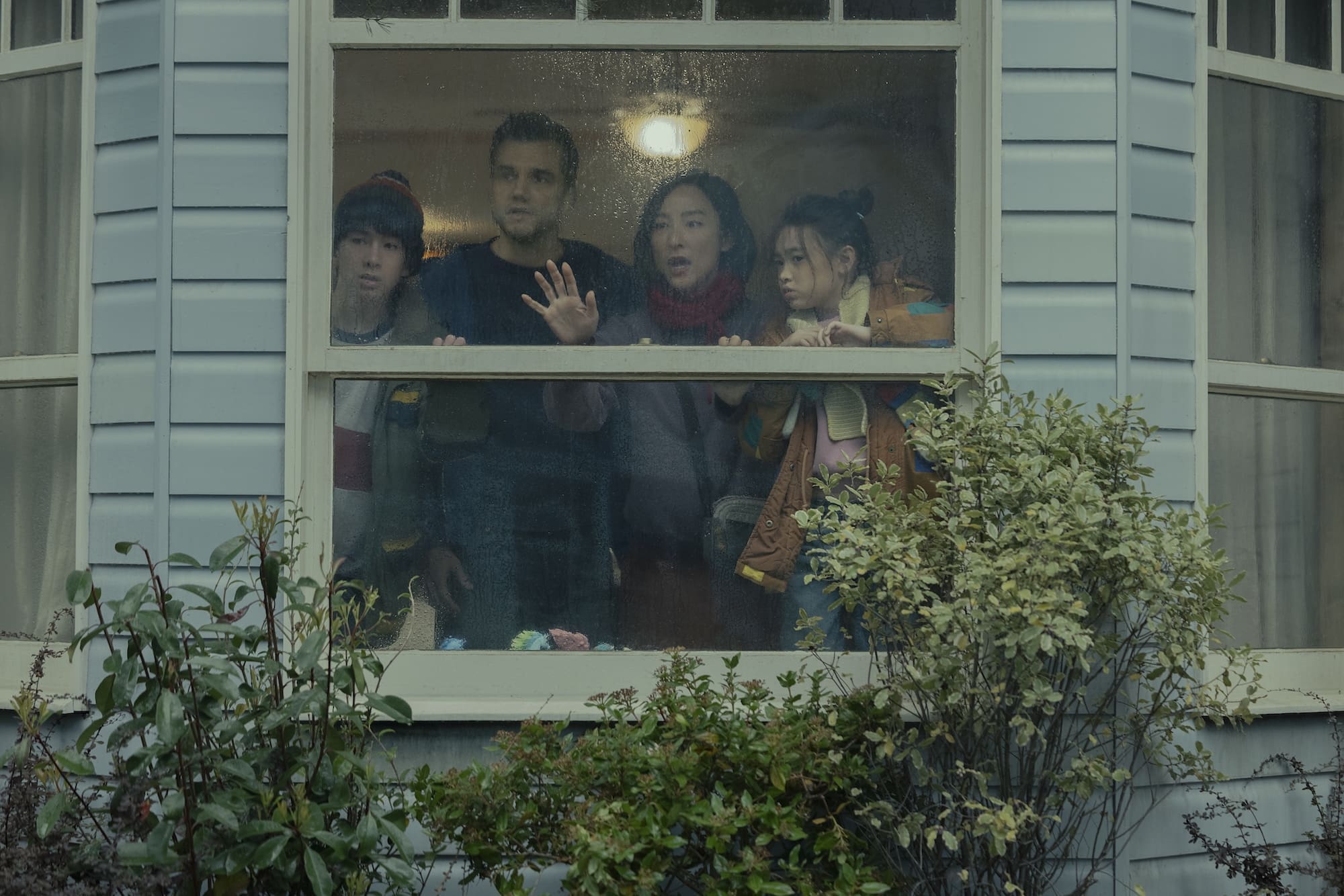
The question of “What if you couldn’t leave your house for days, months, or even years?” is one that still feels all too familiar—we all lived through the COVID-19 lockdowns, essentially confined to our living spaces as they seemed to shrink around us every day. Netflix’s newest thriller asks that same question, clearly inspired by writer Matthew Robinson’s experiences during the lockdown, who wrote the first act during the pandemic. Although we’re more than five years out from the darkest parts of the pandemic, it still feels too soon for an audience to embrace a lockdown-inspired storyline.
The Last House centers on Jason (Wagner Moura, Maul: Shadow Lord) and Ann (Greta Lee, Toy Story 5) and their two children, Graham (Noah Alexander Sosnowski/Gabriel Barbosa) and Ruth (Riley Chung/Emma Ho), a middle-class suburban family living in Seattle. When a mysterious force keeps them locked inside their house, the family of four must learn to survive with what they have, essentially forced to homestead within the confines of their own home.
It’s a fascinating concept, especially when considering the near-complete relatability the premise has for most of its audience. But the execution is tragically awful, especially given the wasted talent of the two leads, who, between them, have earned three major wins and six nominations. The film seems to want to explore the effects of isolation on a family and humanity’s resilience in the face of unforeseen circumstances, all with the backdrop of mysterious, terrifying creatures, but the filmmakers never commit fully enough to any of these themes, leaving the film feeling hollow and underdeveloped.
While mental health is addressed and seems to be an issue plaguing all of the characters, it’s mostly talked about rather than meaningfully played out. It’s a shame because mental health during the pandemic affected many people, and the isolation this family experiences in The Last House is, in many ways, worse than the real-life version. The film could have been an excellent case study into the effects of isolation and the importance of family and community if the filmmakers had taken the care needed to address these issues.
Instead, the moral of the story seems to be “mercy?” It’s a moral that seemingly comes out of nowhere and has little connection to the majority of the film. Rather, it feels like the filmmakers needed a reason to justify the ending they wanted and tacked on a feel-good lesson at the last minute.
The film as a whole is disjointed and confusing, leaving a lot unanswered and even less to be desired. The Last House takes place in two distinct parts; the key word here being distinct, the film switches fairly abruptly from an apocalyptic survival story to a thriller with no clear connection or meaningful buildup. It feels like two separate films with similar casts got smashed together.
The Last House debuted on Netflix as #1 on its list of Top 10 Movies, but there’s nothing justifying its place there beyond the star power of Greta Lee. Unfortunately, it feels like just another forgettable money sink straight to streaming that we’ll all forget about in a few weeks.