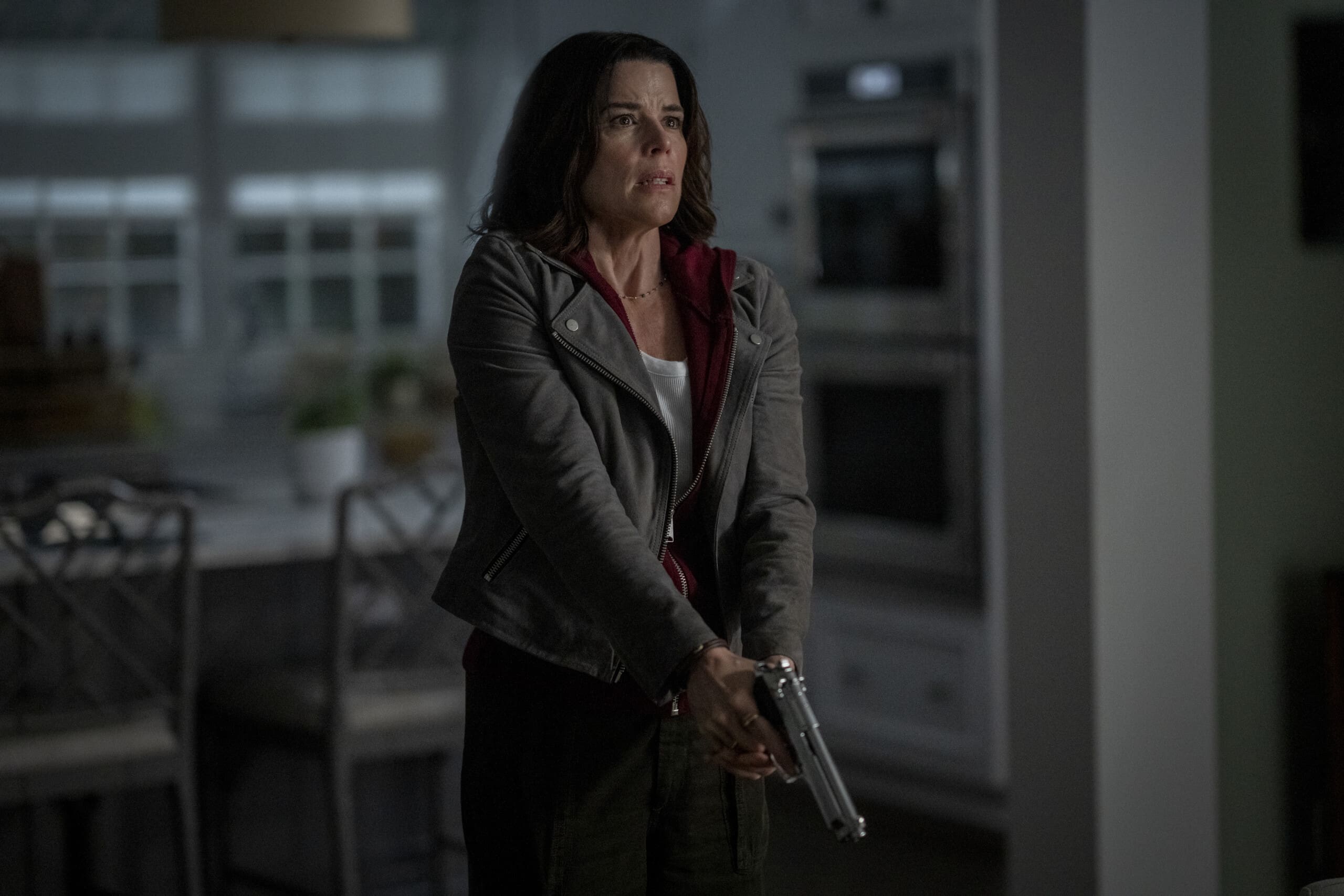
In 1996, the iconic voice of Roger Jackson posed a deceptively simple question to young Drew Barrymore — “Do you like scary movies?” — and, in doing so, ignited a franchise that has endured for three decades. Barrymore’s heavily marketed appearance famously served as a bait-and-switch, her early demise signaling that Scream would play by its own rules. From that shock emerged Neve Campbell as the film’s true anchor, redefining the modern final girl and securing her place among the most lauded Scream Queens the genre has to offer. Scream 7 turns its focus back to Campbell, serving as a twisted love letter to her character, Sidney by having Ghostface attack her and everyone she loves.
Penning the love letter is Kevin Williamson, returning as screenwriter for the first time since Scream 4 while also serving as director. He created the iconic character, so it’s fitting that he would return to tell this story. With him at the helm, and Campbell having embodied Sidney all these years, everything brought to screen feels authentic — from the dialogue, to how she handles herself, even down to Sidney’s signature style. Nobody looks cooler in a hoodie and leather jacket, and nobody is better equipped to face down an obsessed killer, again.
Far from Woodsboro, in Pine Grove, Indiana, Sidney has built a life with her police chief husband, Mark Evans (Joel McHale), shielding her kids, including oldest daughter Tatum, (Isabel May) from the violence that’s always plagued her. Sidney’s past is well-documented, both within the Stab franchise and in her own book, but it’s not something she’s ever been comfortable sharing with Tatum, a reluctance that’s created a distance between them as she’s grown up.
It’s hard to fault someone for being secretive or protective when that someone is Sidney Prescott, but having done such a good job keeping her family away from the violence, Tatum is ill-prepared when the inevitable finally arrives. It’s a compelling dynamic, particularly because she wants to be a fighter like her mother, an interesting contrast to the direction that Halloween (2018) took with Laurie and her daughter.
It does seem a bit unreasonable that they haven’t had any in-depth conversations about her past for the last 17 years. What exactly are they discussing over dinner every time a new Stab movie is released? Even more impractical is the fact that when Ghostface attacks their home and they flee to the panic room, Tatum is completely unaware of its existence. Still, getting that sequence early in the story, as well as what immediately follows, is a welcome surprise. At some point, it feels like “the talk” about Ghostface was more necessary than the one about her boyfriend Ben (Sam Rechner), sneaking in her window, though you do have to be skeptical of the love interest.
May showed with her work in 1883 that she could carry heavy material and provide a guttural scream as needed, and she holds her own opposite Campbell. McHale might be the most pleasant discovery, because while he’s known for playing sarcastic and snarky characters, he’s very endearing in this role. You get a sense for his love of Sidney right away and in his ability to handle himself.
Having both of these characters introduced provides stakes for Sidney again in a way that just isn’t possible otherwise. Seven movies in, there is plot armor around Sidney — and she’s earned it. So, the last few times we’ve seen her on screen, she’s nonchalant about everything even when it seems dire, and while it makes her a badass, it does remove a lot of suspense. Bringing her family into the story makes her vulnerable again, gives her a reason to be angry and fearful and allows Campbell to give her best performance since the first two films.
This is very much a story focused on Sidney and her family. As a result, we don’t spend a lot of time with Tatum’s friends or other secondary characters before things turn violent. Those new faces include Sidney’s neighbors Jessica (Anna Camp) and her son Lucas (Asa Germann), Tatum’s friends Chloe (Celeste O’Connor), and Hannah (Mckenna Grace), and her boyfriend Ben. Since they are all slotted to be Ghostface or victims of Ghostface, it does minimize the impact when one of those things happens. That tradeoff is absorbed by the fact that the killings are especially brutal and inventive.
In a lot of the press leading up to the film’s release, Campbell has said the last two films have been more violent than the tone set by Wes, and that while still a bloody affair, Scream 7 would be more grounded. Either she has a very different opinion of what constitutes violence and gore, or she was just having some fun knowing what was coming with this one. It very much subverts expectations, as it easily takes the crown for the most violent entry in the franchise with some very cruel and elaborate death scenes.
Another returning iconic character of Williamson’s creation is Gale Weathers, played—brilliantly as always—by Courtney Cox. Gale is beloved because she has never really changed across seven films: smart and opportunistic, but fiercely loyal. While she doesn’t always receive the most screen time, she will without fail have one of the movies most memorable moments. That remains true here as Gale’s introductory scene was met with raucous applause, and for good reason. You know that she’s going to show up at some point, but the film’s pacing and momentum are so engaging that you almost forget about anyone not already on screen, and then she’s there, and its perfection.
Williamson is smart in his handling of the Meeks twins, and while they weren’t originally written by him, he keeps them consistent and allows them to play within the space they carved out for themselves in the prior two films. The playful banter between them and their relationship with Gale provides a lot of the humor that’s wedged between attacks and chase sequences. While they aren’t essential to the story this time, it helps blend the last two movies with its future direction.
It’s hard to believe that this is Williamson’s first time in the director’s chair since Teaching Mrs. Tingle (1999), as he not only effectively delivers the chase scene, but also some elaborate set pieces—including a return to the Macher house for the opening. Featuring Michelle Randolph and Jimmy Tatro, the opening not only lives up to expectations, but sets the tone for the level of violence and jump scares for the rest of the movie. It also lays the groundwork for the not-so-secret involvement of Matthew Lillard.
The marketing and plot lean heavily into the long-running fan theory and wish that Stu Macher may still be alive. The love for Stu runs deep with fans of the franchise because on paper, Stu was a fun character, but Lillard transformed him into one of the most beloved and memorable figures in horror history, no small feat for a character who is, at his core, a psychopath.
The movie delivers that return for fans, along with a multitude of other obvious nods to the past. Marco Beltrami’s familiar score returns beautifully, it’s fun to hear Sidney talk about her semester of theater at Windsor College, and seeing Tatum wear her jacket from that time sparks a reaction. Legacy characters that have been lost along the way are kept alive in various ways, whether its Mindy and Chad telling Tatum that their uncle Randy was friends with her mom, Gale being vulnerable speaking about Dewey, or Sidney telling her daughter about the friend she named her after. There are also a few too many references to Sidney not being a part of the events in New York, but that’s a small gripe.
For this franchise, the final act is often either its greatest strength or its most glaring weakness, and for Scream 7, it’s unfortunately the latter. The “whodunit” aspect of the movie is excruciatingly obvious halfway through, so the unmasking is lackluster, and while the central motive is original and explores a connection to Sidney that hasn’t been examined before, it feels rushed in comparison to the rest of the film.
Up to this point, the movie was pacing to be the franchise’s strongest entry since Scream 2. With some tweaks to character connections, a few more minutes to sit with what’s presented, and a clearer explanation of how it all unfolded, it had the potential to be much more impactful. That said, a neat, rational motive isn’t a necessity when dealing with a serial killer. It’s not the idea that falters, but the rushed execution.
Full of sharp one-liners, inventive new deaths, and nostalgic callbacks, Scream 7 is another welcome addition to the phenomenon Kevin Williamson and Wes Craven brought to life decades ago. While it falls short of cementing itself among the very best entries in the franchise, the film comes close enough for most of its runtime to make the experience thoroughly enjoyable for casual viewers and devoted fans. Most importantly, it continues the story of Sidney Prescott in a way that’s worthy of her return.