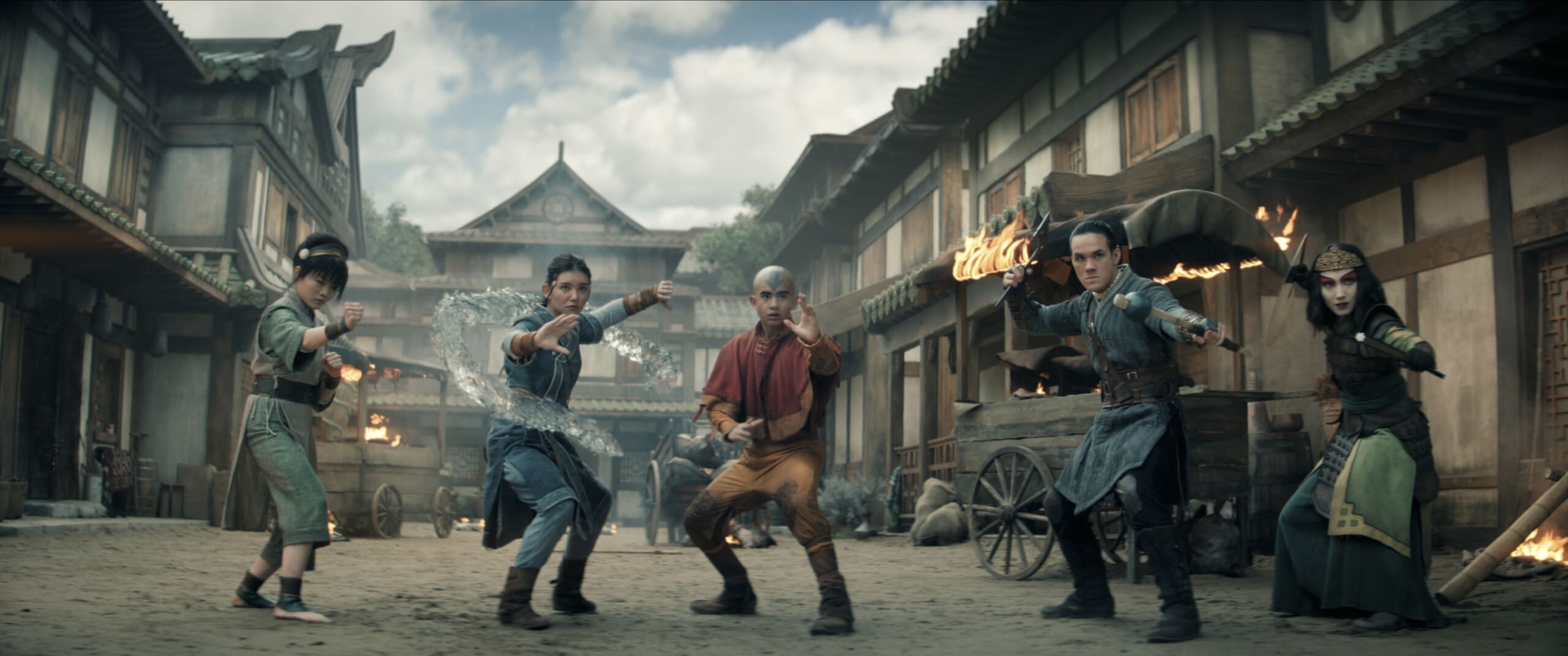
Yip Yip! You might want to sit down for this one. Avatar: The Last Airbender Season 2/Book Two was certainly a wild ride, though not one that longtime fans might have been expecting. Those who were hoping for improvements from Season 1 let’s just say there are some positive improvements and some disappointing downfalls. While this writer, and many others in the ATLA fandom, wanted to love this so much, there’s still much left to be desired.
Let’s start with the good.
The best part of the series is its visuals. It’s nice to see the train ride into Ba Sing Se and their home while they’re living there come to life. The scenes we’ve all watched hundreds of times – for example, in the caves, tea shop or library, are present with the big Netflix budget and the feeling that we longed for.
Season 2 brings with it the introduction of many familiar characters, most notably Toph Beifong (Miyako, The Darkest Minds). Miyako easily gives one of the better performances in the series. She feels like Toph from the animated series realized in live action format. Her nicknames are spot on – “Bald Sing Se” did get a laugh from this writer – and the character feels believable. You hear her force and energy and instantly feel: this is the Toph we know.
There are numerous Season 1 characters who benefit from improved writing and performance. Azula (Elizabeth Yu, Womb) is one of the other standouts; her line delivery in particular feels very reminiscent of the animated Azula, and her cunning nature really comes through this season. Katara (Kiawentiio, What If…?) feels closer to the Katara we’re familiar with. Sokka (Ian Ousley, Physical) cracks some decently Sokka-ish jokes, and Zuko (Dallas Liu, Tekken) does feel like he has some rage within him. While the improvement is evident, these performance fall flat with stiff line delivery or awkward writing that doesn’t feel as close to the characters we know.
Iroh (Paul Sun-Hyung Lee, The Mandalorian), while well cast, is a departure from the original in a few ways – while his wisdom remains, he’s also more serious than he is in the animated version. The lightness of his character in contrast to Zuko is something that defined their dynamic. In this season, we get some significant moments between the pair, but their relationship feels faraway nonetheless. Book Two, in the animated series, is pivotal to the growth of their bond and it has to do with the amount of time they spend in each other’s space, learning about each other and growing their familial connection. The relationship here is a bit disjointed and they are often separated on screen, whereas in animated Ba Sing Se, their arcs are largely tied to one another.
Aang (Gordon Comier, The Stand), who has also improved still doesn’t feel like the animated Aang. He’s also very serious – whereas Aang in the animated version has more energy, humor and sometimes is just being a kid. That feels like a gaping hole in the live action. We see that classic Aang energy come out at times, such as in the montage at the start of Episode 4, however Aang feels like a large departure from the original, which is strange given he is the heart of the story.
Arguably, the worst part of this season is the mischaracterizations. Many characters’ motivations are confusing or inaccurate to the original. Zuko wouldn’t steal from a pregnant woman, even in desperate times – as we’ve seen. Aang wouldn’t rush everyone and act out as he does – he has his frustrated and angry moments of course — but that’s a large part of his character this season. Suddenly, Ozai is not rallying behind Azula like he did in the original. She’s much more upset at him now, leading to what might be a coup against Ozai. The Painted Lady is in Book 3, and Katara isn’t asked to become a Kyoshi warrior, but we find both of these aspects present in the second season which mixes around Katara’s arc. While it’s nice to see the connection between the Painted Lady and the Blue Spirit, viewers make that link and see that parallel on their own, and it’s not necessary to have it all explained for us.
Another glaring issue here is that Serpent’s Pass is in the first episode, rather than much later (it’s 12th in the animated series). The main thing that gets this writer is – Appa isn’t present during the animated episode, as it’s after he’s been taken. So, why are they all even going through the pass, climbing on the edge of the rocks, in danger of falling to their deaths at any moment? Couldn’t Appa just catch them if something bad were to happen, or just carry them on his backs in multiple trips like the fluffy, helpful sky bison he always is?
This show has a “tell, don’t show” problem. For example, yes, you are Toph Beifong and you did invent metalbending, which we know and is obvious without stating it. The writers did not need her to shout it out into the carriage.
The plot is a cobbled together version of the original. It would not be bad if they changed some things; it’s inevitable after all! But the additions they make and whats they choose to remove or switch out are points that are integral to the story. What about the iconic desert? The drill? Appa’s lost days? These are all important story points that show their journey from start to finish and have serious impacts on the characters. Some of these beats – such as the drill – are also valuable action scenes that showcase the turmoil in the city and its inner workings.
Some of the aspects they choose to showcase, such as the politics of the city, the different rebellious groups and the others in command who lead to things being the way they are (or rally against it) are nice additions and understandable to move the plot forward. However, these pieces do not need to change the storyline and the way the characters behave. That’s when this live action becomes a hindrance to itself.
Fun is also missing in many aspects of the series, which is a let down, as the animated version is full of it. We miss out on the gang sneaking into the King’s party, going into the desert and cracking jokes throughout the episodes.
The live action Avatar: The Last Airbender is like ordering your favorite thing off the menu and getting served something that might look right but tastes totally different. This is all disappointing because this series has the elements it needs, namely budget. The sets are, in general, accurate to what viewers might see in the animated series and the vibe of the show is present. Even most of the cast feels decent enough in this second season. Sadly, the poor writing, plot changes and at times subpar acting take the viewer out of the story, one that yours truly loves deeply and would’ve loved to see done the justice it deserves.