Written By Randy Allain and John Aspler
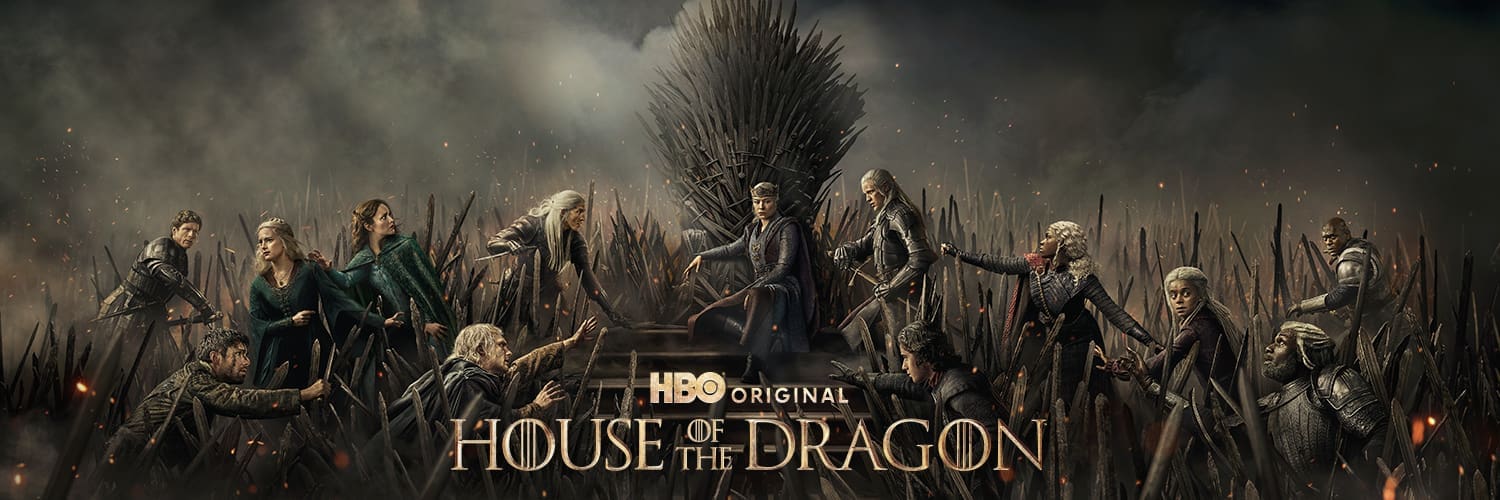
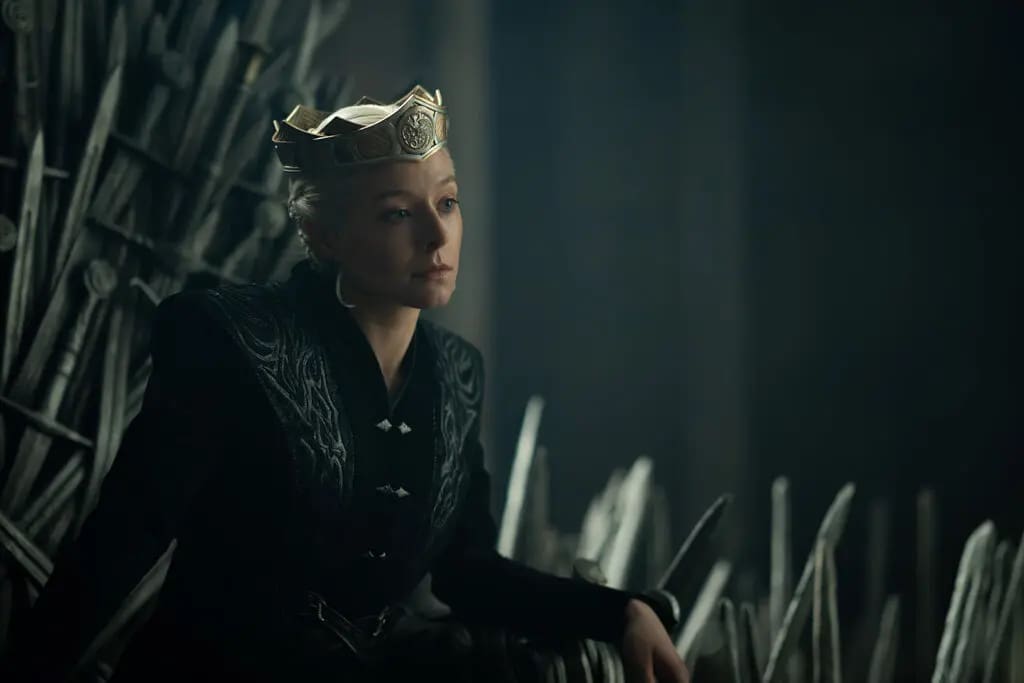
Hello Thrones fans! This is Randy Allain, your resident Pop Break House of the Dragon reviewer and recapper. After waiting two years to resolve the setup from the conclusion of HOTD’s second season, this summer provides a front-row seat to Rhaenyra Targaryen’s (Emma D’Arcy) moral unravelling and opens up the field of potential contenders for the Iron Throne at the end of the age of dragons in Westeros.
While the latest season offers no shortage of ups and downs, it’s an absolute pleasure to review, particularly with the support of my fellow reviewer and friend, John Aspler, PhD. His insights level up the Pop Break coverage, and the two of us just couldn’t say goodbye to Season 3 without giving you a peek behind the curtain at HOTD conversations. So let’s get to it!
John, thank you so much for bringing your unique perspective to our coverage! While you already covered this a bit in your finale recap, I was wondering, after Rhaenyra’s freefall into fascism, is there anything that could put fans back in her corner?
Thanks for the question, Randy; delighted to dialogue with you after your excellent Season 3 coverage!
I wish there had been a bit more complexity to Rhaenyra’s decision-making; it seems like she makes the worst possible decisions, each and every time, instead of continuing the theme of ‘a good person can be a bad – or unsophisticated – ruler’ (evoked by constant references to ‘What Would Viserys Do’). It would have been nice to see well-intentioned policies leading to poor outcomes. I suppose it can be interesting if ‘bad person’ Rhaenyra effects positive change.
Ultimately, I think it comes down to (re)building bridges with the allies she has alienated, which seems unlikely, given her increasing isolation, smallfolk paranoia and pivot toward Daemon Targaryen’s (Matt Smith) delusions of Godhood. At every turn, Rhaenyra has reneged on promises, from giving Harrenhal to the Freys to providing a dragon to protect the Veil, and pushed away her closest allies from refusing to legitimize Corlys Velaryon’s (Steve Toussaint) heirs and dismissing Mysaria (Sonoya Mizuno) to treating the Dragonseeds as worthless and instrumentalizing her family. What remains of her allies are recruited by others – Jacaerys “Jace” Velaryon (Harry Collett) received support from the North, and Daemon (via Alys) got the Riverlands onside. Given where the season ends, it seems unlikely that anyone will be able to pull her back from the brink, though I do wonder if Daemon – who seems to have had a change of heart after witnessing the horrors of multi-sided dragon warfare during the Battle of Tumbleton – will help.
Where does that leave you, Randy? Rooting for a different side (e.g., Team Daeron Targaryen (Benjamin Evan Ainsworth) and Gwayne Hightower (Freddie Fox), Aegon Targaryen (Tom Glynn-Carney) and Aemond Targaryen (Ewan Mitchell), maybe even Team Ulf the White (Tom Bennett)), or is there no one left to support?
John, you are absolutely right about Rhaenyra’s fall. For much of the show’s run, supporting her claim to the throne meant fighting the outdated machinery of the patriarchy that scorned her time and time again. This season, that rusty old machinery continues to keep her down. Nobody on her team steps up to manage King’s Landing, or even the Red Keep for that matter. It seems clear that her charity photo op did little to soothe the suffering of her people, and about the only other actionable advice Rhaenyra receives is Alyn’s (Abubakar Salim) recommendation to fill the palace with cats and replace the rat catchers. Of course, deep down, we all know that this wouldn’t end well since the women of Westeros are still working twice as hard to keep up several generations later, when Robert Baratheon marches into Winterfell as the White Walkers muster their forces.
Since it doesn’t look like we are going to see the downfall of the patriarchy any time soon, the next best thing we can hope for is peace and rebuilding. Currently, the only contender for the throne with intact moral scruples seems to be Daeron. His vision of a decentralized government would save the realm a lot of headaches. Honestly, the Iron Throne isn’t cozy or charming, and it always cuts you in the end one way or another. Let the Lords and Ladies of Westeros lord over their realms, cut the military budget and hopefully find the time and resources to protect and serve the smallfolk in their bounds. If Daeron is the best path toward this future, I can’t help but find myself in his corner, especially now that the devil on his shoulder is burnt to a crisp after a painful violation courtesy of The North. Of course, while I sit here and daydream about a brighter future for Westeros, one terrible question lingers in the background: How can lil’ old Tessarion ever stand claw-to-claw with the bigger dragons out there?
What do you think, John? Ulf is a free agent, Hugh Hammer (Kieran Bew) lost everything he holds dear, and even loyal Addam of Hull (Clinton Liberty) appears to be through with Rhaenyra’s shenanigans. Furthermore, Rhaenyra seems to have used up any goodwill she has left with Corlys, Baela Targaryen (Bethany Antonia) and Rhaena Targaryen (Phoebe Campbell). Is there a chance Daeron catches up in the dragon math game, or do you foresee other futures for these puzzle pieces that are slipping from Rhaenyra’s grasp?
While patriarchy is the true villain of the show (as you said), the closest idea to a series-long thesis statement might be Viserys I Targaryen’s (Paddy Considine) warning in the pilot: “The idea that we control the dragons is an illusion. They’re a power man should never have trifled with. One that brought Valyria its Doom.” Given that there are no more dragons in the time of Game of Thrones, I am tempted to suggest that Daeron doesn’t need the dragon math on his side. He just needs the bigger WMDs to explode, ensuring his foes face some sweet, sweet mutually assured destruction.
That said, it seems like the one potential free agent who can turn the tide in Daeron’s favor might be Hugh. Though he has little reason to love the Greens for their occupation of Tumbleton, especially since they held his wife hostage (not that he knows the extent of their crimes). He has just as little reason to love the Blacks. Rhaenyra consistently spurned his completely reasonable requests for a home, or a stipend, or to let him protect his family (given the many dilemmas and deficiencies in which Rhaenyra was awash). He also disobeyed orders, abandoning his post to try and save his wife. With Ulf’s betrayal, it is not likely that he can return to King’s Landing without consequences. And so, this can provide an opportunity for Daeron to recruit Hugh and Vermithor – perhaps the most powerful dragon besides Vhagar.
With the dragonless future we see in the original series, how do you think HOTD handles the idea of dragons as both a source of power and uncontrollable forces of nature? Do you think this civil war will bring about another Doom, or is it a good thing that mutually assured destruction could also mean mutually assured disarmament?
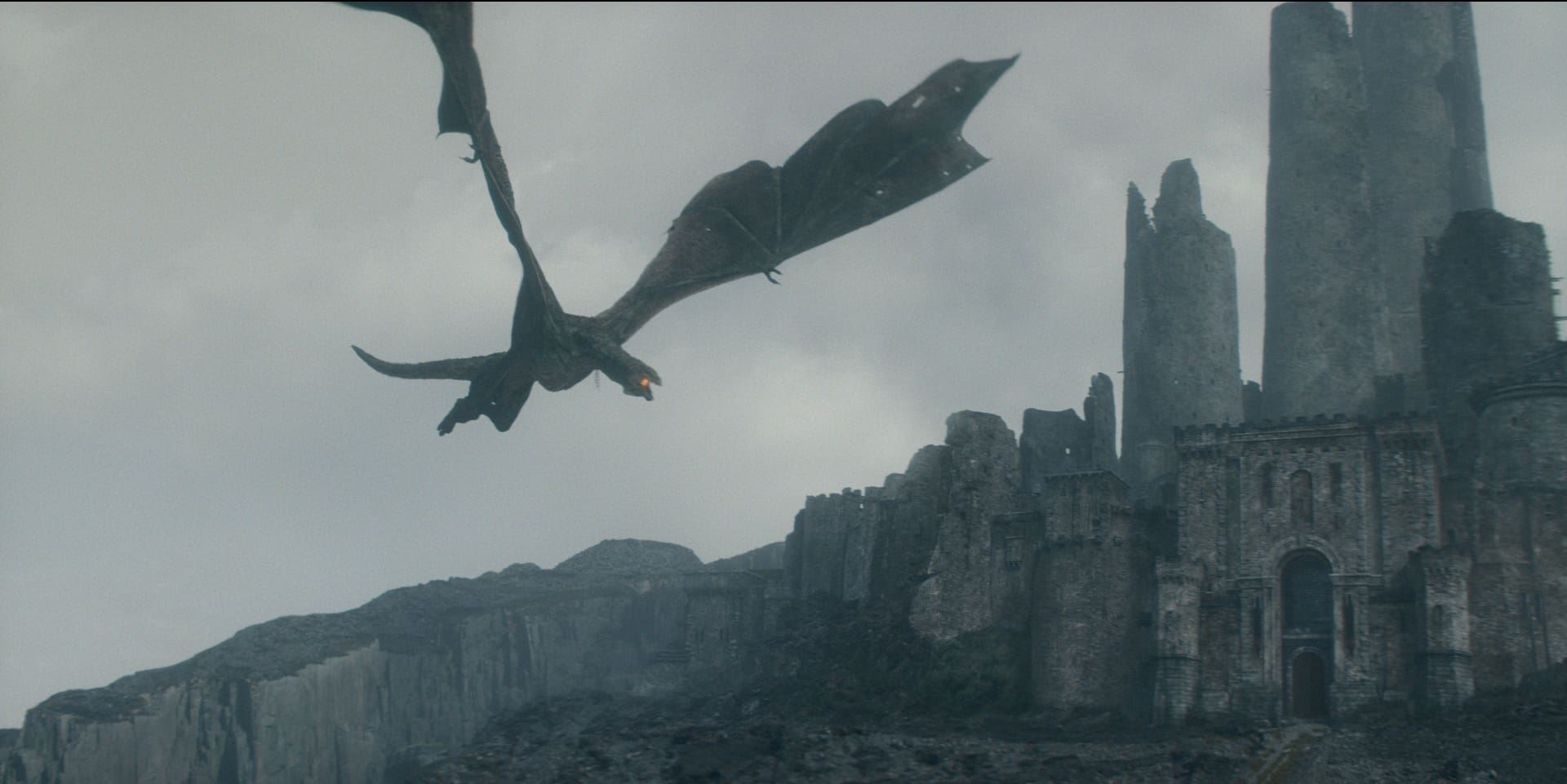
If I step back and look at the big-picture logic here, it sure seems like this civil war is setting up Westeros for an easy dismantling at the hands of the White Walkers. A healthy line of dragons might have been quite useful in the face of the undead horde; although maybe that will enable the Night King to skewer himself with a few more undead dragons. If one thing is consistent across these timelines, it is everyone’s utter failure to realize that large man-made projectiles are pretty effective at taking the big fellas down. Without lingering too long in the murky waters of Game of Thrones Season 8, it seems that the realm will ultimately survive thanks to a small number of people putting duty, honor and sacrifice ahead of personal gain. In fact, the dragons just end up torching a bunch of innocents anyway.
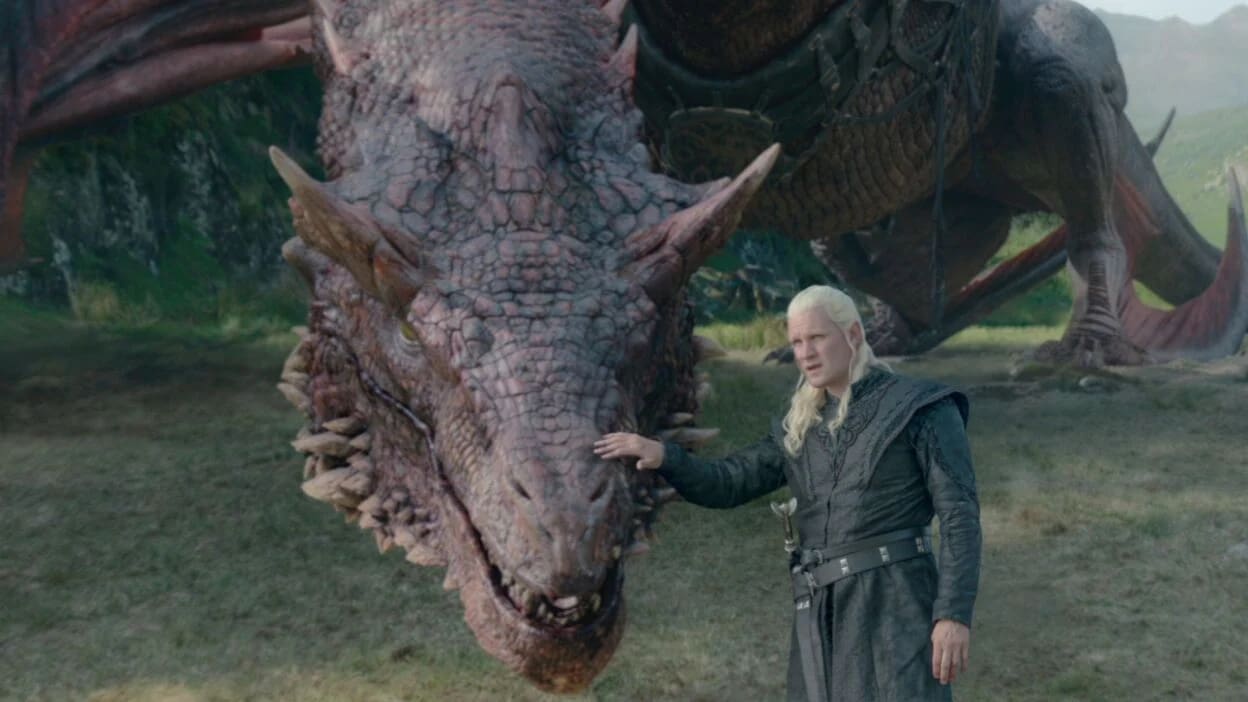
With that in mind, it’s compelling to think of the fall of dragons as a sort of mass disarmament. One of my favorite pop culture moments is Superman (Christopher Reeve) flying the world’s nukes into the sun in Superman IV: The Quest for Peace, but I wish we didn’t have to wipe these magnificent creatures from existence to turn the heat down in Westeros. It will be great if the dragons themselves could play Superman to Westeros, abandon their riders and retire to the hillsides with Sheepstealer. Then maybe, maybe, if humanity ever deserves it, they’ll swoop down to deep-fry some zombies on our behalf.
Well, John, it seems I’ve shifted our conversation into the realm of imagination, but HOTD does find itself in the position to make big adaptive choices to the source material. I know you are a scholar of the text as well as the series, so I was wondering: What are some of your favorite and least favorite adaptive choices the series makes so far? Are there any special considerations you’d recommend as the creative team puts Season 4 in motion?
Adapting a text for the screen necessarily involves accepting changes. I’m not one to get mad just because a change is made; faithfulness to the plot can often be less interesting than faithfulness to a story’s themes — one of HOTD Season 3’s successes — especially given factors like the storytelling medium, the budget and the space provided to tell a story (i.e., the episode count). And in a story like HOTD — an adaptation of a fictional in-world history, where accounts may be skewed or wrong and where motivations and psychology are (mis)understood through centuries of political biases — many of those changes have been fascinating and extremely welcome. Of course, they are not always strictly changes to the plot, but a reframing of historical events, especially for the women of Westeros, who male historians have little interest in understanding.
That said, when it comes to actual textual changes, the best might be everything about Team Green, and the worst might be Rhaena. Starting with the latter, I don’t mind that the showrunners collapsed her arc into a book-only character named Nettles (a young girl who successfully and without issue tames Sheepstealer and eventually has fatherly moments with Daemon). Given the number of characters and the frankly limited amount of story arc Rhaena might have otherwise had, it is an efficient way to connect some dots. Daemon is already a bad dad to his actual daughters, so why not explore that dynamic a bit more? Unfortunately, the execution of that change leaves much to be desired. Rhaena was only partially at fault for Jace’s death (Jace himself, and the Patriarchy, are also to blame), and yet the show — not just Rhaenyra — seems to suggest she’s the most responsible. She doesn’t even appear in the finale, having simply returned home where she can start over. Where does this leave Rhaena; will she follow Nettles’ arc or her own? They appear somewhat mutually exclusive.
Thankfully, many of the adaptive changes have worked really well, with my favorites being Team Green. Ormund Hightower (James Norton) has minimal characterization in the book, while he absolutely chews up the screen with his strange and compelling affect. Gwayne is nowhere near Tumbleton for these events, so bringing him back into his twisted family’s orbit and transforming his arc into that of a humbled nobleman with a moral center adds someone to actually root for. As for Daeron the Daring, it turns out his moniker is more political theater than reality. He isn’t a dragon-fighting champion, but a thoughtful and abused young man who wants to do what’s right, while stuck under the thumb of his horrific cousin. Helaena Targaryen (Phia Saban), the tragic oracle, and Aegon, the almost humbled but actually resurrected villainous King, can come too! HE’S ALIVE!
And with that, since you are largely unburdened by the book’s canon, Randy, I wonder how Season 3 works for you overall? Give me some end-of-season hits and misses!
Season 3 is a bit of a mixed bag for me. This show is at its absolute best when the creative team embraces nuance and trusts viewers to reflect on the complexity of the text they’ve placed before us. I co-sign your appreciation for Ormund’s machinations in Tumbleton, and I feel a similar sense of engagement during Rhaenyra’s POV episode as the weight of the crown makes its presence known.
Unfortunately, the season struggled to sustain that nuance. Subsequent episodes fail to show growth and learning from Rhaenyra; she continues to break down into utter confusion and a desperate need for validation. D’Arcy manages to milk these moments for everything they are worth, but it’s a shame they aren’t allowed more range to explore the character. Rhaenyra needs more wins mixed with her losses, and a bit more time to settle into a confident frame of mind before her final fascist makeover.
On the flipside, nobody is poised to have more fun next season than Glynn-Carney, as the ruins of Rhaenyra’s takeover positions him to step into the role of savior with spiritual validation of the first church of Westeros. With Otto and Ormund out of the picture and Alicent Hightower’s (Olivia Cooke) assassination attempt out in the open, the kids are in full control of the Hightower side of the family tree. Sir Gwayne seems destined for the most complicated babysitting job in Westerosi history as he tries to keep all of his princely nephews alive (and keep them from killing their mom).
Rhaenyra is done pulling her punches, Aegon is drunk on destiny and a bunch of Westerosi WMDs are up for grabs. Whatever the strengths and weaknesses of HOTD Season 3, consider this reviewer sat for the Season 4 premiere! Until then, we hope you’ll consider sitting with us next year when A Knight of the Seven Kingdoms whisks us back to Westeros.