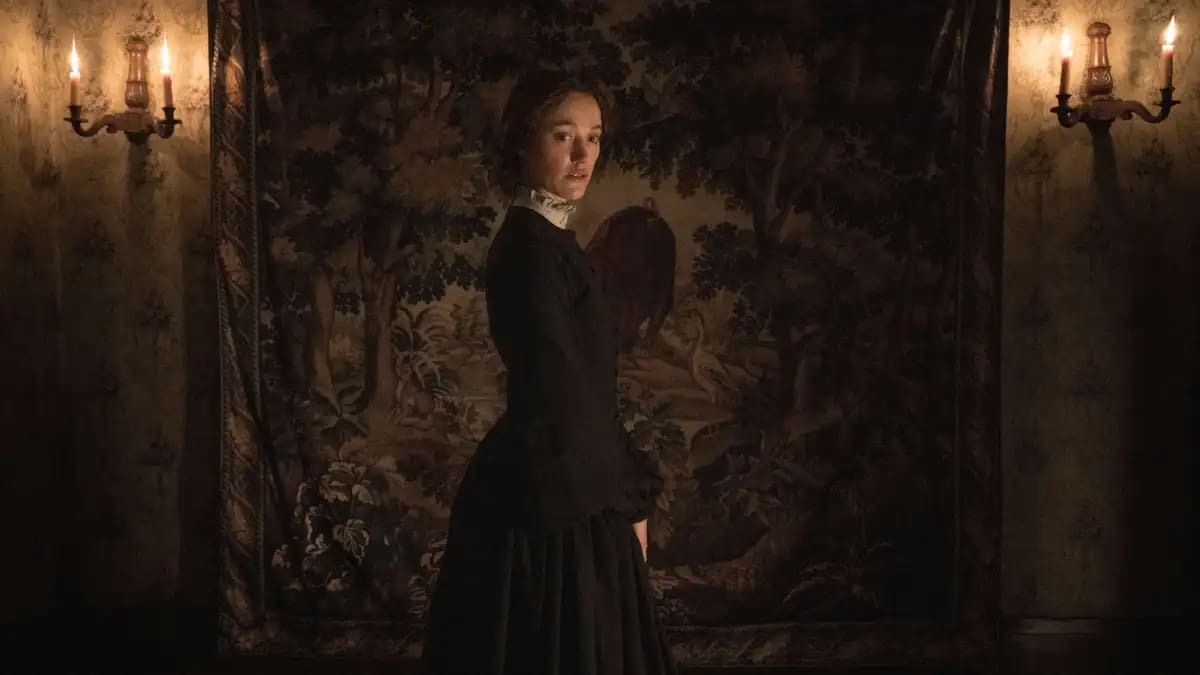
Victorian Psycho, based on the talent attached, has all the makings to be one of the most intriguing horror flicks of the Fall. Director Zachary Wigon is hot off his 2023 dark-comedy/psychological thrill ride, Sanctuary, and lead star Maika Monroe continues to be a beloved force by horror fans. Unfortunately, their combined powers only lead Victorian Psycho to be a mildly entertaining experience that rarely breaks past the surface.
Based on Virginia Feito’s 2025 novel, the film follows governess Winifred Notty (Monroe) as she joins the affluent Pounds family to educate their children. However, as Winifred’s demonic urges grow and her sanity slips, bodies pile up and the Pounds family realizes what they’ve let into their home. Storywise, the film goes about exactly as expected. With each act, Winifred’s sanity dives deeper into darkness and grotesque territory – leading to some gutting turns, and bloody conclusions that’ll easily please horror fans. There’s something incredibly fun about the visual and social contrasts of someone like Winifred terrorizing a “proper” family. We constantly go from buttoned-up dinners at the family table to Winifred going off the deep end with some demonic thoughts or actions that instantly create shock and awe. Its American Psycho inspirations are clear, but it finds its own unique angles through its time period and Monroe’s standout performance.
Let’s face it, Monroe is the pure selling point of Victorian Psycho, and her performance is worth every penny. Even when she’s staring off into the void, you’re mesmerized by her facial expressions and the simple curiosity of what she’s about to do. Monroe utilizes Winifred’s unpredictability to its fullest for a wild performance that shifts from funny to horrifying in an instant. One moment she could be just saying odd things that turn a conversation cold; the next she could suddenly be taking action – which usually has bloody results. No one is safe from her, and the finale lets her off the leash for a deliriously engaging bloodbath that screams “crowd-pleasing.” Seriously, Wigon and Feito hold nothing back as Winifred enacts unimaginable horrors for her own twisted pleasure. Monroe gives it her all from start to finish and provides pure genre delight. It’s just a shame that a great performance like this isn’t paired with a worthwhile narrative or approach that matches the same energy or intrigue.
Despite Winifred’s erratic nature, Victorian Psycho is quickly a fairly ordinary telling of a person going mad. Winifred’s constant bouts against the Pounds children, mainly Andrew (Jacobi Jupe), fall into the same loop of her dodging suspicions while spouting demonic thoughts. The film rarely gives greater depth to these characters, even Winifred at times, so they often come off one-note. Even with Monroe being a blast in the role, there isn’t anything all that compelling past her crazed behavior. Thus, her character is full of empty calories that can only keep you hooked for so long. It doesn’t help that the pacing is incredibly slow-moving, almost sluggish, and even some late-act twists don’t fully save the day. There’s a reveal of why Winifred finds herself with the Pounds family that’s pretty good. It gives her insanity some personal meaning and ratchets up the tension that boils into the final stretch. Yet it’s never allowed to marinate properly, so it leads to anything special. Instead, the film quickly gets to its third-act confrontation full of psychotic bloodshed, which is especially satisfying because most of the film being oddly killless.
Even with a bloodthirsty finale, Victorian Psycho leans heavily into psychological terror rather than full-blown murder-madness. While it is fun to watch her devour some strange things or be out of pocket with children, the wait for Winifred to go full-tilt killer can feel a little unbearable for the first half. It’s where the pacing really drags, and it’s one of the many ways Wigon’s approach to this story doesn’t pay off. While the dark comedy in Sanctuary was sharp and full of big hooks, his comedic approach here lacks that same effect. Monroe does her best and often finds success in letting Winifred’s oddness run wild. But it’s not punchy enough to really make a mark. Not to mention, certain storytelling elements, like dividing the film into acts or having Winifred inner thoughts be expressed through voiceovers, often strip the film and its main character of their mystery and engagement.
Is Victorian Psycho a total loss? No, mainly because Monroe delivers the terrifying, sometimes campy killer goods that horror fans will be more than pleased with within a narrative that provides the perfect scenario for madness to grow and explode. Yet, the potential for more is clearly untapped, making Victorian Psycho an underwhelming watch with fleeting impact.