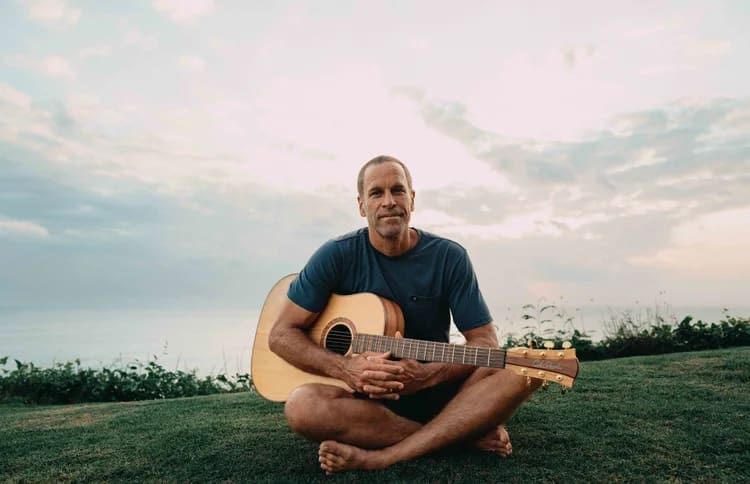
Over the last 25 years, Jack Johnson’s music has soundtracked countless road trips, barbecues, beach days, and photo montages — creating memories that will last a lifetime.
With the release of the new documentary Jack Johnson: SURFILMUSIC, Johnson is now revisiting some of those memories himself. Built around archival footage from his early years as a professional surfer, filmmaker, and musician, Director Emmett Malloy’s film explores the creative journey, defining moments, and lifelong friendships that helped shape Johnson’s career.
Ahead of the film’s release and his upcoming tour — which includes a stop at PNC Bank Arts Center in Holmdel, NJ on June 21 — we sat down with Johnson for an in-depth conversation about friendship, creativity, and learning how to get back up.
I absolutely loved the documentary. I’m a sucker for music documentaries, sports documentaries, and movies about making movies, so this had everything.
There you go. We got all three in one for you.
Your surfing accident at 17 became a turning point that reshaped your life. While making the documentary and revisiting those old tapes, what was it like returning to a moment where one chapter — professional surfing — was ending, and the next hadn’t revealed itself yet?
When I look back at the time and put myself in the mindset of that 17-year-old kid, I kind of wanted to make it no big deal in my mind. Everything was going really good. I don’t think I ever dreamed I was going to be a big-time pro surfer. A lot of kids that come from Hawaii get a chance to flirt with pro surfing. You might get into magazines a little — back then, Surfer Magazine was the big one.
It was an exciting time. Then, about a week after I had the best result I ever had at the Pipe Masters in the trials, I knocked my teeth out. I had that accident. I was so young, I didn’t really have perspective yet. At the time, I was just like, “Pretend like it’s no big deal and get past it.”
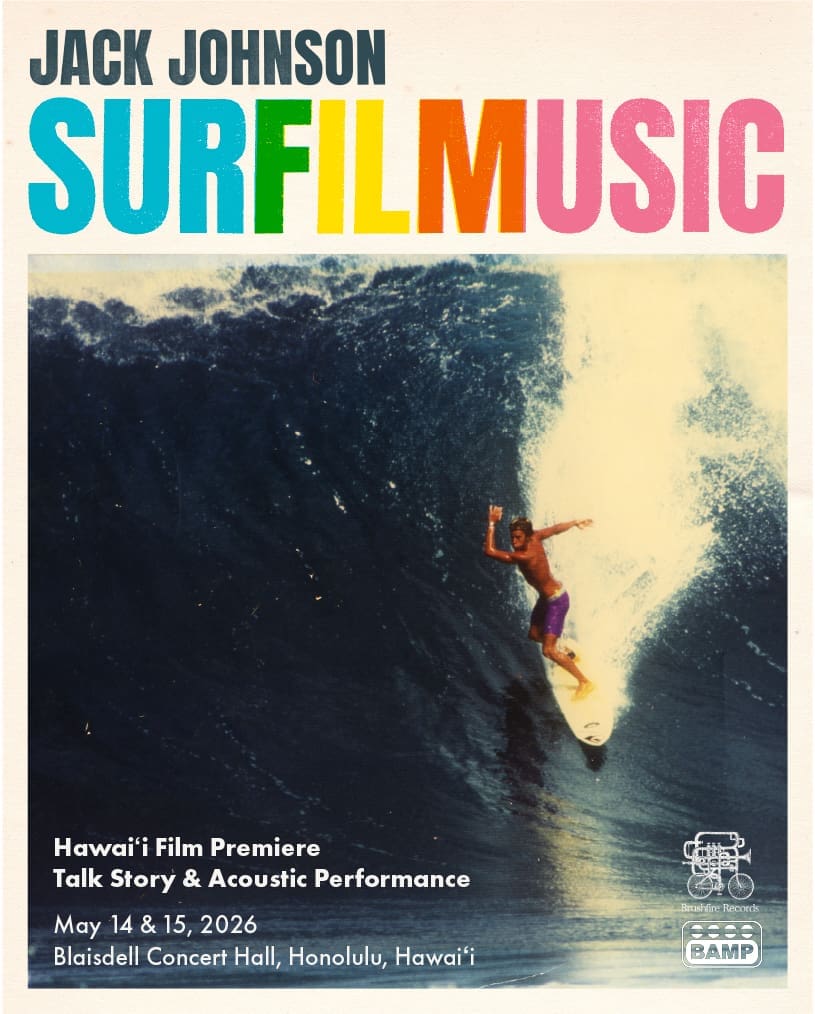
Now when I look back, I see a kid who was sort of insecure and trying to figure things out. I think it was my way of learning how to belly flop and get back up. I literally took a spill, but it’s one of those things in life you wouldn’t hope would happen, but after it does happen, you wouldn’t take it away because it helped shape you as a person.
You learn a lot. You’re humbled. It was definitely a very humbling experience for me. When I look back now, I realize it was a big turning point in my life — not so much because it took me away from pro surfing and into music, but because it taught me how to get back up once you sort of hit rock bottom a little.
You could have taken your career in a number of directions—professional surfing, filmmaking—but music ultimately became the focus. Did that path always feel inevitable, or did the response from your inner circle help push you in that direction?
Everything was going in the right direction for the filmmaking stuff. It was an exciting time because I got to make these surf films. That was never my end goal. When I look back at the surf films now, they were such a fun time. I got to travel to all these remote destinations and have these really unique experiences.
But at the time I remember thinking, “Okay, I don’t want to get stuck just making surf films.” I had just gone to film school and was a little bit of a snob. I told my friends, “Yeah, I’ll come film you guys doing this stuff,” but really what I wanted to do was to be hanging out with David Attenborough in the trees waiting for the rare bird to come.
I always loved camping and being outdoors. I thought I’d be the perfect camera guy for National Geographic documentaries, where you wait all day for the weird little animal to show up.
So that was kind of my goal — to make bigger nature documentaries and that kind of stuff. The surf films felt like the perfect training ground. They were documentaries, and I was learning how to take care of gear in weird places with salt air and everything.
Then the music came along, and all of a sudden I found myself having to make this choice between which one to chase. For a little while I tried to do both. I was still going on surf film trips and recording.
But the music felt so natural. It just kept going, and it was so much fun. Filmmaking always felt like the best career I could ever hope for, and then the music didn’t feel like a career at all. It just felt like getting to do the thing I love every day. So that’s where it’s been going ever since.
Review: ‘Jack Johnson: SURFILMUSIC’ is as Fascinating & Laid Back as The Singer Himself
And it flipped – music has taken you literally all around the world. You’ve performed everywhere.
It flipped over. It’s been a fun experience.
When assembling the footage for SURFILMUSIC, what footage warmed your heart, and what footage made you cringe?
I think the more I listen to my old recordings — a lot of my old four-track recordings from that era — when I made my first album, if I listened to those recordings, which were only a year before my first album, I felt like I’d grown so much. I’d hear all the little mistakes in the recordings and stuff.
Now enough time has passed that when I go back and listen to those four-track recordings, the little mistakes and everything are the parts that I like. Hearing the voice get off and the melodies being kind of different — I’m searching for the melodies though, and I like hearing that search.
There’s a version, I think, of “Symbol in My Driveway” that me and my friends from our record label — it’s just a whole group of friends and we all kind of collaborate on this stuff — were listening to. I remember it was literally the first version I ever recorded, so it was more of a sketch than it even was a song.
The debate was like, “Do we include something that’s this raw?” You can hear two different words being said at times and stuff like that. But we decided to put it on there.
Some stuff was so vulnerable that there were decisions to make about whether we put it out or not. Then other stuff was really heartwarming, like getting to see a lot of the footage of my friend Tamayo Perry, who passed away a couple years ago.
A lot of the reason the project even got finished was digging through footage and finding footage of him and all of us taking the time to reflect on that period in our lives. So a lot of that was really heartwarming, just getting to see footage we had forgotten about and different things like that. It was really nice for our whole friend group to go through all that.
While much of the documentary centers on your journey and friendships, it also serves as a tribute to your friend and fellow surfer, Tamayo Perry. What’s something about him you hope audiences take away from the film?
It’s an interesting thing because he was one of my best friends. He was sort of the glue to our friend group. He was kind of our moral compass. So personally, it’s really nice to share his story with the world because he’s such a legend.
Then I guess almost like an archetype, it’s nice to sometimes show friendship on a larger scale for people to see how important collaboration is and how important it is to trust your friends, even in the creative process with something that feels really personal. Sometimes you need to kind of understand what your strong points are and what they’re not, and then trust friends to help get you across the finish line on things.
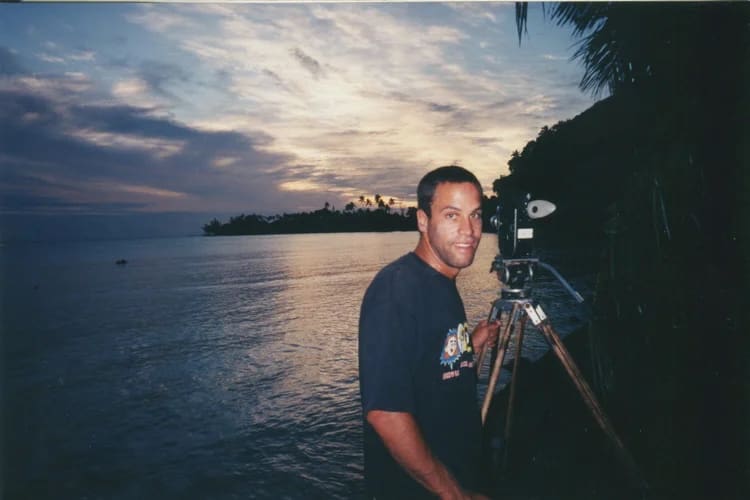
That’s a big part of what I hope people take away. Even though I’m the throughline in the movie, to me it’s a documentary about friendship and about making things. I also hope that if younger viewers see it, they get inspired to make stuff because we wanted to show those early attempts at creative things where they’re not that great. There’s a part with Mr. Slater Goes to Work, this little video Kelly [Slater] and I made together. It’s so dumb, but it’s rad. I want kids to be able to see that the first stuff you make doesn’t have to be perfect. You can just start trying stuff.
It’s an interesting time for kids now because you could be working on something and there’s probably always a little button that says “send out to the world.” You can put things on the internet so quickly and easily now. So it’s always that choice of, “Do I keep working on things or do I share it? What do I want to share? What’s just a sketch?”
It’s a trickier time for people now, but I do want to encourage people to make things with friends, get them out there, keep learning from every project, and don’t worry if the first thing you make isn’t your masterpiece.
It’s literally never been easier to make things. You guys were using old cameras that didn’t record audio. That’s not the case anymore. Your phone is better than anything you were using at that time to record, which is crazy.
Limitations sometimes make the creative process easier because you only have so much you can do, so you just have to move on. It’s hard now when you can make so many decisions. Which app do I use to get this done quicker? Do I use something to help fill in all the frames in between, or do I actually shoot this?
There are so many choices now. But on the optimistic side, it’s nice to have all these tools at your hands to be creative. I always talk to my own kids about that. There are so many tools to be creating stuff with now.
Going through everything, did you get the bug again? Did you get inspired to start shooting more?
Yeah, definitely. We ended up shooting some in the documentary. It’s an interesting thing because, like you said, I’m kind of the through-line or the focus, but one of my best friends is the director, and he was there for at least the film and music part of my life.
The film is broken into three parts: the surf part in the beginning, the film part in the middle, and the music at the end. My friend Emmett Malloy directed it, and he was there for the film and music part. He and my wife manage my career, and I’m lucky to have friends managing me. He was just along for the journey. He helped edit the old surf films and all that stuff, so he knows it all really well.
As we started doing this, he had to incorporate me to get all the old footage that I had — family stuff and everything. The only way I was going to let something come out into the world was if I was part of that creative process. Through that, we got the old Bolex out again, and he wanted me to start shooting some shots. So it was fun. It was collaborative.
It’s a little autobiographical in a way, but it’s definitely a collaboration between Emmett, myself, my wife, and all the friends who made the surf films. It was a group effort, even though Emmett ultimately directed it.
As someone who grew up listening to your music, it was especially compelling to hear the early 4-track demos that helped soundtrack the film. What do those early recordings and performances represent to you now? Seeing yourself performing with G. Love and Ben Harper for the first time and seeing all that archival footage — what do those moments represent to you now?
There’s actually one moment in the film that makes me laugh every time. When Emmett first dug up this interview and showed it to me, we laughed so hard because it’s weird.
It’s me, but I almost just see a scared kid in the headlights. It’s the part when the guy in San Diego says, “Hey, last year nobody even knew who you were. Now you’re on that main stage and everybody’s coming to this festival just for you. What happened?” And I just say, “I don’t know.” [laughs]
I still don’t know. In that moment, I can just see it in my face where I genuinely have no answer for the guy. It flashes me back to that moment. It was a really exciting time, but I kept waking up thinking somebody was going to pull the rug out from under me and this was all going to go away. Like, “This is pretty weird.”
That shot is really funny for me because I can remember being there and thinking, “What do I tell this guy? I don’t know.”
The G. Love footage and the Ben stuff is really fun for all of us too. Every time I’d find stuff, I’d send it off to those guys, and they’d say, “Oh, I remember that,” and send me stuff back.
The footage just kept showing up. It was really weird how much we kept being able to piece [it] together. A friend of mine had been filming us making the old surf films on film with a Super 8 camera, and he sent me all this footage of my friend rolling me around on a skateboard while I was shooting shots like a fake dolly.
We didn’t know we had that footage. I didn’t know I had the footage of my mom catching me in the yard while I was wearing diapers. I just got that footage last year from one of my uncles.
Every time we got something, we’d think, “Wow, this almost tells this part of the story.” The film just kept piecing itself together. It was like the story was too easy to tell.
I really enjoyed seeing the behind-the-scenes footage, like you shooting on the back of a moving car.
Yeah, that was my old car. It was a gold Chrysler LeBaron that I got from my grandma when I went to college. My girlfriend at the time, who’s my wife now, Kim, used to always say that was the dumbest car. That’s the car in that shot.
There was also the footage of your college band, Soil, performing an early punk version of “Flake.”
It was kind of punk. Our drummer, my friend Dave, used to just whack the drums so hard because he came from a punk background.
It was a fun band because Tory, the bass player, was really into the Grateful Dead. Jason, the singer and lead guitar player, was really into Stevie Ray Vaughan and different stuff. I was kind of into Fugazi and Hendrix and stuff, and then the drummer was really into punk stuff and Helmet and Korn.
So our mashup was really funny. We didn’t think of ourselves as a punk band at all, but the drumming was definitely real punk.
It reminded me of your song “Tape Deck,” where you say, “We sounded folk, but we wanted to be punk.”
But bringing that up, and also hearing the four-track version of “Horizon Has Been Defeated,” it sounded very melodic, almost like something Beck would’ve put on Sea Change or Morning Phase.
I love those records. I also love that early Beck record with all the acoustic stuff on it that came out after Mellow Gold.
But yeah, when I heard “Horizon Has Been Defeated,” I think that was the first time I tried to figure out how to do harmonies on my four-track. There are weird little harmonies on there. Some of the choices I was making were kind of cool, but there are parts where I’m like, “Why’d you pick that note?”
I can dig on it and laugh at it at the same time because I know I was trying to figure it out. I didn’t know how to do harmonies, but I was trying to figure it out on my little four-track. That’s what I hear when I listen to that one.
When you were putting these songs together for what would be your first two albums, what do you feel was the biggest influence in crafting your specific sound?
I would say the two people that became like older brothers to me in the music world were G. Love and Ben Harper.
I think hearing their music — and then with Garrett (G.Love), it was this acoustic kind of sound, not acoustic because he’d play electric a lot too, but this really rootsy sound where you could hear the hip-hop influence, but you could also hear old blues and folk. You could tell he was listening to music that I loved, and he was finding a way to make it sound contemporary and hip.
And the same goes with Ben Harper. I could hear the Jimi Hendrix in there. I could hear the Cat Stevens. I could hear Marley and all these influences, but he blended it together into this thing. I listened to both those records so much that I think that’s what I was shooting for. I think sometimes your limitations become the creative factor that defines you.
I was always trying to sing more, but my voice was naturally kind of quiet. Then, eventually, you get this whispery sound that you embrace. So I don’t know what the exact inspiration was for sounding like myself, but G. Love and Ben Harper definitely helped me find my voice.
From what it sounds like in music and film — and I’m guessing surfing too — it’s all about limitations and what you can control. That’s kind of shaped your career.
Yeah. When I was first writing, I was always on acoustic guitar by myself, and I was trying to emulate the sound of a snare drum when I’d hit the strings percussively, and then figure out how to do bass notes on the guitar too. You’re almost trying to fill in for the bass, the drums, and the guitar all at once because you’re sitting there writing on acoustic guitar, but you want to make music that sounds funky like the stuff you love.
So I always pictured maybe someday having a band, but for now I had to do it all on the acoustic guitar. And then once I started playing with a band, that acoustic percussive style was so ingrained in me that I couldn’t stop doing it. I think that helped define the sound too — how much the guitar carries the percussion.
Hermanos Gutiérrez is featured throughout the soundtrack of the film. When did you first hear about them, and how did that collaboration come about?
They’ve been one of my favorite bands the last couple of years. The first time I heard their music, the first thought I had was, “I want to play music with these guys.” There was something in it. The percussive guitar with the little bit of dubbed-out delay, and then that really sweet lead guitar over the top — I just thought it would blend really nicely with the way I like to play.
Just from hearing the music, I felt like we could sit in a room together and make something really nice. Then I found out they grew up watching the old surf films and were really inspired by them.
Once I shared with them that we were making this documentary based around those films, we just started sending little recordings back and forth. They’d say things like, “This reminds me of the sound when light glimmers across the ocean,” or “This feels like a heavy wave in Tahiti.”
The way they hear music is very cinematic and visual. So I kind of put it out there like, “Hey, do you guys want to help me do a song for the movie?” Then we got together and started making a bunch of songs. We’d watch scenes together and play music while watching them.
A real quick friendship developed. They’re just really sweet humans. I love hanging out with those guys. It’s interesting because the film is about friendship and celebrating these old friendships, and during the process of scoring it, I made this new musical connection that I’m really excited about. We’re going on tour together and playing more music together, and it feels mutual.
What can you tell us about the upcoming tour?
You’ll get to hear them do their set, and then I’ll definitely be featuring them a lot throughout our set too. We’re going to collaborate a lot during the night, so it should be a really fun night of music.
Thank you for taking the time to do this interview. Your career and the creativity you have inspired my career as a writer and photographer. Within the span of a month, I got to accomplish two dream, bucket-list events in my career – cover the Foo Fighters at a small venue in New Jersey, and interview you. So, thank you for the inspiration.
I’ve got to tell you real quick then.
Back when I was making films, my friend Emmett — who directed this film — used to direct some of the Foo Fighters music videos, and he hired me to come shoot B-camera footage with the same old wind-up Bolex camera.
I had a little cassette four-track, and Emmett passed it to Dave Grohl one day during catering and said, “Hey, this is that guy over there shooting.”
Dave actually took the time to listen to my tape. The next day he pulled me aside and told me to stick with it. He said, “Those are really good songs.” To have somebody like Dave Grohl tell you that there’s potential in your songs — that meant a lot to me.
Years later, I saw him at a festival, and when he said, “Nice to meet you,” I reminded him of the story. He said, “Now I feel like an asshole because I don’t remember you.” And I was like, “No way, man. You’re the best.” He’s awesome.
Jack Johnson: SURFILMUSIC, premieres in Hawaiʻi on May 14th & 15th, 2026, with a wider theater release scheduled for June 2026.
The SURFILMUSIC Soundtrack and 4-Tracks, arriving May 15 via Brushfire Records.
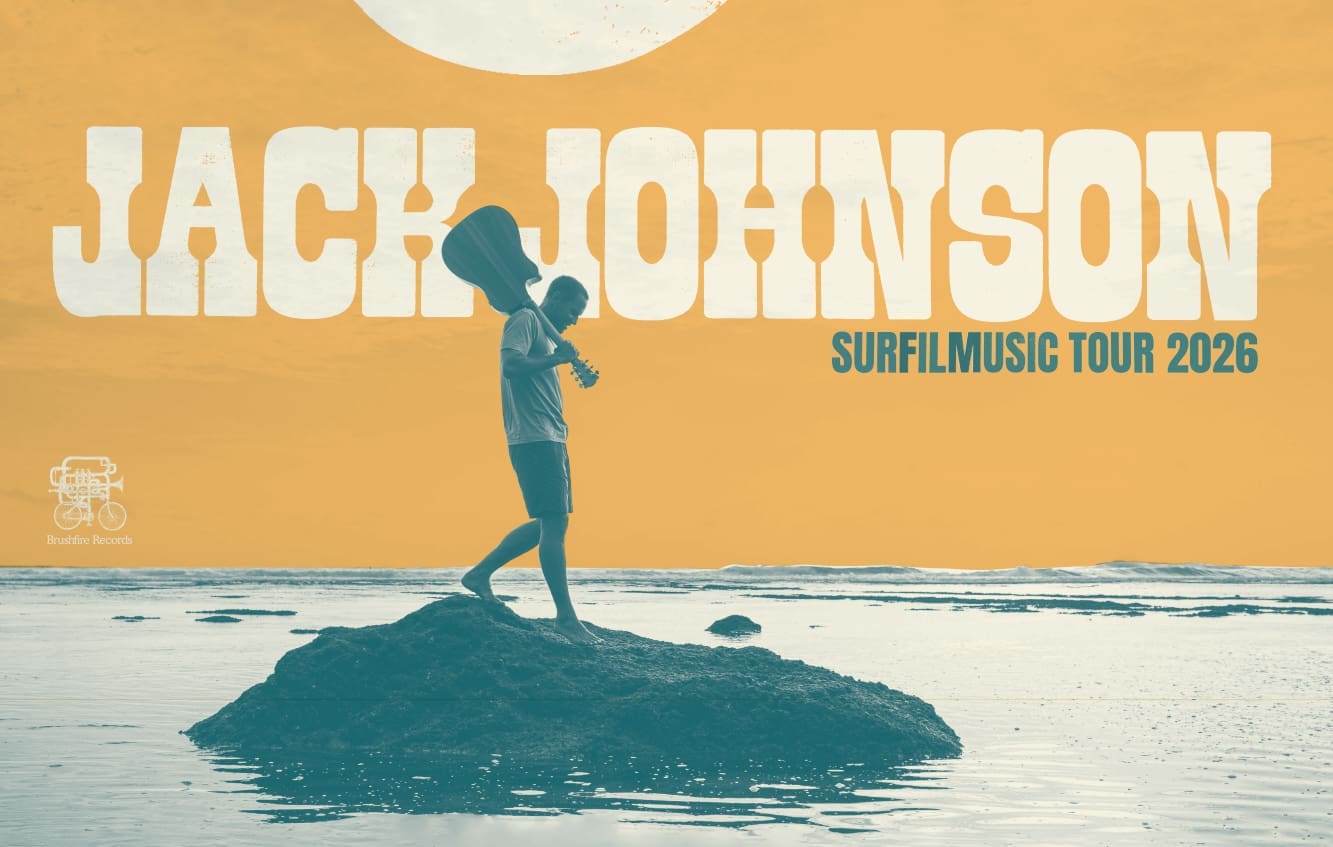
The tour officially kicks off on June 19. For tickets and info visit https://jackjohnsonmusic.com/.